


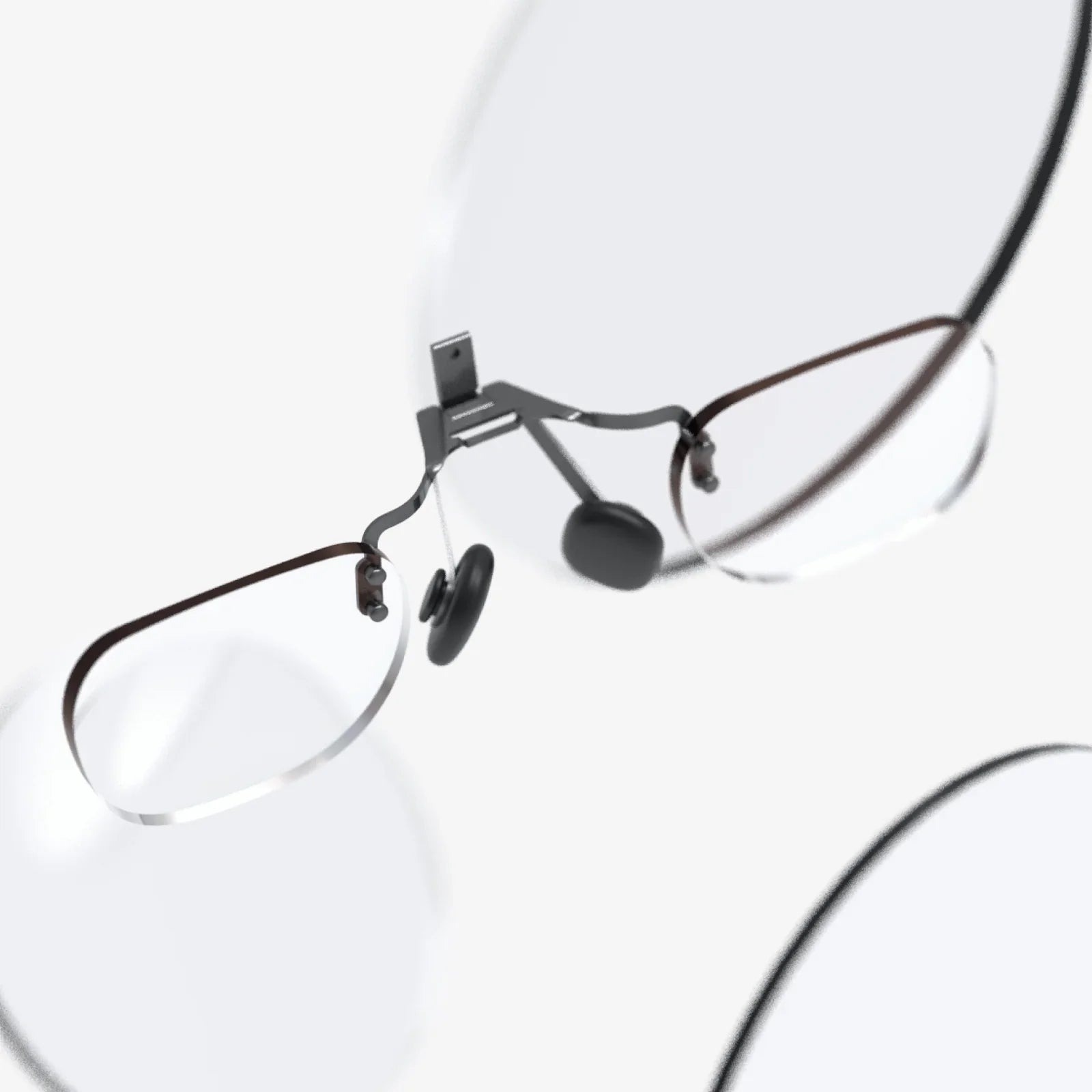
Imagine a world where information doesn't live on a screen in your hand but is woven seamlessly into the fabric of your reality. Where directions appear as a gentle glow on the pavement, the name of an old acquaintance discreetly materializes in your periphery during a stressful networking event, and a complex technical manual is projected onto the machinery you're repairing, hands-free. This isn't a scene from a science fiction film; it's the imminent future being built today, and it’s all happening through a revolutionary device perched on the bridge of your nose. The question on everyone's lips is no longer about if this will happen, but what it will truly mean for our lives, our work, and our society.
Beyond Frames and Lenses: Deconstructing the Core Concept
At its most fundamental level, AI glasses are a wearable computer in the form of spectacles. They are the physical embodiment of augmented reality (AR), designed to overlay digital information and visuals onto the user's real-world view. But to call them simply "smart glasses" is a significant understatement. While earlier iterations focused on basic notifications and camera functions, true AI glasses are defined by the powerful, integrated artificial intelligence that acts as their brain.
This AI is the differentiator. It processes a constant stream of data from an array of sophisticated sensors—high-resolution cameras, microphones, inertial measurement units (IMUs) for tracking movement, and often depth sensors or LiDAR for mapping the environment in 3D. The AI's job is to make sense of this data in real-time: to see what you see, hear what you hear, understand the context, and then provide relevant, contextual information without you ever having to ask. It’s a shift from a pull model of technology, where you search for information, to a push model, where technology anticipates your needs and delivers insights proactively and unobtrusively.
The Technological Symphony Inside the Frame
The magic of these devices is a feat of miniaturization and engineering, packing a suite of advanced components into a form factor light and comfortable enough to wear all day.
- Visual Processing: This is achieved through either optical see-through or video see-through systems. Optical see-through uses clever waveguides or semi-transparent mirrors to project images directly onto the lenses, allowing you to look directly at the world. Video see-through uses cameras to capture the real world and then displays an augmented version on micro-displays inside the glasses, offering more vivid digital overlays but with a potential lag.
- Sensing the World: A suite of sensors acts as the glasses' eyes and ears. Cameras not only capture images and video but also scan objects, text, and QR codes. Microphones capture audio for voice commands and ambient noise analysis. IMUs track head movement and orientation with precision, ensuring digital objects stay locked in place in the real world.
- The Onboard Brain: A dedicated processing unit, often a System-on-a-Chip (SoC), handles the immense computational load. For complex tasks like real-time language translation or object recognition, the glasses may offload processing to a connected smartphone or, more powerfully, to cloud servers via a wireless connection, leveraging vast neural networks.
- Powering the Experience: All this technology is notoriously power-hungry. Balancing performance with battery life is one of the biggest challenges, leading to innovations in low-power displays, efficient processors, and the strategic distribution of tasks between the glasses and a companion device.
A Day in the Life: Transformative Applications
The theoretical is impressive, but the practical applications are where AI glasses will prove their worth, transforming mundane tasks and empowering professionals.
Revolutionizing Daily Navigation and Interaction
For the average user, AI glasses promise an end to smartphone-induced zombie-walking. Navigation becomes intuitive, with arrows painted onto the street itself. Shopping is reimagined; glance at a product on a shelf to see reviews, price comparisons, and nutritional information floating beside it. Social interactions are augmented with subtle cues—name and key details about a person you just met appearing discreetly. For travelers, real-time translation of street signs, menus, and conversations could finally break down language barriers, not through a screen, but as subtitles for the world.
The Professional's New Essential Tool
The impact on various industries will be profound. In healthcare, a surgeon could see vital signs and 3D anatomical guides overlayed directly on the patient during a procedure. Medical students could practice on virtual cadavers. For field engineers and technicians, complex wiring diagrams or assembly instructions can be projected onto the equipment they are servicing, reducing errors and training time. In logistics and manufacturing, warehouse workers could see optimal picking routes and inventory data, dramatically increasing efficiency and accuracy.
Redefining Accessibility and Creativity
This technology holds incredible promise for accessibility. Individuals with visual impairments could receive audio descriptions of their surroundings, identifying objects, reading text aloud, and recognizing faces. Those with hearing difficulties could see real-time transcriptions of conversations. For creators and designers, AI glasses offer a boundless canvas, allowing them to sculpt virtual objects in physical space or visualize architectural changes to a real-world environment before a single brick is laid.
The Other Side of the Lens: Ethical and Social Considerations
This powerful technology does not arrive without significant challenges and concerns. The very features that make AI glasses so compelling also make them potentially problematic.
- The Privacy Paradox: A device that is always on, always seeing, and always hearing is a privacy advocate's nightmare. The potential for constant, surreptitious recording raises alarming questions about consent and surveillance. How do we prevent a world where every conversation in a public cafe is potentially being recorded and analyzed? Robust digital ethics, clear regulations, and obvious, audible indicators of recording are non-negotiable prerequisites for public adoption.
- The Social Divide: The term "digital divide" will take on a new meaning. Will these devices create a two-tiered society between those who can afford augmented intelligence and those who cannot? Furthermore, what are the social etiquette rules for wearing technology that can secretly identify strangers or record interactions? The constant distraction of notifications could also further erode our ability to be present in the moment, leading to a new form of digital isolation.
- Data Security and Dependence: The amount of personal, biometric, and visual data collected by these devices will be unprecedented. Securing this data from hackers is paramount. There is also a risk of over-reliance, where our own cognitive abilities—like memory for directions or faces—could atrophy from disuse.
From Prototype to Mainstream: The Road Ahead
While the promise is immense, several hurdles remain before AI glasses become as ubiquitous as smartphones. The technology needs to become smaller, more powerful, and more energy-efficient. The design must evolve beyond its often-utilitarian look to become a fashionable accessory that people want to wear. Most importantly, the software and AI need to become flawlessly intuitive, providing genuinely useful information without becoming a distracting nuisance. The killer application—the thing that makes them a must-have—has yet to be universally identified, though many contenders exist.
The journey is just beginning. Early models are laying the groundwork, testing the waters of public acceptance, and iterating on both hardware and software. The path forward will be a collaborative effort between technologists, policymakers, ethicists, and designers to ensure this powerful tool enhances humanity without compromising our privacy, our security, or our fundamental human connections.
The next time you squint at your phone's map or fumble to translate a menu, remember: the solution is evolving, and it’s designed to sit right before your eyes. This isn't just about a new gadget; it's about fundamentally reshaping our relationship with information and the world around us, creating a future where the digital and physical coexist in a harmony we are only just beginning to imagine.
Share:
VR Headset 3D Glasses: The Ultimate Immersive Experience Unveiled
Cost of Augmented Reality Technology: A Comprehensive Breakdown for Businesses and Developers