


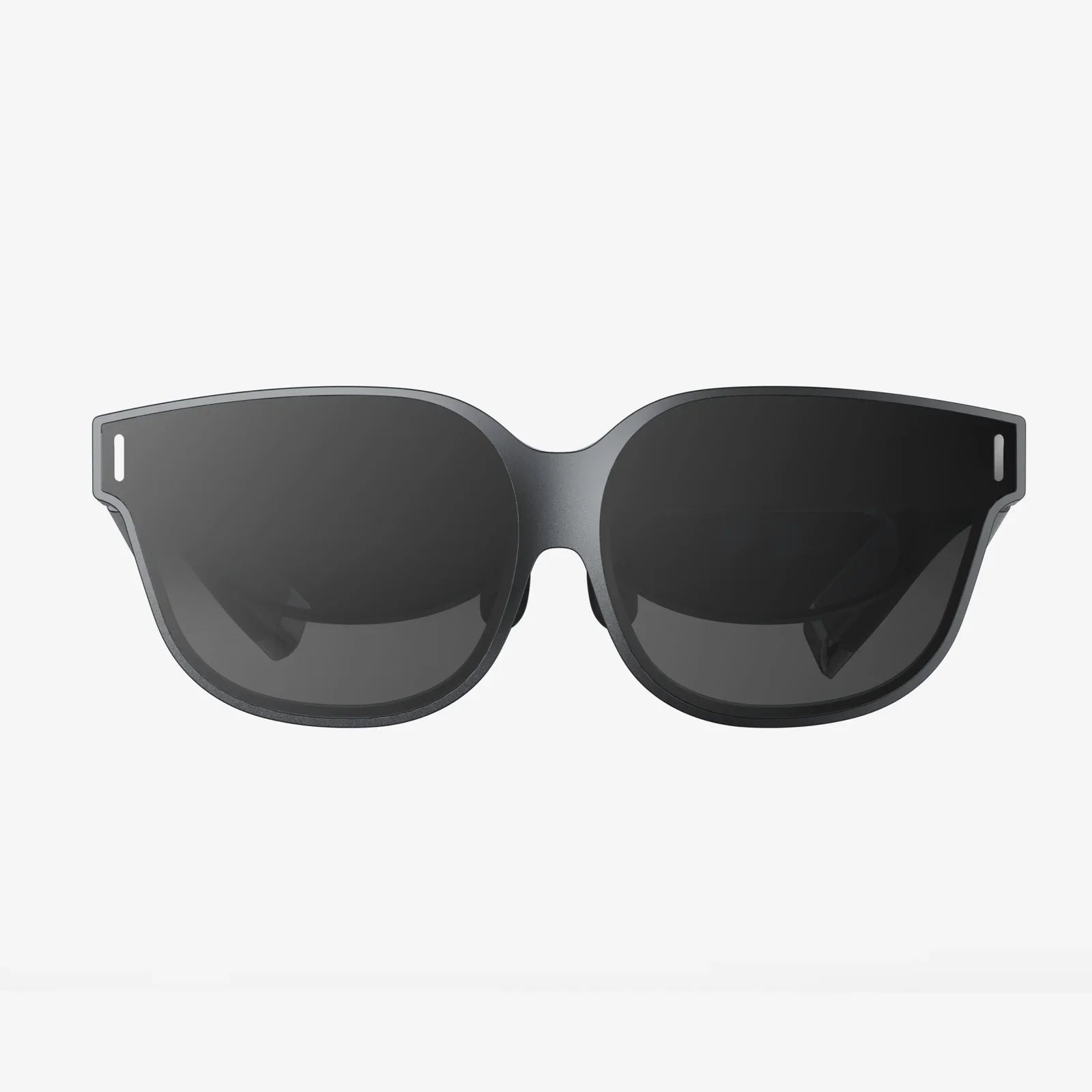
Imagine a world where information doesn’t live on a screen you hold in your hand, but is woven into the very fabric of your reality. Where directions appear as a glowing path on the sidewalk before you, where the name of a distant star constellation floats beside it in the night sky, and where a complex engine repair is guided by digital arrows overlaid on the physical machinery. This is not a distant science fiction dream; it is the fundamental promise of Augmented Reality (AR) glasses, and it represents the next great leap in our relationship with technology—a leap from looking at a device to looking through it at an enhanced world. The question isn't whether this future will arrive, but why we should actively embrace and prepare for it.
Beyond the Screen: The Tyranny of the Rectangle
For decades, our primary portal to the digital world has been the screen. From the bulky desktop monitors to the sleek smartphones we carry everywhere, these devices have connected us to vast stores of information and to each other. But this connection comes at a cost. We are constantly forced to divide our attention between the rich, immersive physical world around us and the captivating, but isolating, rectangle of glass in our hands. This creates a phenomenon often called "presence bleed," where we are never fully here nor fully there.
AR glasses propose a radical solution: instead of pulling us out of our reality to interact with a digital one, they bring the digital into ours. The goal is to make technology an intuitive extension of our natural perception, not a distraction from it. It’s about augmenting human intelligence and capability in real-time, contextually, and without the constant need to crane our necks downward. This shift is as profound as the move from the command-line interface to the graphical user interface; it’s a more natural, human-centric way of computing.
The Seamless Integration of Knowledge and Action
The core argument for AR glasses lies in their ability to bridge the gap between information and action. Currently, if you need to fix a leaky faucet, you likely pull out your phone, search for a video, and constantly shift your gaze between the tiny screen and the actual pipes, trying to mentally map the instructions onto the physical object. It’s a disjointed, inefficient process.
Now, envision wearing AR glasses. As you look at the faucet, your glasses recognize the model. Instantaneously, a digital overlay appears, highlighting the specific nut you need to loosen with a glowing arrow. A real-time, hands-free video tutorial plays in your peripheral vision, and each step is annotated directly onto your field of view. The manual is literally projected onto the machine. This seamless integration drastically reduces cognitive load, minimizes errors, and accelerates learning and execution. This principle applies to countless fields:
- Medicine: Surgeons could see vital signs, ultrasound data, or 3D anatomical guides overlaid directly on a patient during an operation.
- Manufacturing & Repair: Technicians could see torque specifications, wiring diagrams, and step-by-step assembly instructions superimposed on complex equipment.
- Education: Students studying anatomy could walk around a life-sized, interactive hologram of the human heart. History classes could witness historical events unfold on their actual school grounds.
Revolutionizing Social Connection and Presence
Video calls have kept us connected, but they are a poor substitute for true presence. We stare at a grid of faces, unable to make natural eye contact, and completely missing the shared physical space. AR glasses can redefine remote collaboration and socialization.
Imagine a virtual meeting where 3D holograms of your colleagues sit around your actual desk. You can make eye contact, read body language, and collaboratively interact with a 3D model of a new product design that everyone can see and manipulate as if it were physically present. For personal connections, grandparents living across the country could appear to be sitting on the couch reading a story to their grandchildren, sharing the same space despite being miles apart. This technology, often referred to as "telepresence," has the potential to make digital interactions feel significantly more human and less isolating.
Enhancing Our Perception and Navigation of the World
AR glasses will act as a perceptual superpower, giving us access to a layer of data about our environment that is currently invisible. This augmented layer can make us more knowledgeable, efficient, and safe.
- Navigation: Instead of staring at a blue dot on a phone map, turn-by-turn directions can be painted onto the road itself, guiding you intuitively to your destination while allowing you to keep your head up and aware of your surroundings.
- Accessibility: For individuals with visual impairments, AR glasses could highlight curbs, identify obstacles, and read out street signs. For those who are hard of hearing, real-time transcription of conversations could be displayed, making dialogue fluid and inclusive.
- Tourism & Exploration: Point your gaze at a landmark, and its history materializes before you. Look at a restaurant, and see its reviews and menu highlights. Look at the night sky, and see the names and mythology of the constellations.
Addressing the Inevitable Concerns: Privacy, Security, and Society
No discussion about a technology this pervasive can be complete without addressing the significant challenges it presents. The idea of a device constantly recording and analyzing our environment raises profound questions about privacy and data security. The "always-on" camera is perhaps the single biggest societal hurdle AR glasses must overcome.
Responsible development must be built on a foundation of transparency, user control, and ethical design. This means:
- Clear, unambiguous visual indicators when recording or scanning is active.
- Robust on-device processing to keep sensitive data local, rather than streaming it to the cloud.
- Granular user permissions controlling what data is collected and how it is used.
- Strong digital ethics frameworks to prevent the creation of overwhelming advertisements or manipulative interfaces.
The path forward requires not just technological innovation, but also a parallel development of social norms, etiquette, and potentially new laws to ensure this powerful tool enhances society without eroding our fundamental rights.
The Invisible Foundation for a New Reality
The ultimate success of AR glasses will be their eventual invisibility. Unlike today's VR headsets, which are bulky and obvious, the end goal for AR is a form factor as socially acceptable and lightweight as a standard pair of eyeglasses. The technology itself will fade into the background, allowing the augmented experiences to feel magical and effortless. This is why current iterations, while clunky, are so crucial—they are the stepping stones to a future where the technology is unobtrusive and always available, ready to assist us the moment we need it.
We need AR glasses because they represent the next logical step in the democratization of information and the augmentation of human potential. They promise to free us from the confines of the screen, deepen our connections with each other, and unlock a deeper understanding of the world around us. They are not about replacing reality, but about making our reality richer, smarter, and more connected. The revolution won't be televised on a screen; it will be seen through the lens of what is to come.
The true potential of this technology lies not in the wow-factor of digital dinosaurs walking through your living room, but in the quiet, profound moments it will enable: a mechanic mastering a repair with newfound confidence, a medical student understanding the human body in three dimensions, a family feeling truly together despite being continents apart, and anyone, anywhere, being able to see the hidden layers of wonder and information that exist all around us, just waiting to be revealed.
Share:
What Does Stream Music Wirelessly Mean - A Complete Guide to Untethered Audio
Have Any of You Ordered Glasses Without the AR Coating? The Surprising Truth