


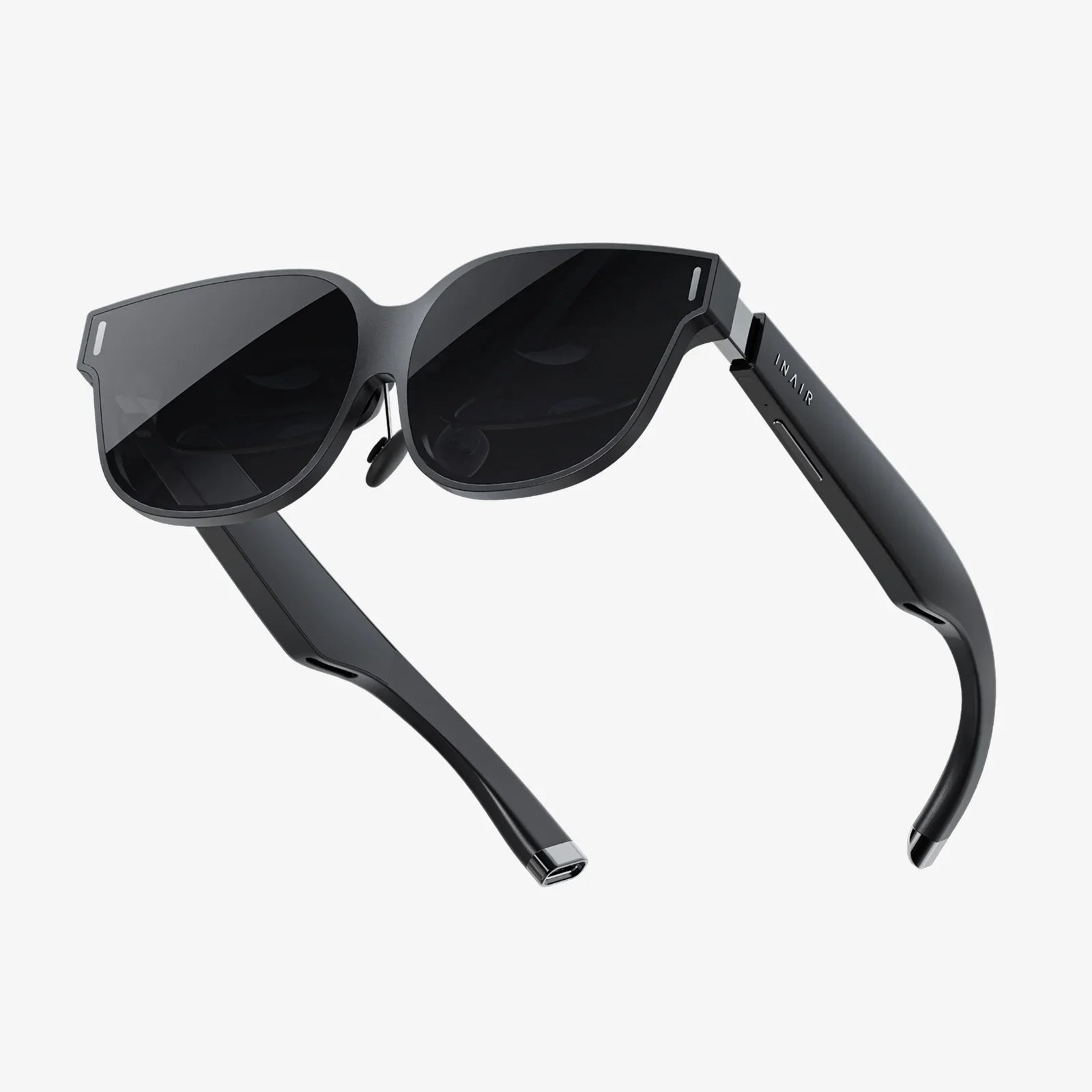
Imagine a world where your entire digital life—the texts from a friend, the turn-by-turn navigation to a new restaurant, the video call with your family—floats seamlessly in your periphery, accessible with a glance but never obstructing the beautiful, real world in front of you. This is the ultimate promise of XR display glasses, a technology not of science fiction, but of the imminent future, poised to redefine our relationship with technology and reality itself.
The Architectural Blueprint: How XR Glasses Create Digital Sight
At their core, XR display glasses are a feat of optical engineering, a symphony of miniaturized components working in concert to paint digital light onto your perception of the real world. Unlike virtual reality headsets that transport you to a fully digital environment, or augmented reality apps on a smartphone that confine digital content to a small screen, XR glasses are designed for all-day wear, merging the digital and physical into a single, cohesive experience.
The magic begins with the micro-displays. These are incredibly small, high-resolution screens, often utilizing technologies like MicroOLED or advanced LCOS (Liquid Crystal on Silicon). They are the source of the digital image, but they are not what you look at directly. Instead, their light is channeled through a critical component: the waveguide.
Think of a waveguide as a piece of specially engineered glass or plastic that acts like a holographic highway for light. It uses a process of diffraction (etched gratings) or reflection (with tiny, complex mirrors) to "bend" the light from the micro-display and project it directly into your eye. This allows for a large, virtual image to be perceived while keeping the physical lenses of the glasses remarkably thin and seemingly normal.
This optical system is then married with a suite of sensors that give the glasses awareness. Inside-out tracking cameras constantly map the room, understanding surfaces, depth, and objects. An inertial measurement unit (IMU) tracks the precise movement and orientation of your head. Often, there are eye-tracking cameras that monitor where your gaze is focused, enabling intuitive control and rendering optimization. All this sensor data is processed in real-time by a dedicated processing unit, either housed in the glasses themselves or offloaded to a companion device, to anchor digital objects convincingly in your space.
A Spectrum of Experiences: From Assisted Reality to Full Immersion
The term "XR" or "Extended Reality" is an umbrella, encompassing a spectrum of experiences that these glasses can deliver. It's not a single mode but a fluid continuum.
Assisted Reality (aR)
This is the most basic and often most practical layer. Here, information is displayed in a monochromatic, heads-up display (HUD) format, typically in your peripheral vision. It provides crucial, context-aware data without demanding your full attention. Think of a warehouse worker seeing the next item to pick float next to the correct bin, a surgeon seeing patient vitals without looking away from the operating table, or a cyclist seeing their speed and route guidance while keeping their eyes on the road. It's about enhancing efficiency and safety, not replacing reality.
Augmented Reality (AR)
This is the richer, more interactive cousin of aR. AR involves placing persistent, life-like 3D digital objects into your environment. This is where the magic becomes palpable. You could place a virtual sculpture on your real coffee table, have a life-sized digital avatar of a colleague sitting on your sofa for a meeting, or see how a new piece of furniture would look and fit in your living room before you buy it. AR overlays the world with a digital skin, enriching it with information, entertainment, and artistic expression.
Virtual Reality (VR)
While typically associated with bulkier headsets, some advanced XR glasses can also act as a VR portal by using dimmable lenses to block out the external world. When engaged, you are fully transported to a digital realm for immersive gaming, virtual tourism, or collaborative design sessions in a shared virtual space. The glasses become your window to entirely new worlds.
Beyond Novelty: The Transformative Applications
The true power of XR display glasses lies not in their technological wizardry, but in their potential to fundamentally improve how we work, learn, connect, and play.
Revolutionizing the Workplace
The industrial and enterprise sectors are early and eager adopters. The value proposition is clear: increased efficiency, reduced errors, and enhanced safety.
- Manufacturing & Logistics: Technicians can see assembly instructions overlaid on the machinery they are repairing. Warehouse pickers are guided by visual cues to the exact location of items, hands-free.
- Field Services: A engineer working on a wind turbine can have a remote expert see their view and annotate the real world with arrows and diagrams to guide them through a complex repair.
- Design & Architecture: Architects and engineers can walk through full-scale 3D models of their designs, identifying potential issues long before construction begins.
Redefining Education and Training
XR glasses can turn every classroom into a time machine, a human body, or a physics lab.
- Medical students can practice complex surgical procedures on detailed holographic patients, gaining muscle memory without risk.
- History students can witness historical events unfold around them, walking through ancient Rome or standing on the deck of a Viking ship.
- Mechanics can learn to disassemble and reassemble complex engines, with each part labeled and animated instructions playing in their view.
The Future of Social Connection and Telepresence
The flat, pixelated video call will feel archaic. With XR glasses, telepresence will mean sharing a space with photorealistic avatars or even volumetric captures of people. You'll feel like you're sitting across from someone, making eye contact and reading body language, even if they are on another continent. This has profound implications for remote work, keeping families connected, and reducing the need for travel.
A New Canvas for Entertainment
Entertainment will escape the screen and inhabit your world. Imagine watching a basketball game with live stats floating above the court on your coffee table, or playing a table-top strategy game where the board and pieces come to life with stunning animations. Directors will create interactive narratives that play out in your own home, blurring the line between audience and participant.
The Hurdles on the Road to Ubiquity
For all their promise, XR display glasses face significant challenges before they can become a mainstream consumer product.
The foremost challenge is social acceptance. Google Glass famously highlighted the "glasshole" problem—the social unease and privacy concerns that come with always-on cameras and a person who appears to be distracted by a screen only they can see. The design must evolve to be indistinguishable from fashionable eyewear, and clear social norms and visual indicators (like a recording light) must be established to build public trust.
Then there are the technical limitations. Battery life remains a constraint, as powering high-resolution displays, multiple cameras, and powerful processors is incredibly demanding. The field of view (how large the digital image appears) is still narrow in many devices, creating a "letterbox" effect. Achieving true visual fidelity—where digital objects are indistinguishable from real ones in terms of lighting, occlusion, and resolution—is the holy grail but remains a work in progress.
Finally, we must navigate a complex web of privacy and ethical concerns. Always-aware devices that see what you see raise monumental questions about data ownership, surveillance, and advertising. Will every interaction be recorded and analyzed? How do we prevent malicious use, such as creating convincing deepfakes of the real world? Establishing a robust ethical and legal framework is not an option; it is a prerequisite for a healthy XR future.
The Invisible Revolution: Blending the Digital and Physical
The long-term trajectory of XR display glasses is not to create a world where we are glued to another screen, but quite the opposite. The goal is to make the computer itself invisible. Instead of pulling a device from your pocket, information and assistance will appear contextually, exactly when and where you need it, and then fade away when you don't.
This represents the third major wave of computing. The first was the personal computer, which tethered us to a desk. The second was the smartphone, which put a computer in our pocket. The third will be spatial computing, experienced through XR glasses, which will weave computing into the very fabric of our perceived reality. It will be always available, yet never in the way; powerful, yet intuitive; digital, yet real.
We are standing at the precipice of a fundamental shift in human-computer interaction. The devices are moving from tools we hold to interfaces we inhabit. The success of this transition hinges not just on making the technology smaller and faster, but on designing it to be human-centric—enhancing our lives without diminishing our humanity, connecting us more deeply to both the digital and the physical worlds we cherish. The future is not on a screen; it's all around us, waiting to be unlocked.
Share:
Glass AI APK: The Future of Visual Intelligence in Your Pocket
What Smart Glasses Display Real-Time Subtitles for People Who Are Hard of Hearing