


Imagine a world where digital information doesn't live on a screen in your hand but is seamlessly woven into the fabric of your reality, where helpful guides and fantastical creatures coexist with your morning coffee and commute to work. This is the tantalizing promise held by the next generation of wearable technology, a frontier dominated by two often-confused terms: XR and AR glasses. The race to place a lightweight computer on your face is more than a tech trend; it's a fundamental shift in how we will interact with information, entertainment, and each other. But to understand where we're headed, we must first cut through the marketing hype and clearly define the battle, and synergy, between Extended Reality (XR) and Augmented Reality (AR) glasses.
Demystifying the Acronyms: A Spectrum of Reality
Before pitting XR against AR, it's crucial to understand that they are not direct competitors. Think of them not as separate entities but as points on a continuous spectrum of digital immersion. This spectrum, often called the Reality-Virtuality Continuum, ranges from the completely real environment we perceive with our naked eyes to a fully digital, virtual world.
Augmented Reality (AR) sits closer to the real-world end of this spectrum. AR glasses function by overlaying digital content—images, text, 3D models—onto the user's view of their physical surroundings. The core principle is that the real world remains the primary stage, and digital elements are supplementary actors enhancing it. The goal is to provide contextually relevant information without severing the user's connection to their environment.
Extended Reality (XR) is not a type of technology but an umbrella term. It encompasses all combined real-and-virtual environments, including AR, Virtual Reality (VR), and Mixed Reality (MR). Therefore, AR glasses are a subset of XR glasses. When people use "XR glasses," they are often referring to devices capable of more than just AR; they are hinting at a device that can handle a blend of realities, potentially shifting along the spectrum from augmented to more immersive, virtual experiences.
The Core Architectural Divide: How They See the World
The most significant difference between dedicated AR glasses and more advanced XR glasses lies in their fundamental architecture and how they process the world.
Optical See-Through vs. Video See-Through
Most pure AR glasses on the market today utilize an optical see-through (OST) design. This means you are looking directly at the real world through transparent lenses (like sunglasses or safety glasses). Digital content is projected onto these lenses, making it appear as a hologram in your field of view. The advantage is a direct, high-resolution view of reality with zero latency—what you see is literally what is there. The challenge is that digital objects can struggle to look solid and occlude real-world objects convincingly, as they are merely glowing images superimposed on your vision.
More immersive XR glasses often employ a video see-through (VST) system. Here, outward-facing cameras capture the real world in real-time. This video feed is then combined with digital content inside the headset and displayed on opaque screens in front of your eyes. This method allows for incredibly convincing mixed reality: digital objects can perfectly occlude real ones, and the environment can be dramatically altered or filtered. However, it requires extremely high-quality, low-latency cameras and displays to avoid a laggy, nauseating experience, and the user is ultimately viewing a video feed of the world, not the world itself.
Understanding and Interacting: Sensors and Processing
Both types of devices are packed with sensors, but their complexity varies. Basic AR glasses might include an IMU (Inertial Measurement Unit) for tracking head movement and a simple camera for rudimentary interaction. Advanced XR glasses are sensor powerhouses. They typically feature:
- Depth Sensors (LiDAR, ToF): To map the environment in 3D, understanding the geometry of a room down to the millimeter.
- High-Resolution Cameras: Multiple cameras for tracking hand movements (hand-tracking), decoding the environment (SLAM), and capturing the video feed for VST systems.
- Eye-Tracking Cameras: To understand where the user is looking, enabling foveated rendering (which saves processing power by rendering only the spot you're looking at in high detail) and more intuitive UI interactions.
This sensor suite allows XR glasses to not just overlay information but to understand and interact with the world intelligently, a key step towards true spatial computing.
A Tale of Two Experiences: Use Cases and Applications
The technological divide dictates the ideal applications for each type of device. They are tools designed for different jobs.
The Domain of AR Glasses: Information and Assistance
AR glasses excel in scenarios where users need hands-free access to information while remaining engaged in a task. They are designed for utility and longevity, often aiming for all-day wearability.
- Enterprise and Field Service: A technician repairing complex machinery can see schematics and animated instructions overlaid on the equipment. A warehouse worker can see navigation cues to the exact shelf location and verify picking orders without glancing at a handheld scanner.
- Navigation: Walking or driving directions can be projected onto the road ahead, eliminating the need to look down at a phone.
- Remote Assistance: An expert miles away can see what a field worker sees and draw annotations directly into their field of view to guide them through a complex procedure.
- Basic Data Display: Imagine checking your heart rate from a smartwatch overlay during a run, seeing meeting reminders floating by your door, or having recipe instructions appear next to your mixing bowl.
The ethos here is augmentation: enhancing productivity and perception without isolation.
The Realm of XR Glasses: Immersion and Transformation
XR glasses, with their greater processing power and advanced sensors, target more immersive and interactive experiences. They are often used for shorter, more focused sessions.
- Gaming and Entertainment: This is the killer app for immersion. Imagine a virtual pet that interacts with your real furniture, a strategy game where the battle unfolds on your coffee table, or a horror experience where entities can hide in your actual hallway. The line between game and reality blurs spectacularly.
- Design and Prototyping: Architects and product designers can life-size 3D models into a physical space, walk around them, and make changes in real-time. Collaborators in different locations can appear as avatars in the same virtual model, examining it together.
- Training and Simulation: Medical students can practice procedures on virtual patients overlaid on mannequins. Mechanics can train on virtual engine models that respond exactly like real ones.
- Social Connection and Telepresence: Moving beyond video calls, XR enables holographic telepresence, where a person's lifelike avatar can sit on your couch and converse with you, making remote interaction feel profoundly more present.
The ethos here is immersion and transformation, creating new experiences and realities that are impossible with pure AR.
The Form Factor Conundrum: Style vs. Substance
This philosophical difference manifests physically. There is a constant tension between form factor (how they look and feel) and capability (what they can do).
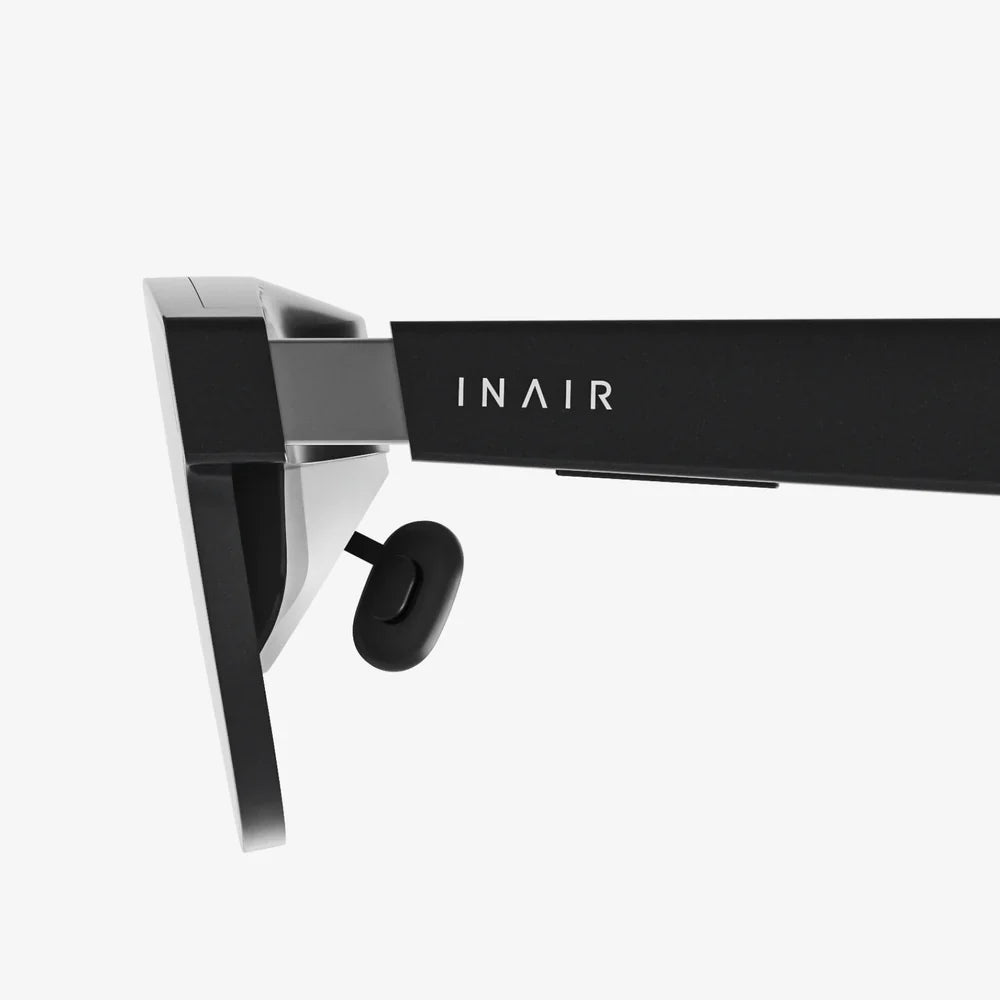
AR glasses strive for normality. The goal is to look as close to regular eyeglasses or sunglasses as possible. This prioritizes lightweight materials, smaller batteries, and less obtrusive displays. This makes them socially acceptable and comfortable for all-day wear but limits their computational and graphical power. They are fashion-forward and discreet.
XR glasses, often unapologetically embrace a more robust, "headset"-like design. They need to house more processors, a larger battery pack, a complex array of sensors, and sophisticated cooling systems. While advancements are making them smaller, they are currently more noticeable. They prioritize performance and experience over blending in. The trade-off is clear: you get a vastly more powerful and immersive experience at the cost of a bulkier device.
The Convergence: The Future is Not "Vs." but "And"
Framing the discussion as XR vs AR glasses is ultimately a simplification. The future does not lie in one winning over the other, but in a convergence. The industry's holy grail is a single pair of glasses that can fluidly shift along the reality spectrum—functioning as a discrete information overlay during your workday and then transforming into an immersive gaming portal when you want to play.
This requires breakthroughs in several key areas:
- Display Technology: We need new waveguide and holographic optics that can transition from transparent to immersive, all while being thin, efficient, and offering a wide field of view.
- Battery Life and Processing: Advances in chip efficiency (e.g., dedicated XR chipsets) and perhaps distributed computing (offloading processing to a phone or cloud) are essential to power these advanced experiences without requiring a helmet-sized battery.
- Spatial Understanding: The devices need to become masters of their environment through ever-improving sensor fusion and AI, understanding context and intent to provide the right experience at the right time.
The path forward is not a choice between augmentation and immersion, but a journey towards a single device capable of both, contextualizing the digital world to our immediate needs and desires.
We stand at the precipice of a revolution that will make the smartphone's ascent look like a minor trend. The ultimate winner in the XR vs AR glasses evolution won't be a specific device category, but a new paradigm of human-computer interaction. It's a future where your world becomes the interface, your context becomes the command, and the boundaries between what is real and what is digital become beautifully, usefully, and thrillingly blurred. The device that finally cracks the code on blending immense power with social grace will not just be worn on our faces—it will redefine our reality.
Share:
How to Wear Glasses with VR Headset: The Ultimate Guide to a Clear and Comfortable Experience
What Software Is Used for Augmented Reality - The Ultimate Guide to AR Development Platforms