


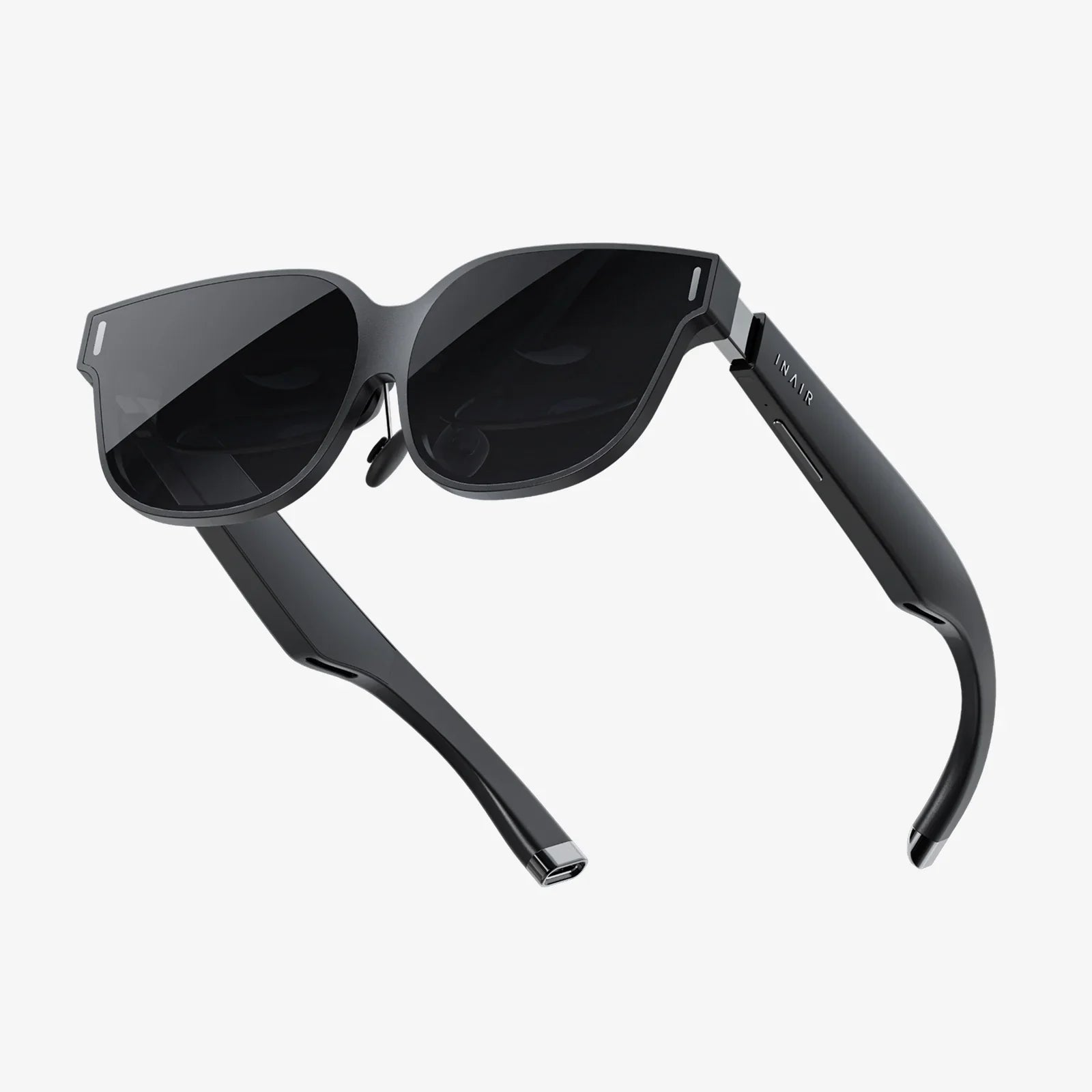
Imagine a world where digital information doesn't live on a screen in your hand or on your desk, but is seamlessly woven into the very fabric of your environment. Where walking through a museum brings ancient statues to life, where complex engine repair instructions are overlaid directly onto the machinery, and where a virtual colleague can point to a specific part of a 3D model as if it were physically present on your table. This is not a distant science fiction fantasy; it is the imminent future being unlocked by the rapid evolution of the augmented reality headset. This technology, once a clunky and expensive novelty, is maturing into an elegant, powerful, and profoundly disruptive force that promises to fundamentally alter how we work, learn, connect, and perceive reality itself.
Beyond the Hype: Defining the Augmented Reality Experience
To understand the significance of the modern AR headset, one must first distinguish it from its technological cousins. Unlike virtual reality, which seeks to fully immerse the user in a completely digital environment, shutting out the physical world, augmented reality aims to enhance the real world by superimposing computer-generated perceptual information onto it. The goal is not escape, but augmentation. A true AR headset allows you to see your actual surroundings, but enriched with a layer of interactive data, graphics, and digital objects that appear to coexist in your space.
The magic of this experience hinges on a sophisticated stack of technologies working in concert. At its core, a robust AR headset requires:
- Advanced Display Systems: Using either optical see-through or video see-through methods, these displays project images directly into the user's field of view. Waveguides, micro-LEDs, and lasers are miniaturized to create bright, high-resolution graphics that can be viewed in various lighting conditions.
- Spatial Mapping and Computer Vision: A constellation of outward-facing cameras, depth sensors, and LiDAR scanners continuously scans the environment. This data is processed in real-time to create a precise digital map of the room, understanding the geometry of surfaces, the location of objects, and even recognizing specific items. This allows digital content to snap onto a table, hide realistically behind a couch, or interact with a real-world object.
- Precise Positional Tracking: Using a combination of inertial measurement units (IMUs), visual odometry, and sometimes GPS (for outdoor use), the headset must know its own position and orientation in space with millimeter accuracy. This ensures that virtual objects remain locked in place, preventing the disorienting "drift" that plagued earlier systems.
- Powerful Onboard Compute: Processing the immense amount of visual and spatial data requires significant processing power. This is handled by specialized chipsets designed for simultaneous localization and mapping (SLAM), AI inference, and high-fidelity graphics rendering, all while managing stringent power and thermal constraints.
From Clunky Prototypes to Sleek Wearables: The Evolution of Form Factor
The journey of the AR headset has been a relentless pursuit of miniaturization and user comfort. The earliest systems were often tethered to powerful desktop computers, with bulky headsets and limited field of view. They were impressive proofs-of-concept, but impractical for sustained use.
Today, the industry is converging on two primary form factors, each with its own advantages and target use cases. The first is the all-in-one, glasses-style device. These aspire to be as lightweight and socially acceptable as a pair of premium sunglasses. They prioritize mobility and all-day wearability, often leveraging your smartphone's processing power via a seamless connection or utilizing ultra-low-power displays for simple notifications and basic information overlay. They represent the ultimate goal of making AR an invisible, always-available utility.
The second form factor is the more powerful, feature-rich standalone headset. These devices contain all the necessary compute, battery, and sensors within the headset itself. While often slightly larger than their glasses-style counterparts, they offer a vastly more immersive and interactive experience, capable of rendering complex 3D models and supporting sophisticated applications. They are the workhorses for enterprise and industrial applications, where maximum capability trumps absolute discretion. The ongoing trend is for these two categories to merge, with standalone headsets becoming lighter and glasses gaining more power, eventually culminating in a single, versatile device for all needs.
Transforming the Frontlines of Industry: Enterprise Applications
While consumer applications capture the public imagination, the most significant and tangible impact of AR headsets is currently happening on factory floors, in surgical theaters, and on construction sites. Enterprises are adopting this technology not for its novelty, but for its demonstrable return on investment, solving real-world problems with startling efficiency.
- Manufacturing and Field Service: Technicians wearing AR headsets can receive remote expert guidance, with an off-site senior engineer able to see their field of view and annotate the real world with arrows, circles, and text to point out components and steps. Complex wiring diagrams or assembly instructions can be overlaid directly onto the equipment, reducing errors, slashing training time, and minimizing downtime. A study by a major aircraft manufacturer found that using AR for wiring harness assembly resulted in a 90% reduction in errors and a 30% reduction in time taken.
- Healthcare and Medicine:
In medicine, the stakes are incredibly high, and AR headsets are rising to the challenge. Surgeons can use them to visualize patient data, such as MRI or CT scans, projected directly onto the patient's body, effectively giving them "X-ray vision" to guide incisions and locate tumors. This enhances precision and can lead to less invasive procedures. Medical students can practice complex surgeries on detailed, interactive holographic models, accelerating their learning curve without risk. Furthermore, AR can assist in vein visualization for nurses or provide hands-free access to patient records and vital signs during rounds.
- Design and Architecture: Architects and interior designers are using AR to step inside their 3D models at a 1:1 scale before a single brick is laid. They can walk through a full-scale holographic rendering of a building, assessing spatial relationships, lighting, and flow in a way that is impossible on a 2D screen. Clients can see and interact with a proposed design within the actual physical space, allowing for informed feedback and changes early in the process, saving immense time and cost.
The Future is Social and Contextual: Next-Generation Interfaces
The next frontier for AR headsets lies in moving beyond simple information display to creating truly contextual and socially aware experiences. This evolution is being driven by rapid advancements in artificial intelligence and sensor fusion.
Future devices will move from understanding where things are to understanding what they are and their context. Your headset will not only see a coffee machine but will know its model, be able to pull up its manual, and overlay step-by-step instructions for descaling it. It will see a person's face and, with permission, display their name and last meeting notes as a subtle reminder. This shift from a geometric understanding of the world to a semantic one will make interactions far more intuitive and powerful.
Furthermore, the paradigm of user input is shifting. The goal is to move beyond handheld controllers to more natural forms of interaction. This includes advanced hand tracking, allowing users to manipulate holograms with their fingers as if they were physical objects. Eye tracking will enable foveated rendering (dynamically focusing processing power only where the user is looking) and create new, intuitive UI paradigms based on gaze. Eventually, brain-computer interfaces may allow for control through thought alone. The ultimate objective is for the technology to fade into the background, making the interaction with digital content feel as natural as interacting with the physical world.
Navigating the Invisible Minefield: Challenges and Ethical Considerations
For all its promise, the path to ubiquitous AR is fraught with significant technical, social, and ethical challenges that must be thoughtfully addressed.
- The Privacy Paradox: An AR headset, by its very nature, is a powerful sensor platform with always-on cameras and microphones. The potential for pervasive surveillance, both by individuals and institutions, is a grave concern. Clear ethical frameworks and robust privacy-by-design architectures are non-negotiable. Users must have absolute control over their data, with transparent policies on what is recorded, processed, and stored, and who has access to it.
- The Digital Divide and Accessibility: There is a risk that this transformative technology could exacerbate existing social and economic inequalities. Ensuring that AR applications are designed for accessibility from the ground up is crucial to prevent creating a new barrier for people with disabilities. The cost of hardware and access to high-bandwidth connectivity must also be considered to avoid a future where AR privileges only a wealthy few.
- Safety and Digital Addiction: Overlaying digital information onto the real world creates novel safety hazards, from distracted walking to the potential for missing critical cues in dangerous environments like construction sites or while driving. Furthermore, the always-available, hyper-stimulating nature of AR could lead to new forms of digital addiction and further blur the lines between work and personal life. Establishing digital etiquette and "AR-free" zones will be an important social adaptation.
The true potential of the AR headset is not merely to put a screen on our faces, but to unlock a deeper, more intuitive, and more intelligent relationship with the world around us. It is a tool that can make us more knowledgeable workers, more skilled surgeons, more connected collaborators, and more creative problem-solvers. The device itself is merely the conduit; the real revolution is the invisible layer of understanding and capability it grants us. We are standing at the precipice of a new era of human-computer interaction, one where the digital and physical finally become one, and it will change everything.
Share:
VR Systems for Sale: Your Ultimate Guide to Entering the Virtual World
VR Chat Headsets: The Ultimate Portal to Digital Social Realms and Human Connection