


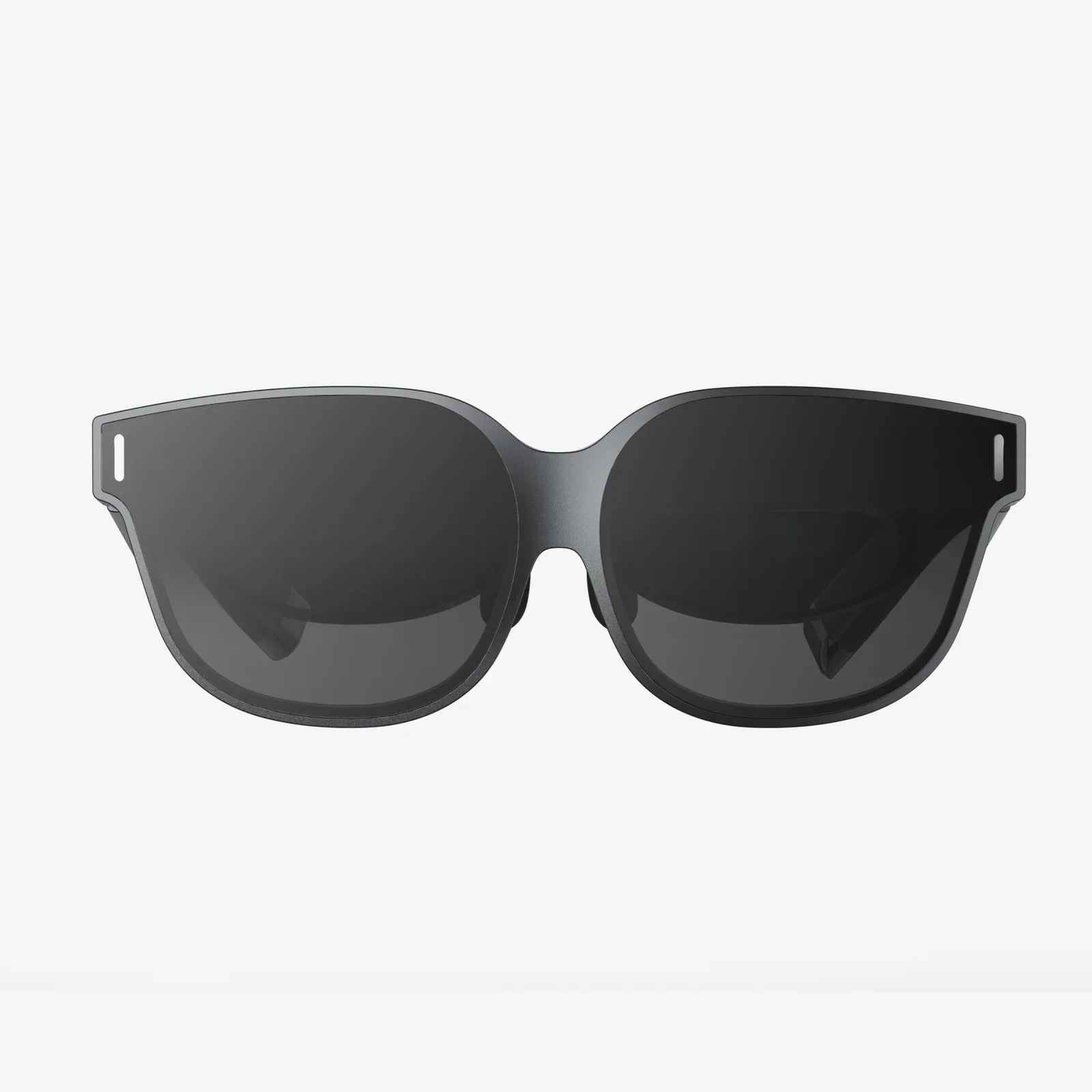
- by wangfred
AI Glasses Latest Models 2025: The Dawn of Seamless Augmented Living
- by wangfred
Imagine a world where information doesn't reside on a screen in your pocket but is seamlessly woven into the very fabric of your perception. A world where language barriers dissolve in real-time, where complex data is visualized before your eyes as you discuss it, and where your digital assistant understands your context so profoundly it anticipates your needs before you voice them. This is no longer the realm of science fiction; this is the promise delivered by the AI glasses latest models of 2025. We are standing at the precipice of a new computing paradigm, moving beyond handheld devices to a future of ambient, intelligent, and truly personal technology. The latest iterations are not just incremental upgrades; they represent a fundamental leap forward, making the once-clunky prototypes of yesterday feel like ancient history and bringing the dream of seamless augmented living into stunning, high-definition focus.
The foundational shift in 2025's AI glasses is a move away from being mere peripherals for a smartphone. They have evolved into self-contained, sophisticated computing platforms. This independence is powered by a trifecta of technological breakthroughs.
First, on-device neural processing units (NPUs) have become exponentially more powerful and energy-efficient. These aren't the simple chips of old; they are dedicated AI engines capable of handling trillions of operations per second with minimal power draw. This allows for complex machine learning models for computer vision, natural language processing, and predictive analytics to run locally on the glasses themselves. The implication is profound: latency is virtually eliminated. The response to a voice command or the translation of a street sign happens instantaneously, without a round-trip journey to a distant cloud server. This not only enhances speed and usability but also bolsters privacy and security, as sensitive data no longer needs to leave the device.
Second, advanced sensor fusion has reached new heights. The latest models are equipped with a sophisticated array of hardware that goes far beyond a simple camera and microphone. We're now seeing the standard integration of high-resolution LiDAR scanners for precise depth mapping and 3D environment reconstruction, hyperspectral sensors that can gather data beyond the visible light spectrum, and ever-more sensitive inertial measurement units (IMUs) for tracking head and body movement with sub-millimeter accuracy. These sensors work in concert, feeding a constant, rich stream of contextual data to the NPU, which synthesizes it to understand the user's environment and intent on a deeply granular level.
Third, battery technology and power management have finally caught up to the ambition of the hardware. Through the use of new solid-state battery compositions and radically efficient display technologies, 2025 models are achieving all-day battery life under normal usage. Furthermore, innovative solutions like solar charging via specially treated lenses or kinetic energy harvesting from movement are moving from concept to commercial reality, significantly reducing charging anxiety and moving us closer to a state of perpetual ambient computing.
Perhaps the most immediately noticeable improvement in the 2025 cohort is in the quality of the augmented reality display. The dim, ghostly, and narrow field-of-view projections that plagued earlier generations are gone. In their place are brilliant, high-contrast, and expansive visual overlays that feel physically present in the world.
The key innovation is the maturation of micro-LED waveguide technology. These displays project light onto a nearly invisible waveguide etched into the lens, which then directs it into the user's eye. The latest micro-LEDs are incredibly small and bright, allowing for resolutions that meet or exceed the human eye's acuity, making text and complex graphics razor-sharp. Furthermore, advancements in laser beam scanning and holographic optical elements have dramatically widened the field of view, now often exceeding 70 degrees. This creates an immersive canvas where digital objects can be placed anywhere in the user's natural field of vision without feeling constrained to a small, floating window.
This visual revolution is compounded by intelligent adaptive display systems. The glasses now continuously monitor ambient light conditions using dedicated sensors, automatically adjusting the brightness and contrast of the overlay to ensure perfect readability whether the user is in a dark conference room or walking in bright sunlight. Some models even feature electrochromic lenses that can tint electronically, functioning like transition lenses but controlled by the AI to optimize both the user's view of the real world and the clarity of the digital overlay.
Hardware is nothing without software, and the true soul of the 2025 AI glasses is their operating system and AI stack. This is where the leap from augmented reality to augmented intelligence becomes clear. The AI is no longer just reactive; it is increasingly proactive and contextual.
This is powered by a persistent and dynamic world graph. The glasses are continuously building and updating a private, local 3D map of the user's surroundings, understanding the geometry of spaces, recognizing objects, and even identifying people (with appropriate privacy controls and permissions). This allows the AI to anchor digital information to specific physical locations with incredible stability. For example, leaving a virtual sticky note on a specific machine in a factory, or having navigation arrows appear to hover directly on the path ahead.
Furthermore, the AI leverages multimodal input—what it sees, what it hears, and your personal data (calendar, emails, preferences)—to predict and serve up relevant information. It's the evolution of the digital assistant into a true contextual companion. Imagine walking into a grocery store: the glasses instantly highlight the items on your list, overlaying a subtle path on the floor to guide you to them. They might also flag a recipe for dinner based on what's in season and on sale, and even warn you if a product contains an allergen you've listed in your health profile. The interaction is shifting from "Hey glasses, what's on my list?" to the glasses simply showing you, because they know where you are and what you're likely trying to do.
The impact of these advancements is being felt far beyond consumer convenience. Entire industries are being reshaped by the capabilities of these new tools.
Surgeons are using AI glasses for real-time intraoperative guidance. During a complex procedure, vital signs, MRI overlays, and surgical checklists can be projected directly into their field of view, allowing them to maintain focus on the patient without looking away at a monitor. Medical students can practice on virtual anatomy overlays, and paramedics can receive remote expert guidance, with a specialist seeing what they see and annotating their view to help stabilize a patient.
Field engineers can look at a complex piece of machinery and see animated, step-by-step repair instructions overlaid directly onto the components they need to adjust. Architects and construction managers can walk through a building site and see the BIM (Building Information Modeling) data overlaid onto the unfinished structure, identifying potential clashes between systems before they become costly errors.
Learning becomes immersive and interactive. History students can witness historical events unfold around them on the school grounds. Mechanics-in-training can practice disassembling and reassembling virtual engines, with tools and parts highlighted and mistakes flagged in real-time. Language learning is accelerated by real-time subtitles and translations during conversations with native speakers.
With such profound capabilities come equally profound responsibilities. The 2025 models have ignited intense discussion around privacy, ethics, and the future of human interaction.
The always-on cameras and microphones represent a significant privacy challenge. Manufacturers have responded with robust privacy-by-design features. This includes physical hardware shutters for cameras, prominent LED indicators that are hardwired to show when a sensor is active, and sophisticated on-device processing that anonymizes data from strangers before it is ever processed. The principle of "local first" is key: ensuring that as much data as possible is processed and stored on the device itself, giving users ultimate control over their digital footprint.
There are also concerns about cognitive overload and societal divides. Will a constant stream of notifications and information lead to attention fatigue? Will a world where people interact with digital overlays more than with each other erode social cohesion? The design philosophy in 2025 is increasingly focused on "calm technology"—interfaces that reside on the periphery of attention until they are truly needed, and that enhance human connection rather than detract from it. Features like "focus mode" that minimizes distractions and emphasizes eye-contact detection to encourage real-world interaction are becoming standard.
Furthermore, the potential for a "digital divide" is acute. The cost of this advanced technology, while decreasing, is still significant. There is a risk that the immense benefits in productivity, education, and access to information could be limited to those who can afford it, creating a new societal stratification between the digitally augmented and the unaugmented. Addressing this through accessibility programs and enterprise-scale deployments will be a critical challenge for the industry.
The AI glasses of 2025 are more than just a new gadget; they are the harbinger of a fundamental shift in our relationship with technology. They are moving computing from something we use to something we experience, from a tool we actively engage with to an intelligent layer that enhances our perception and capabilities passively and continuously. The clumsy, isolated prototypes are gone, replaced by sleek, powerful, and socially aware companions. They promise to make us more knowledgeable, more efficient, and more connected to a world rich with digital possibility. The future is not in your hand; it's right before your eyes.
Share:
Visual and Augmented Reality: The Invisible Layer Reshaping Our World
Brands That Use Augmented Reality Are Redefining the Consumer Experience