


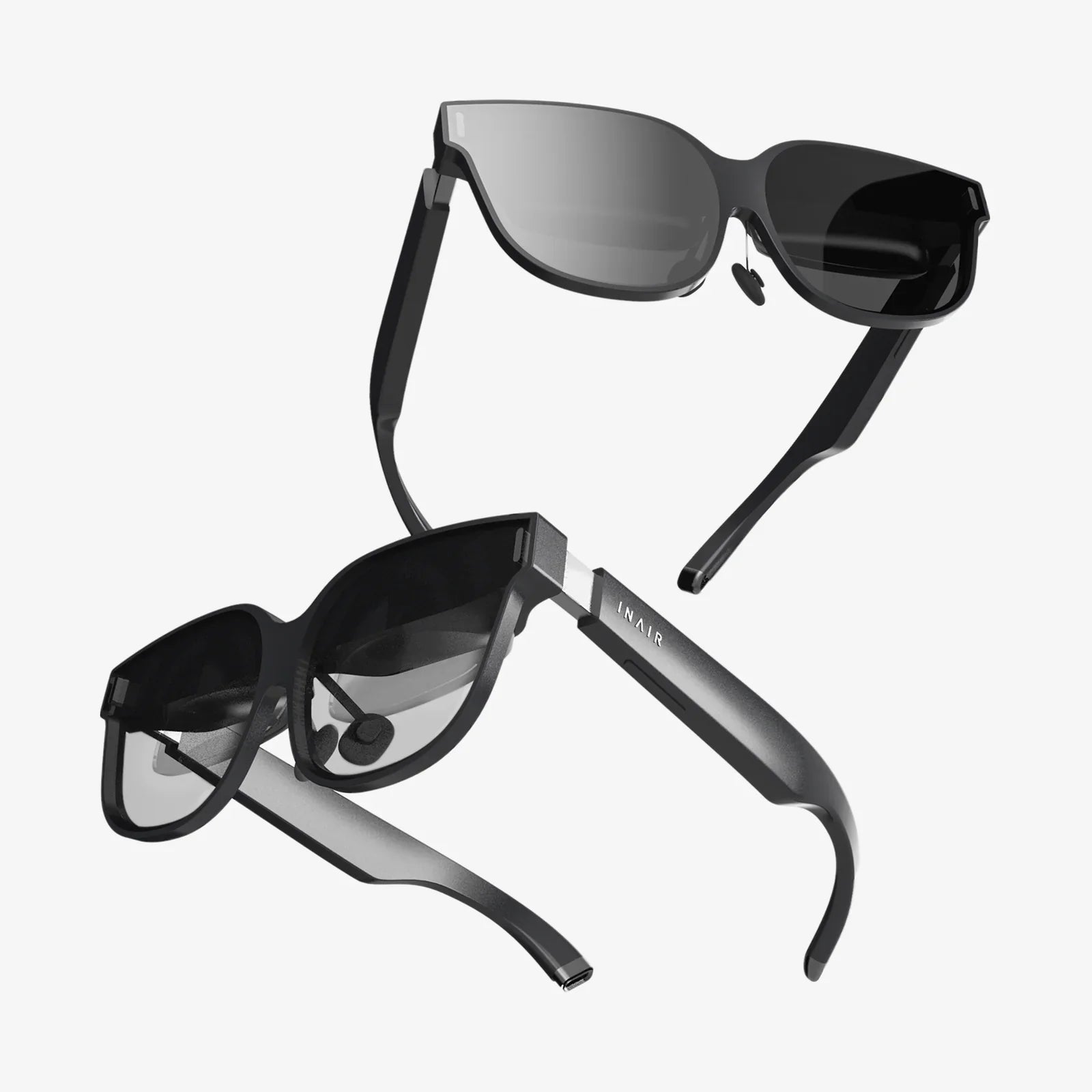
Imagine a world where your digital life doesn't confine you to a screen but instead flows seamlessly into your physical reality, or a world where you can escape entirely to fantastical realms with the flick of a switch. This is the promise of next-generation wearable technology, a battle for the space on your face between two distinct paradigms: the augmented subtlety of AI glasses and the immersive dominance of VR headsets. The choice isn't just about features; it's about how you want to perceive and interact with reality itself.
Defining the Core Experience: Augmentation vs. Immersion
The most fundamental difference between these two categories lies in their relationship with your environment. They are built upon opposing philosophies of human-computer interaction.
AI Glasses: The Digital Overlay
AI Glasses, often falling under the broader category of Augmented Reality (AR) wearables, are designed to enhance your real-world experience. Their primary function is to overlay digital information—text, images, data, animations—onto your field of view. Think of them as a sophisticated, context-aware head-up display for your entire life. You remain fully present in your surroundings; the technology merely adds a layer of useful computation. You can navigate a city with arrows painted onto the street, translate a foreign menu just by looking at it, or see a colleague's name hovering above them in a meeting. The real world remains the primary stage, and the digital elements are the supporting actors.
VR Headsets: The Digital Replacement
Virtual Reality headsets operate on a completely different principle: immersion through isolation. Their goal is to block out the physical world entirely and replace it with a convincing, computer-generated simulation. By using opaque displays and sophisticated tracking, VR headsets transport your visual and auditory senses to a fully digital environment. Whether you're exploring a virtual museum, battling aliens on a distant planet, or collaborating with avatars in a digital boardroom, the physical room you're standing in ceases to exist. The digital world isn't an overlay; it is the world for the duration of your experience.
Under the Hood: A Tale of Divergent Technologies
These contrasting experiences are enabled by vastly different technological architectures. The components and their priorities are tailored to their specific missions.
Display Systems: See-Through vs. Block-Out
This is the most obvious hardware differentiator. AI glasses utilize optical see-through systems, often employing waveguides or micro-projectors to beam images directly onto the user's retinas while allowing ambient light to pass through the lenses. This technology is incredibly challenging to perfect, requiring a balance between brightness, field of view, and transparency. The holy grail is a display that is both high-resolution and nearly invisible when not in use.
VR headsets, in contrast, use immersive, opaque displays. These are typically high-resolution LCD or OLED panels placed mere centimeters from the eyes, combined with lenses that widen the field of view. Their purpose is to fill your entire vision with pixels, leaving no room for light leakage from the real world. The focus is purely on graphical fidelity, refresh rate, and pixel density to sell the illusion of reality and prevent simulator sickness.
Processing Power: On-Device vs. Tethered/Standalone
The computational demands also differ significantly. A true, all-day AI glass aims for a sleek, lightweight form factor akin to traditional eyewear. This severely limits the space for batteries and powerful processors. Consequently, many designs offload heavy computation to a paired device, like a smartphone, or leverage specialized low-power AI chips designed for constant sensor data processing and simple overlays.
VR headsets, being larger and often worn for shorter, dedicated sessions, can pack in significantly more processing power. Standalone VR headsets are essentially powerful computers strapped to your face, with dedicated GPUs and CPUs to render complex 3D environments in real-time. PC-tethered VR headsets push this even further, leveraging the immense power of a desktop computer to achieve photorealistic graphics.
Sensors and Tracking: Context vs. Position
Both devices are laden with sensors, but they gather data for different reasons. AI glasses are equipped with outward-facing cameras, microphones, and environmental sensors to understand the world around you. Their tracking is about context: object recognition, surface detection (for placing digital objects), and spatial mapping to align digital content with physical spaces.
VR headsets are equipped with sensors focused inward on the user. Inside-out tracking cameras and sensors meticulously map the room (called guardian or boundary systems) not to augment it, but to keep you from bumping into walls. They also constantly track the precise position and rotation of the headset and controllers in 3D space to make your movements one-to-one with the virtual world. This is about positional and rotational accuracy to maintain immersion.
The User Experience: All-Day Companion vs. Session-Based Escape
This technological divergence creates a massive gap in how you use these devices in daily life.
Form Factor and Social Acceptance
AI glasses live and die by their social acceptability. The ultimate goal is to look like a regular, if slightly stylish, pair of glasses. They must be comfortable enough to wear all day and discreet enough that you aren't a spectacle in public. The "cyborg" stigma is a significant hurdle. Successful AI glasses will make the technology fade into the background.
VR headsets are unapologetically obvious. They are bulky headsets that cover half your face, deliberately isolating you. Wearing one in public is currently impractical and socially awkward. They are designed for private, controlled environments—your living room, an office, or a dedicated VR arcade. Their use is an intentional, session-based activity, not a passive, all-day state of being.
Primary Use Cases and Applications
The applications for each device highlight their philosophical differences perfectly.
AI Glasses excel at:
- Contextual Information: Real-time translation, navigation, and information retrieval hands-free.
- Remote Assistance: Allowing an expert to see what you see and guide you with annotations overlayed in your vision.
- Work and Productivity: Having multiple virtual screens available anywhere, or following step-by-step instructions while repairing equipment.
- Subtle Notifications: Discreetly reading messages or alerts without pulling out a phone.
VR Headsets excel at:
- Gaming and Entertainment: Providing deeply immersive experiences that are impossible on a flat screen.
- Training and Simulation: Practicing dangerous or expensive tasks (surgery, flight, machinery operation) in a risk-free virtual space.
- Virtual Social Spaces: Attending concerts, meetings, or just hanging out with friends as embodied avatars in a shared digital world.
- Design and Architecture: Walking through a 1: scale model of a building before it's built.
The Future Trajectory: Convergence or Coexistence?
While currently distinct, the lines are beginning to blur with concepts like Mixed Reality (MR). Some high-end VR headsets now feature high-resolution color passthrough cameras, effectively allowing them to function as AR devices by reconstructing the real world on their internal displays. However, this is often a lower-fidelity, video-based experience compared to the optical see-through of dedicated AR glasses.
The prevailing belief is that these devices will ultimately coexist rather than one replacing the other. They serve different human needs. AI glasses will become the successor to the smartphone—an ambient, always-available tool for navigating and enhancing reality. VR headsets will become the ultimate tool for escapism, deep training, and telepresence—the equivalent of a personal theater or simulator you step into.
The battle for your face isn't a zero-sum game. It's a spectrum of experience, from gently augmented reality to fully synthetic virtuality. The winner will be the technology that best understands the task at hand: do you need the world enhanced, or do you need a world replaced? Your choice will define not just what you see, but how you live, work, and play in the decades to come.
Share:
XR Glasses Best Buy: Your Ultimate Guide to Navigating the Future of Computing
Virtual One Glasses: The Dawn of a Seamless Digital Reality