


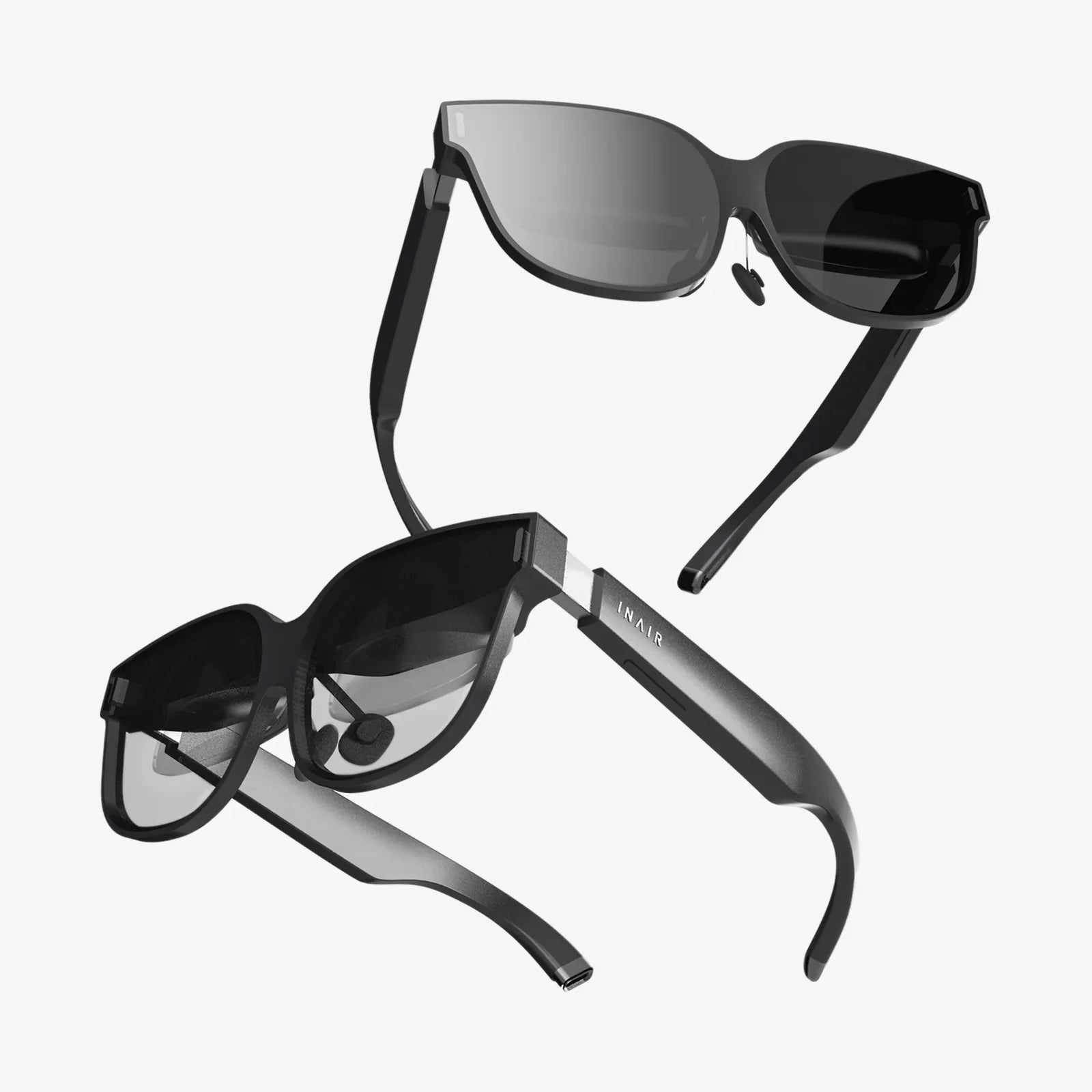
Imagine a world where your most trusted confidant, your most knowledgeable guide, and your most creative collaborator doesn't reside in your pocket or on your desk, but sits right on your face, seeing what you see and hearing what you hear. This is the imminent future promised by AI spectacles, a technological leap that will move computing from something we hold to something we are. This isn't just an incremental upgrade; it's a fundamental reimagining of our relationship with technology, shifting the paradigm from looking at a screen to having a digital intelligence augment your very perception of reality. The bridge of your nose is about to become the most valuable real estate in the tech world.
From Concept to Reality: The Evolutionary Leap
The journey to true AI spectacles has been a long and winding road. For decades, the concept of computerized eyewear existed primarily in the realm of science fiction, a tantalizing glimpse of a future that always seemed just out of reach. Early attempts, often clunky and limited, focused primarily on projecting a small, monochromatic display into the user's field of view. They were novel, but they failed to capture the public's imagination, often criticized for their limited functionality and socially awkward design.
The turning point came not from a single breakthrough, but from a convergence of several technological rivers flowing into one powerful delta. The miniaturization of processors advanced at a breathtaking pace, following Moore's Law to pack incredible computational power into chips smaller than a fingernail. Battery technology, while still a challenge, made significant strides in energy density. Most critically, the revolution in artificial intelligence, particularly in machine learning and computer vision, provided the essential brain. Suddenly, devices could not just display information but could understand the world around them in real-time. This confluence transformed the ambition from merely creating a wearable display to creating a contextual, aware, and intelligent visual assistant.
The Symphony of Technology: What Makes Them Tick
At their core, AI spectacles are a marvel of modern engineering, a symphony of sophisticated components working in perfect harmony. Unlike their simpler predecessors, these devices are packed with a suite of sensors that act as their eyes and ears.
- High-Resolution Cameras: These are the primary visual input, capturing the world from the user's perspective. They are not for recording video in the traditional sense but for feeding visual data to the on-board AI for real-time analysis.
- Microphone Arrays: Advanced beamforming microphones can pick up the user's voice clearly while filtering out ambient noise, enabling seamless voice interaction even on a noisy street.
- Inertial Measurement Units (IMUs): These sensors, including accelerometers and gyroscopes, track head movement and orientation, allowing the AI to understand where the user is looking and how they are moving through space.
- Miniature Speakers or Bone Conduction Transducers: For private audio feedback, these deliver sound directly to the user's ears without the need for bulky headphones, keeping them aware of their environment.
- The On-Board AI Co-Processor: This is the heart of the entire system. A specialized chip, often called a Neural Processing Unit (NPU), is dedicated to running complex AI models locally. This is crucial for both speed and privacy, as data often doesn't need to be sent to the cloud for processing.
- Advanced Display Technology:
The method of presenting information is perhaps the most debated technical aspect. Waveguide technology, which uses microscopic gratings to bend light directly into the eye, allows for sleek designs that look almost like ordinary glasses. Other systems use miniature projectors to create a focused image that appears to float in the user's field of view. The goal is always the same: to overlay digital information onto the physical world without obscuring it—a concept known as augmented reality (AR).
Beyond Vision Correction: A Multitude of Applications
The true power of AI spectacles lies not in their individual components, but in the transformative applications they enable. Their utility will span across every facet of human life, becoming as indispensable as the smartphone is today.
Revolutionizing Accessibility
For individuals with visual or auditory impairments, AI spectacles could be life-changing. Imagine a device that can read text aloud from any surface—a menu, a street sign, a product label—in real time. It could identify and narrate the faces of friends approaching, describe scenes, and even warn of obstacles on the sidewalk. For those who are hard of hearing, it could provide real-time subtitles for conversations, translating spoken words into text floating near the speaker's face, effectively breaking down communication barriers instantly.
Redefining Professional Work
In the professional sphere, the potential for enhanced productivity is staggering. A surgeon could see vital signs and 3D anatomical guides overlaid directly on their patient during an operation. A field engineer could look at a complex machine and see diagnostic data, repair instructions, and schematics superimposed on the components. Architects could walk through a construction site and see their digital blueprints realized in the physical space. The hands-free, context-aware nature of the technology eliminates the constant need to look away from the task at hand to consult a manual or a screen.
The Ultimate Travel and Learning Companion
For the traveler and the lifelong learner, AI spectacles will be the ultimate guide. Look at a foreign language menu, and see an instant translation. Gaze upon a historical landmark, and watch a historical reenactment play out before your eyes, accompanied by a narration of its significance. Visit an art gallery, and receive detailed commentary on each painting you stop to admire. The world itself becomes an interactive, informative canvas.
Enhancing Social and Daily Interactions
On a more personal level, these devices could act as a social aide. They could discreetly display the name and key details of a person you've met before, helping you avoid awkward introductions. They could analyze a room's lighting for a photographer or suggest a wine pairing based on the label at a dinner party. The mundane tasks of navigating, remembering, and learning could be effortlessly augmented.
The Inevitable Challenges: Privacy, Security, and the Social Contract
With such profound capability comes equally profound responsibility. The advent of AI spectacles will force a societal reckoning on issues of privacy and ethics that we have only begun to grapple with.
The most glaring concern is the always-on, first-person perspective camera. The potential for surreptitious recording in private spaces is a legitimate fear. Robust physical indicators—like a mandatory, un-hackable LED light that activates when recording—will be a non-negotiable feature for widespread adoption. Furthermore, the data collected is incredibly intimate: a continuous log of everything you see, hear, and do. Who owns this data? How is it stored, processed, and used? The business models cannot rely on monetizing this personal information; instead, they must be built on a foundation of radical transparency and user control. Strong, end-to-end encryption and the ability for local processing will be paramount.
Beyond privacy, there are social etiquette questions. Will it be considered rude to wear them during a conversation? Will restaurants and private venues ban them? We will need to develop new social norms to govern the use of such a pervasive technology. Furthermore, the digital divide could widen into a chasm; a world where some have access to real-time information and translation and others do not could create new forms of inequality.
The Future Vision: Where Do We Go From Here?
The current generation of devices is merely the prototype, the proof of concept. The future trajectory points toward even greater integration and invisibility. We can expect advances in battery technology, perhaps leveraging solar power or kinetic energy from movement. Displays will become full-color, high-resolution, and eventually offer a full field of view. The AI will evolve from a reactive assistant to a proactive partner, anticipating needs based on context and behavior.
Further out, the line between the technology and the human may blur even further. Research into neural interfaces suggests a future where interaction could happen not through voice or gesture, but through thought alone. The spectacles could become a permanent, stylish fixture of our lives, as ubiquitous as eyeglasses are today, continuously connecting us to a layer of intelligent information woven seamlessly into the fabric of our reality.
The age of staring down at a slab of glass and metal is drawing to a close. The next computing platform is rising to meet our eyes, offering a more natural, intuitive, and human way to interact with the digital universe. AI spectacles represent more than just a new gadget; they are the key to unlocking a world where technology enhances our humanity instead of distracting from it, where our reality is not replaced, but richly, intelligently, and wonderfully augmented.
Share:
3D Hologram Projector: Peering Into the Future of Visual Communication
Augmented Reality Headset News Today 2025: The Year Reality Got an Upgrade