


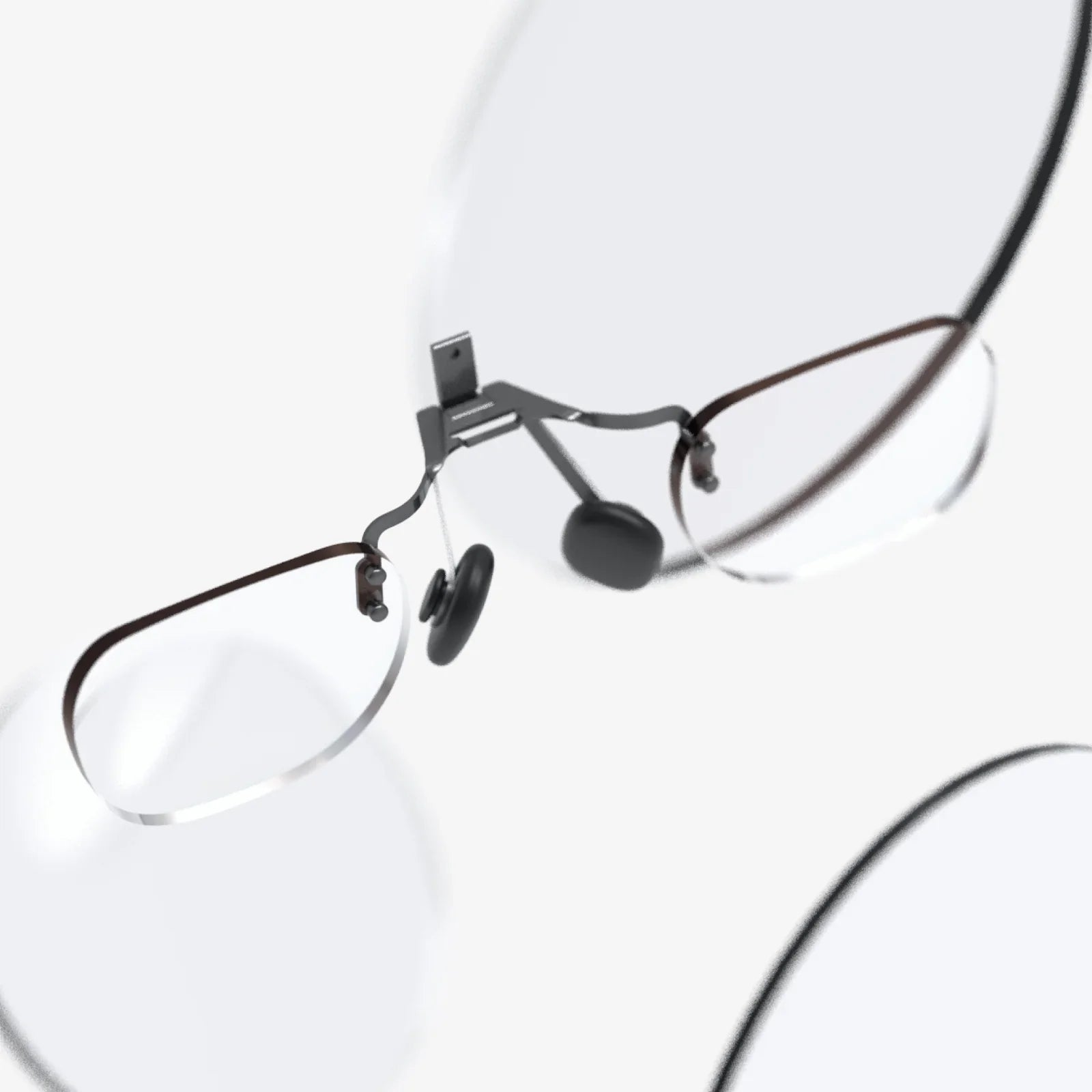
Imagine a world where digital information doesn’t just live on a screen in your hand but is woven seamlessly into the fabric of your reality. This is the promise of augmented reality (AR) glasses, a technology poised to revolutionize everything from how we work and learn to how we socialize and play. But this dazzling future isn’t built on the glasses alone. Lurking in the background, the true unsung hero, is the AR Glasses Hub—the central nervous system that will power, connect, and manage this new augmented layer of existence. This isn't just an accessory; it's the foundational bedrock upon which the entire augmented world will be built.
The Indispensable Role of the Hub
To understand the necessity of an AR Glasses Hub, one must first appreciate the immense computational burden AR places on a device. High-fidelity, real-time AR requires staggering amounts of processing power for tasks like simultaneous localization and mapping (SLAM), object recognition, spatial audio processing, and rendering complex 3D graphics. While on-device processing is advancing rapidly, there are inherent limitations in terms of heat dissipation, battery size, and weight for a wearable form factor.
This is where the hub concept becomes critical. It acts as a powerful external brain. By offloading the most demanding computational tasks to a stationary, well-cooled, and powerfully equipped hub, the glasses themselves can become lighter, more comfortable, more energy-efficient, and far less expensive. The hub handles the heavy lifting—the intense number crunching—and streams a refined, actionable data stream to the glasses. This symbiotic relationship is essential for achieving the smooth, immersive, and all-day usability that consumers will demand.
Architectural Blueprint: What's Inside the Hub?
The AR Glasses Hub is not a monolithic device but a sophisticated ecosystem of hardware and software components designed to work in concert. Its architecture can be broken down into several key functional layers.
The Computational Core
At its heart, the hub features a high-performance processor, often with a dedicated neural processing unit (NPU) and a powerful graphics processing unit (GPU). This is the engine room where complex algorithms parse the world. It takes the raw sensor data from the glasses—camera feeds, inertial measurement unit (IMU) data, depth sensor information—and constructs a coherent, understanding of the user's environment in real-time. This environmental understanding is the canvas upon which digital content is painted.
The Connectivity Nexus
A hub is defined by its connections. It must serve as a universal translator and router for a multitude of protocols:
- High-Bandwidth Wireless Link to Glasses: A ultra-low-latency, high-throughput connection like a specialized Wi-Fi standard or a future wireless protocol is non-negotiable. Any lag or stutter in this connection breaks immersion instantly.
- Cloud Access: The hub tethers the entire system to the cloud, enabling access to vast libraries of AR content, applications, and services. It allows for updates, social features, and storage of personalized spatial maps.
- Peripheral and IoT Integration: It will connect to your smartphone, smartwatch, smart home devices, and other peripherals, acting as the command center for your digital life. Imagine your hub telling your glasses to display a notification that your laundry is done, overlaying cooking instructions from your smart oven onto your countertops, or letting you answer a call from your laptop through your glasses.
The Data Management and Security Vault
AR glasses will generate an unprecedented amount of personal and environmental data. The hub becomes the secure local vault for this information. It can store personalized spatial maps of your home and office, your preferences, and your application data. Crucially, it also serves as the first line of defense for privacy and security, handling encryption, user authentication, and managing what data is sent to the cloud versus what remains locally stored. This local processing capability is vital for sensitive applications, ensuring that a video feed of your living room isn’t needlessly streamed to a remote server.
Use Cases: The Hub in Action
The theoretical benefits of the AR Glasses Hub become concrete when applied to real-world scenarios.
The Professional Workspace
In an engineering firm, a designer wearing lightweight AR glasses can walk around a full-scale, holographic 3D model of a new product prototype. The complex rendering and physics simulations are handled by the hub under their desk, which is plugged into the corporate network and high-performance computing cluster. Colleagues in different locations see the same model through their own systems, with the hubs synchronizing the experience in real-time. The designer can manipulate the model with gestures, with all changes instantly processed by the hub and reflected for everyone. This setup enables powerful collaboration without requiring prohibitively expensive and bulky headsets for every employee.
The Smart Home Ecosystem
At home, your AR Glasses Hub is integrated with your smart home system. As you walk into your kitchen, the hub recognizes the context and instructs your glasses to overlay recipe steps directly onto the mixing bowl in front of you. It pulls data from your smart fridge to suggest recipes based on available ingredients. When the doorbell rings, the hub pulls the video feed from your doorbell camera and displays it in a floating window in your periphery, along with the option to unlock the door for a trusted visitor. The hub seamlessly orchestrates all these data points and devices into a single, intuitive interface layered over your world.
Immersive Entertainment and Social Connection
For entertainment, the hub transforms your living room. It can stream a high-resolution, interactive movie where characters and effects appear to exist in your space. For gaming, it handles the demanding graphics of a fully immersive AR game, turning your entire home into a playground. Socially, the hub enables persistent AR experiences. You could leave a virtual note for your family on the refrigerator or collaborate on a virtual art project that remains anchored to a specific wall in your home, with the hub maintaining the persistent world state for all authorized users.
Overcoming the Challenges: The Path to Standardization
For the vision of a universal AR Glasses Hub to become reality, significant challenges must be overcome. The most formidable is the lack of standardization. Without agreed-upon protocols for connectivity, data exchange, and spatial mapping, we risk a fragmented ecosystem where a hub from one ecosystem is incompatible with glasses from another. Industry-wide consortia will need to emerge to establish these critical standards, much like the Wi-Fi Alliance or the Bluetooth Special Interest Group did for their respective technologies.
Furthermore, user acceptance hinges on elegant design and seamless setup. The hub must be a device you plug in and forget about, not a complex piece of computer hardware that requires constant maintenance. Its value must be immediately apparent through a dramatically improved experience with the glasses themselves.
The Future is Orchestrated
The journey towards ubiquitous augmented reality is not a sprint but a marathon. The first generation of AR glasses will likely make compromises—battery life, weight, processing power, and cost—as they strive for independence. But as the technology matures, the logic of distributed computing will become irresistible. The AR Glasses Hub represents the elegant solution to this complex problem, a dedicated device that empowers the glasses to fulfill their ultimate potential as an invisible window into a richer world.
We are moving towards a future where our digital and physical realities are no longer separate, but fused. This new layer of existence will be vast, complex, and incredibly powerful. And orchestrating it all, from the deepest computational tasks to the simplest smart home command, will be the silent, intelligent, and indispensable AR Glasses Hub. It won’t be the star of the show you see on your face, but it will be the reason the show can go on, transforming a compelling piece of technology into an invisible, magical part of your everyday life.
Share:
Adjust Window Size: The Ultimate Guide to Optimizing Your View and Workflow
Android Virtual Reality SDK: Building Immersive Worlds for the Mobile Future