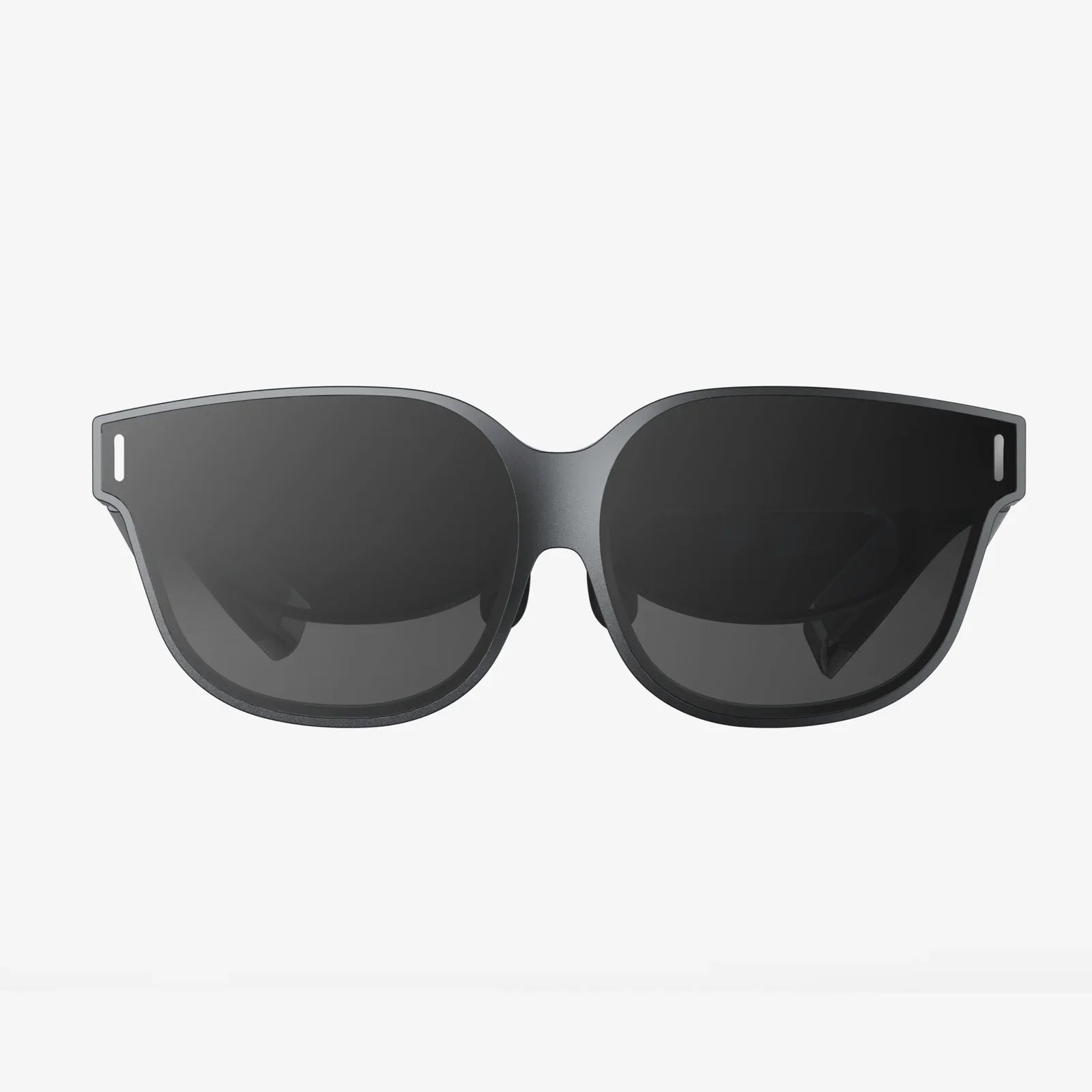
Imagine your entire office, not on a desk, but in the air around you. A sprawling canvas of browser tabs floats to your left, a pristine document awaits edits directly ahead, and a real-time data dashboard hovers serenely to your right—all visible only to you, through a pair of sleek, unassuming glasses. This is not a scene from a distant sci-fi future; it is the imminent reality promised by AR glasses with virtual monitors, a technology set to shatter the century-old paradigm of the physical screen and redefine the very nature of work, creativity, and digital interaction.
The Tyranny of the Rectangle: Why We Need to Break Free
For decades, our primary window to the digital universe has been a glowing rectangle. From the bulky cathode-ray tubes of the past to the sleek, ultra-thin bezels of today, the fundamental concept has remained unchanged: a flat, static, physical object that demands our fixed attention. This model has served us well, powering the information age, but its limitations are becoming increasingly apparent. We are constrained by the size of our desks, the weight of our luggage, and the sheer physical reality of these glass and plastic slabs. Productivity is often measured in the number of these screens we can physically acquire and arrange, leading to cluttered workspaces and a constant hunger for more digital real estate. The virtual monitor capability of AR glasses represents a fundamental leap beyond this constraint, offering a screen-less, spatially-aware computing experience.
How It Works: Painting Pixels onto Reality
The magic of virtual monitors lies in a sophisticated fusion of hardware and software. Advanced waveguide optics project high-resolution images directly onto the user's retinas, creating the perception of bright, stable screens existing in the real world. Meanwhile, inside-out tracking sensors, including cameras and inertial measurement units (IMUs), constantly map the physical environment and track the precise position and orientation of the user's head. This allows the virtual displays to remain "locked" in place in the real world. If you turn your head or walk around the room, the displays stay right where you left them, behaving exactly like physical objects. This persistent anchoring is the critical illusion that makes the technology so powerful and intuitive.
The Unmatched Benefits: A Workspace Unshackled
Infinite Real Estate, Zero Footprint
The most immediate and compelling advantage is the liberation from physical constraints. Your digital workspace is limited only by your preference, not by your desk size. You can have a single, cinema-sized display for immersive coding or movie-watching, or a mosaic of a dozen different windows for complex data analysis. When you are done, they simply vanish, leaving your physical space completely clear. This transforms any location—a cramped coffee shop, an airplane seat, a quiet library nook—into a potent, multi-monitor command center.
Radical Portability and On-The-Go Productivity
For the modern mobile professional, this is a game-changer. The entire concept of a "mobile workstation" is inverted. Instead of carrying a powerful laptop with a large screen or seeking out external monitors, your entire multi-screen setup is contained within your glasses and a connected computing device, like a powerful smartphone or a compact computer in your pocket. Your perfect, personalized ergonomic setup is now with you everywhere, instantly deployable.
Enhanced Focus and Contextual Computing
Unlike a physical monitor that competes for attention with the distractions of your environment, virtual displays can be designed to minimize this cognitive load. Techniques like digital dimming or "passthrough blending" allow users to control how much of the real world they see alongside their virtual screens. This enables a powerful state of focused immersion when needed, or a seamless blend of digital data and physical context. Imagine following a repair tutorial with a schematic diagram pinned directly to the machine you are fixing, or watching a cooking video with the instructions floating right above your mixing bowl.
The Ultimate Ergonomic Freedom
Neck strain and poor posture are common ailments of the digital age, often caused by fixed screen positions. With virtual monitors, ergonomics become dynamic and personalized. You can position your primary display at the perfect height and depth to maintain a neutral spine position, whether you are sitting upright, reclining in a chair, or even lying down. The screens conform to you, not the other way around.
Navigating the Current Frontier: Challenges and Considerations
While the potential is staggering, the path to mainstream adoption is not without its hurdles. The technology is still maturing, and early adopters must weigh these considerations.
The Visual Fidelity Gap
The holy grail is achieving visual parity with high-end physical monitors: exceptional resolution, high brightness, perfect color accuracy, and a wide field of view that feels natural. Current generations are impressive but can still suffer from limitations like a "screen door effect," lower perceived resolution at the edges of the field of view, or challenges with rendering perfect blacks. The race is on to develop next-generation optics and micro-displays that will make virtual screens indistinguishable from real ones.
Battery Life and Processing Power
Rendering multiple high-resolution displays and processing complex environmental data in real-time is computationally intensive. This demand impacts both the form factor, as processing units need to be powerful yet small, and battery life. All-day productivity will require significant breakthroughs in power efficiency, both in the glasses themselves and in the connected devices that power them.
Design and Social Acceptance
For any wearable technology to succeed, it must be something people actually want to wear. The design challenge is immense: balancing advanced technology, battery capacity, and processing hardware into a form factor that is lightweight, comfortable, and socially acceptable. The goal is a product that looks more like fashionable eyewear than a bulky piece of technical headgear. Furthermore, social norms around wearing computers on our faces in public are still evolving.
Software Ecosystem and User Interface
The hardware is only half the story. A robust and intuitive software ecosystem is crucial. This includes not only the operating system that manages the virtual displays but also new forms of spatial input. How do we best interact with these floating windows? Voice commands, hand tracking, wearable controllers, and adaptive gaze control are all competing to become the primary interface for this new medium, and a standard has yet to emerge.
A Glimpse into the Future: Beyond the Virtual Desktop
The concept of virtual monitors is merely the first and most obvious application of this technology. It is the "killer app" that will drive initial adoption, but it opens the door to far more profound changes. We are moving towards a world of contextual and ambient computing, where information is not trapped on a screen but is instead interwoven with our reality. Data visualizations could exist as three-dimensional models you can walk around and inspect from all angles. Colleagues' avatars could join your physical space for a collaborative design session, manipulating virtual prototypes together. Your entertainment will no longer be a window you look into, but a world you are inside. The virtual monitor is the stepping stone from a 2D digital experience to a true 3D spatial computing paradigm.
The glowing rectangle that has defined our digital lives is living on borrowed time. AR glasses and their ability to project virtual monitors are not just an incremental upgrade; they are the key to a fundamental shift, promising a future where our workspaces are boundless, our focus is sharpened, and our digital and physical realities finally converge into a seamless, personalized flow of information and creation. The revolution won't be televised on a flat screen; it will be experienced all around you.


Share:
Top AI Glasses 2025: The Dawn of a Seamless Augmented Reality Future
Smallest VR Glasses: The Unseen Revolution Reshaping Digital Reality