


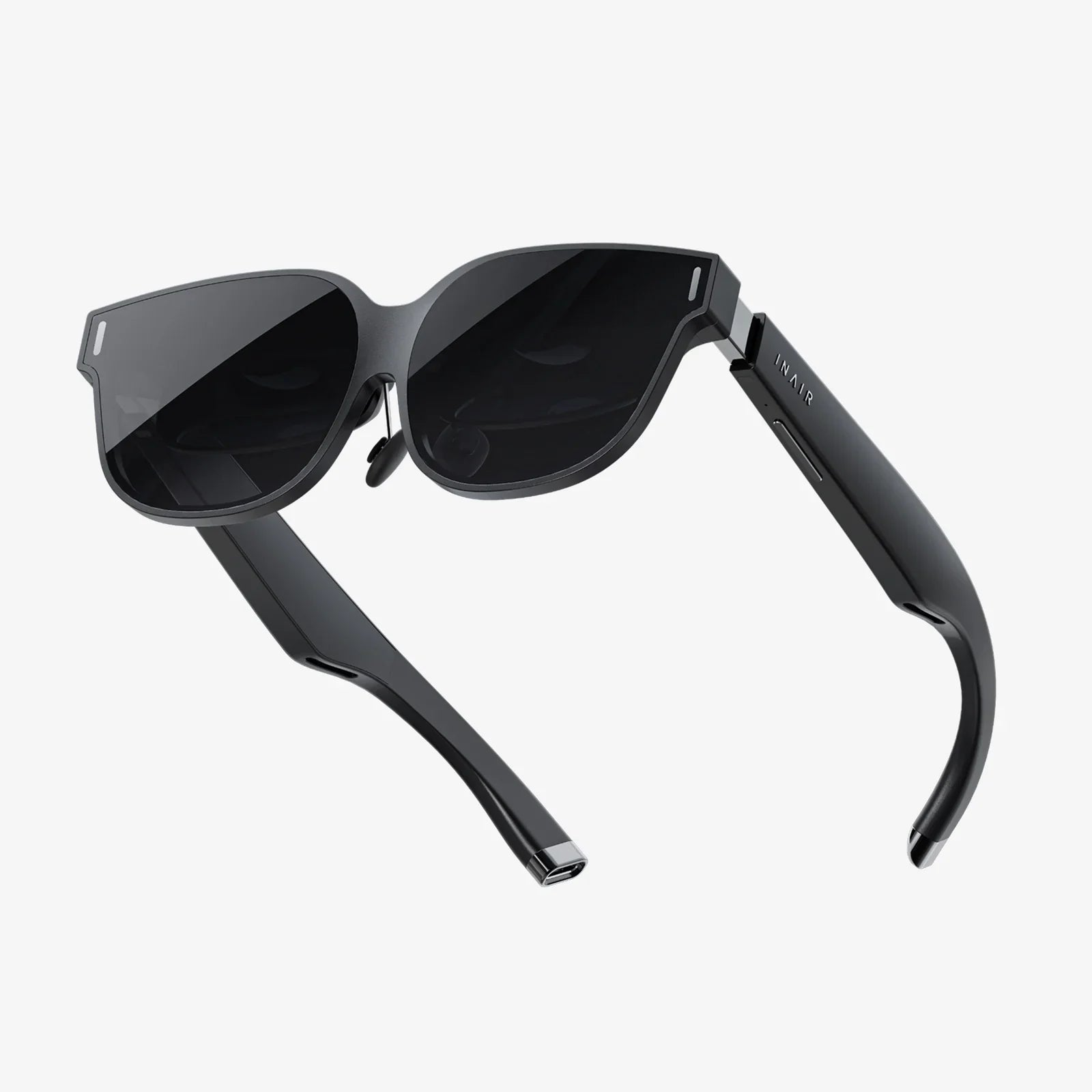
Imagine a world where digital information seamlessly overlays your morning commute, or where you can be instantly transported to a concert on the other side of the globe without leaving your living room. This is no longer the realm of science fiction; it's the burgeoning reality shaped by two distinct yet often conflated technologies: Augmented Reality glasses and Virtual Reality headsets. The choice between them isn't just about picking a gadget; it's about deciding how you want to interact with the digital universe—whether by enhancing your own world or escaping into a completely new one.
Defining the Realms: Augmented Reality vs. Virtual Reality
At their core, these technologies are founded on fundamentally different principles. Understanding this dichotomy is the first step in navigating the market.
Virtual Reality (VR) is an immersive, all-encompassing technology. A VR headset functions as a blindfold to the physical world, replacing your entire field of view with a computer-generated simulation. Using a combination of sensors, lenses, and displays, it tracks your head and, often, your hand movements to make you feel present within a digital environment. Whether you're exploring a fantasy landscape, undergoing training in a virtual cockpit, or watching a movie on a giant virtual screen, the key tenet of VR is isolation. It cuts you off from your immediate surroundings to fully engage your senses in a crafted experience.
Augmented Reality (AR), in contrast, is about integration, not isolation. AR glasses are designed to be transparent windows to the real world, upon which digital information—images, text, 3D models—is superimposed. Instead of replacing reality, AR aims to augment it with a contextual digital layer. Think of navigation arrows painted onto the street in front of you, a recipe hovering next to your mixing bowl, or a colleague's 3D avatar sitting across from you in your real meeting room. The goal is to enhance your perception of and interaction with your existing environment.
The Hardware Divide: How They Achieve Their Magic
The philosophical difference between augmenting and replacing reality dictates a dramatic divergence in their hardware design and technical requirements.
VR Headsets: The Power of Immersion
VR headsets are, by nature, complex and powerful computing devices. Their primary job is to render two high-resolution, high-refresh-rate images (one for each eye) to create a convincing, seamless world. This requires significant processing power, which historically has been supplied by a connected personal computer or a console. Modern standalone headsets have this computer built-in, but it demands advanced mobile chipsets, active cooling, and large batteries, resulting in a heavier form factor.
Key components include:
- High-Resolution Displays: Positioned mere centimeters from your eyes, these displays must be incredibly sharp to avoid a "screen door effect."
- Precision Lenses: These focus your eyes on the close-up displays and create a wide field of view (FOV), crucial for selling the illusion of being inside the virtual space.
- Advanced Tracking Systems: Using external sensors or internal-out cameras, these systems track your head's position and rotation in six degrees of freedom (6DoF—forward/back, up/down, left/right, pitch, yaw, and roll) to make the virtual world move with you naturally.
- Controllers: Most VR systems include handheld controllers tracked in 3D space, allowing you to interact with the virtual environment using your hands.
AR Glasses: The Challenge of Transparency
The engineering challenge for AR glasses is entirely different and, in many ways, more profound. The device must be lightweight, socially acceptable, and optically transparent. The holy grail is a pair of glasses that look and feel nearly normal but can project vivid digital imagery onto the real world. This is achieved through several cutting-edge technologies:
- Waveguide Displays: A dominant technology where light from a micro-display is "piped" through a transparent glass or plastic lens using microscopic structures before being directed into the user's eye. This allows the user to see both the real world and the digital overlay simultaneously.
- Micro-OLED Displays: Extremely small, bright, and efficient displays that project images directly onto the lenses or into the waveguides.
- Spatial Mapping Cameras: To anchor digital objects convincingly in the real world, AR glasses use cameras to constantly scan and map the environment, understanding surfaces, planes, and depth. This is a primary differentiator—where VR tracks the user, AR must track the world.
- Always-On Connectivity: Many AR glasses concepts rely on a tethered connection to a smartphone or a small computing pack to handle the intense processing of computer vision and AI, keeping the glasses themselves light and comfortable for all-day wear.
A World of Applications: Work, Play, and Everything In-Between
The practical uses for AR and VR are as different as the technologies themselves, carving out unique and sometimes overlapping niches across various industries.
The VR Domain: Deep Dive Experiences
Virtual Reality excels in situations where total focus is required, or where the real world is a distraction or simply incapable of providing the necessary environment.
- Gaming and Entertainment: This is VR's flagship application. It offers unparalleled immersion, placing you inside the game world. From rhythm games to epic adventures and social VR platforms, it's the ultimate tool for experiential entertainment and simulated social gatherings.
- Training and Simulation: Pilots, surgeons, soldiers, and mechanics use VR to practice complex, dangerous, or expensive procedures in a consequence-free environment. It allows for perfect repetition and the simulation of rare edge-case scenarios.
- Therapy and Rehabilitation: VR is used for exposure therapy to treat phobias, for physical therapy to make exercises more engaging, and for meditation apps that create serene, controlled environments to aid mindfulness.
- Virtual Tourism and Real Estate: Walk through a museum on another continent or tour a property for sale without physically being there. VR offers a powerful sense of "presence" that flat images and videos cannot match.
The AR Frontier: Enhancing Everyday Life
Augmented Reality aims to be a practical tool woven into the fabric of daily life, enhancing productivity, providing information, and offering new ways to connect.
- Remote Assistance and Collaboration: A field technician wearing AR glasses can receive live visual annotations from an expert thousands of miles away, who can "see what they see" and guide them through a complex repair. Colleagues in different locations can collaborate on 3D models placed on a real table as if they were physically together.
- Navigation and Information: Imagine walking through a city and seeing directional arrows on the pavement or historical information popping up about landmarks you pass. This contextual, heads-up information layer is a killer app for AR.
- Industrial Design and Manufacturing: Engineers can visualize and interact with full-scale 3D prototypes of machinery before it's built. Factory workers can have assembly instructions, part numbers, and safety warnings overlaid directly on their workspace.
- Retail and Try-Before-You-Buy: See how a new sofa would look in your living room at true scale or virtually try on glasses and makeup using your smartphone's camera—a precursor to more advanced glasses-based AR.
The User Experience: Isolation vs. Awareness
Perhaps the most immediate practical difference a user will notice is the experience of wearing the device.
Strapping on a high-end VR headset is an intentional, committed act. You are choosing to disconnect from your physical space for a dedicated period. This makes it fantastic for focused sessions but impractical for constant, all-day use. You are largely stationary or confined to a pre-defined "play area," and you are cut off from the people and events around you. It is an experience you schedule.
In an ideal future, putting on AR glasses should be as simple and routine as putting on your prescription eyewear. They are designed for ambient, always-available computing. You remain fully aware of your environment and can interact with both the digital and physical worlds simultaneously. This makes them suited for productivity, communication, and receiving continuous, context-aware information throughout your day. The goal is to make the technology fade into the background until you need it.
The Road Ahead: Convergence and the Future of Spatial Computing
While currently distinct, the lines between AR and VR are beginning to blur. The concept of Mixed Reality (MR) sits at this intersection. Some high-end VR headsets now feature high-resolution color passthrough cameras, allowing them to function as video-based AR devices by showing you a live video feed of your room with digital elements added on top. This "passthrough AR" is a stepping stone, though it currently lacks the visual fidelity and natural feel of true optical-see-through AR glasses.
The ultimate dream for many in the industry is a single device—a pair of sleek glasses—capable of dynamically switching between transparent AR and occluded VR, perhaps using electrochromic technology to dim the lenses to black. This unified device would be the pinnacle of "spatial computing," a term that encompasses both AR and VR, defining the next great platform for human-computer interaction after the mobile phone.
Making Your Choice: Which Digital Reality is Right for You?
So, should you invest in AR glasses or a VR headset? The answer hinges entirely on what you want to do.
Choose a VR Headset if: Your primary goal is immersive gaming, consuming immersive media, or engaging in dedicated training/simulation exercises. You value deep, uninterrupted experiences and are comfortable being isolated from your physical surroundings for periods of time. You have a dedicated space to use it safely.
Look towards AR Glasses if: You are interested in technology that enhances your daily life, productivity, and interaction with the real world. You want hands-free information, remote collaboration tools, and digital aids that feel integrated into your workflow and environment. You value situational awareness and a form factor that promises eventual all-day wearability.
For the average consumer today, VR offers a more mature and readily available experience for entertainment, while advanced consumer-grade AR glasses are still emerging, with most current products targeted at enterprise and developer markets. However, this landscape is shifting rapidly.
The journey into digital realities is just beginning. Whether you choose to augment your world with contextual data or escape into limitless virtual ones, these technologies are poised to redefine our relationship with computing, information, and each other. The device that will ultimately win your attention may not be the one that shuts the world out, but the one that helps you see it in a brilliantly new way.
Share:
New Virtual Glasses: Redefining Reality and the Future of Human Connection
VR Prescription Glenses: The Ultimate Guide to Crystal Clear Immersion