


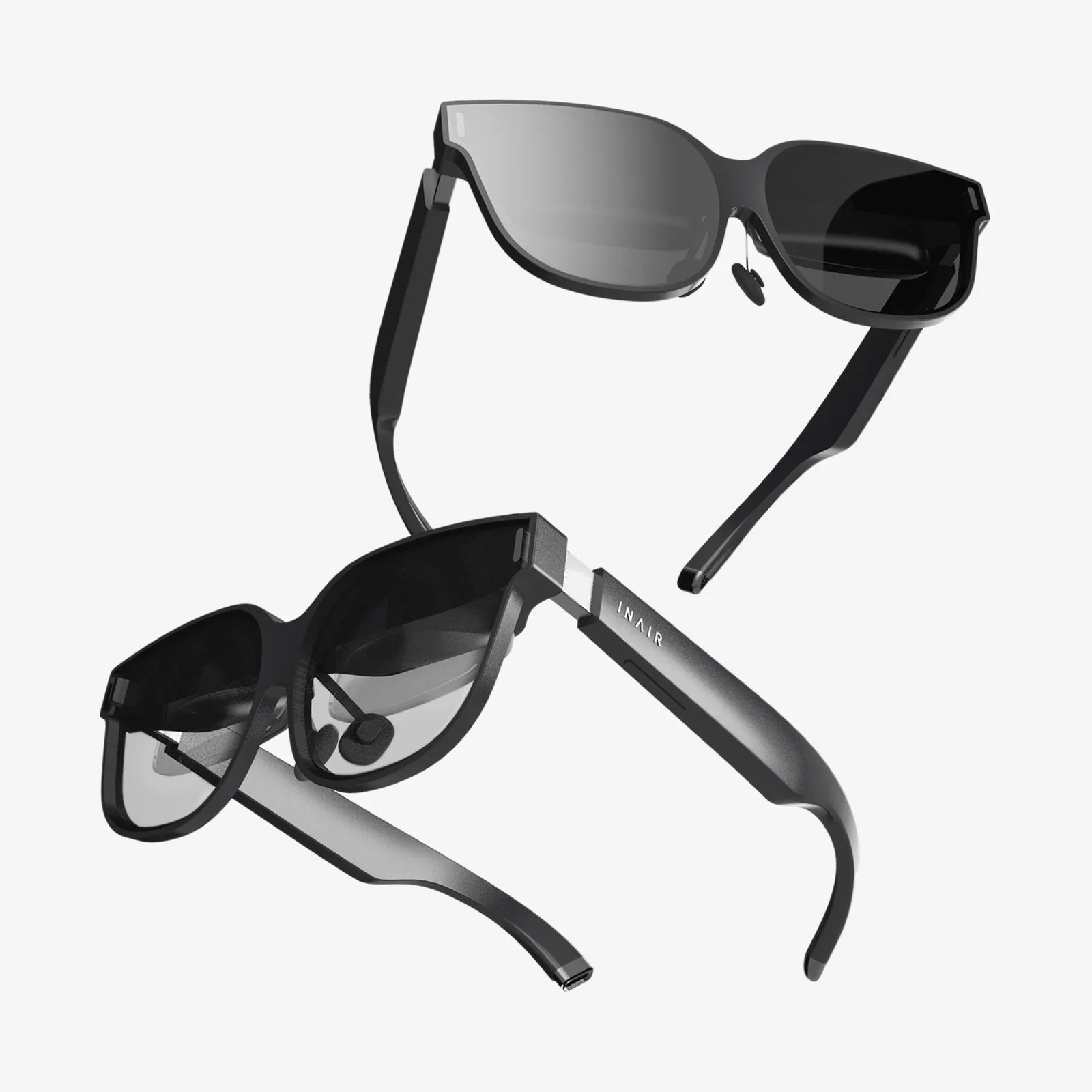
Imagine a world where digital information doesn't live on a screen in your hand, but is seamlessly woven into the very fabric of your reality. Where instructions float over the engine you're repairing, historical figures reenact battles on the very ground they were fought, and a navigational path is painted onto the sidewalk ahead of you. This is the promise of the modern AR headset, a technological leap that feels less like an evolution of the smartphone and more like the discovery of a new sense. We are standing on the precipice of a revolution that will make the digital world tangible, and it’s all happening through a pair of lenses.
Beyond Science Fiction: Defining the Modern AR Experience
For decades, augmented reality was confined to the realms of science fiction and bulky, impractical laboratory prototypes. Today, it is a rapidly maturing technology, and the AR headset is its primary vessel. Unlike virtual reality, which seeks to replace your world with a digital one, augmented reality aims to augment and enhance your perception of the real world by superimposing computer-generated sensory inputs onto it. This fundamental difference is what makes AR so powerful and potentially ubiquitous; it doesn't ask you to log out of reality, but to log into a richer version of it.
The core magic of an advanced AR headset lies in its complex suite of technologies. It's a symphony of miniaturized components working in perfect harmony:
- Advanced Display Systems: Through technologies like waveguide optics, birdbath lenses, and micro-LED projectors, these devices beam images directly onto transparent lenses or the user's retina, creating the illusion that digital objects coexist with physical ones at various depths.
- Spatial Mapping: A constant dance of sensors, including depth-sensing LiDAR, cameras, and inertial measurement units (IMUs), scans the environment thousands of times a second. This creates a live digital twin of the space, allowing virtual objects to understand and interact with the physics of your room—occluding behind real objects and sitting firmly on real surfaces.
- Intuitive Interaction: The goal is to move beyond controllers. Hand-tracking cameras interpret your gestures as commands, allowing you to pinch, grab, and manipulate digital artifacts as if they were real. Voice assistants provide a hands-free layer of control, and evolving technologies like eye-tracking allow the system to know precisely where you are looking, enabling context-aware interfaces.
The Professional Paradigm Shift: From Factory Floors to Operating Theaters
While consumer applications capture the imagination, it is in enterprise and specialized fields that AR headsets are already delivering staggering returns on investment and, in some cases, saving lives. The value proposition is undeniable: providing the right information, at the right time, right in your line of sight.
In manufacturing and complex machinery maintenance, technicians wearing AR headsets can see schematic diagrams and animated repair instructions overlaid directly on the equipment they are fixing. This reduces errors, slashes training time for new hires, and allows experts to provide remote guidance by seeing what the on-site worker sees and annotating their field of view from across the globe. A seasoned engineer in one country can effectively project their knowledge onto the eyes of a technician anywhere else, democratizing expertise instantly.
The medical field is witnessing nothing short of a transformation. Surgeons are using AR to visualize CT scans and MRI data—such as tumors or critical blood vessels—precisely registered on a patient's body during procedures. This is like granting them X-ray vision, enhancing precision and improving patient outcomes. Medical students can practice complex procedures on detailed, interactive holographic models, and first responders could one day have vital signs and patient history displayed as they attend to an emergency.
Architects and engineers are walking through full-scale 3D holograms of their building designs before a single foundation is poured, identifying design clashes and experiencing spatial relationships in a way a 2D screen could never allow. This application alone prevents millions in costly construction errors and facilitates better collaboration among stakeholders.
Rewiring Social Connection and Storytelling
The implications for human connection are profound. Current video calls flatten us into rectangles on a screen. AR envisions a future where holographic representations of people can appear in your living room, able to make eye contact and gesture naturally, creating a palpable sense of presence and shared space that transcends physical distance. This could redefine remote work, family gatherings, and telepresence, making digital communication feel human again.
Entertainment and storytelling will be utterly reinvented. Imagine watching a film where characters and scenes unfold around your home, or playing a game where your entire environment becomes the level—aliens bursting through your actual walls, or a puzzle game that uses your furniture as platforms. Museums will curate holographic exhibits that surround visitors, and educators will transport students to ancient Rome or the bottom of the ocean, not through a video, but as if they were truly there. This immersive form of storytelling has the power to foster empathy and understanding on an unprecedented scale.
The Invisible Obstacles: Challenges on the Road to Ubiquity
For all its promise, the path to a universally adopted AR future is fraught with significant technical and social hurdles that must be overcome.
The most immediate challenge is hardware form factor. The dream device must be indistinguishable from a regular pair of eyeglasses—lightweight, comfortable, socially acceptable, and offering all-day battery life. Current technology is still converging on this goal, often requiring compromises in processing power, field of view, or battery size. Achieving this sleek form factor without sacrificing computational muscle is the industry's holy grail.
Then there is the question of the user interface (UI). How does one design an interface for reality? We have decades of convention for screens, but AR is a blank slate. Information must be contextual, minimal, and non-obtrusive to avoid overwhelming the user or creating dangerous distractions, especially when walking down a street or driving. The UI must be a gentle guide, not a distracting overlay.
Perhaps the most critical hurdles are privacy and security. An AR headset is, by its nature, a sensor-rich device that is constantly capturing its environment. This raises dystopian concerns about perpetual surveillance, data ownership, and advertising. Who has access to the video feed from your eyes? How is data about your home, your habits, and the people you meet being used? Establishing robust ethical frameworks, data encryption standards, and clear user controls is not just a feature; it is an absolute prerequisite for public trust and adoption.
A Glimpse into the Next Decade: The Invisible Revolution
Looking forward, the trajectory points toward a world where AR headsets evolve from a distinct device into an integrated part of our lives. We are moving toward more intuitive neural interfaces, where control can be exerted through subtle intention rather than broad gestures. The concept of the "spatial web" will emerge—a layer of information and experiences anchored to places and objects in the real world, accessible only through AR. Your coffee machine could have a virtual interface floating above it, and a historic monument could have a virtual tour guide waiting for anyone who looks at it through their lenses.
Ultimately, the goal is for the technology to become so seamless and integrated that it fades into the background, becoming invisible. We won't think about putting on an "AR headset"; we'll simply put on our glasses and engage with a enhanced layer of reality that is always available, yet never intrusive. It will become a fundamental utility, like electricity or the internet, powering new forms of creativity, collaboration, and human experience.
The true potential of the AR headset lies not in the wow-factor of holographic dinosaurs in your kitchen, but in its capacity to amplify human potential. It will make us more knowledgeable workers, more skilled surgeons, more connected friends, and more empathetic learners. It promises to erase the lingering barriers between the digital information we have created and the physical world we inhabit, forging a new partnership between human intuition and machine intelligence. This isn’t just about what we will see through these new lenses; it’s about how seeing the world differently will fundamentally change us, unlocking new ways of working, creating, and connecting that we are only just beginning to imagine.
Share:
Standalone VR Headset 2025: The Untethered Future of Immersive Reality
Best VR Headset: The Ultimate Guide to Immersive Reality in 2024