


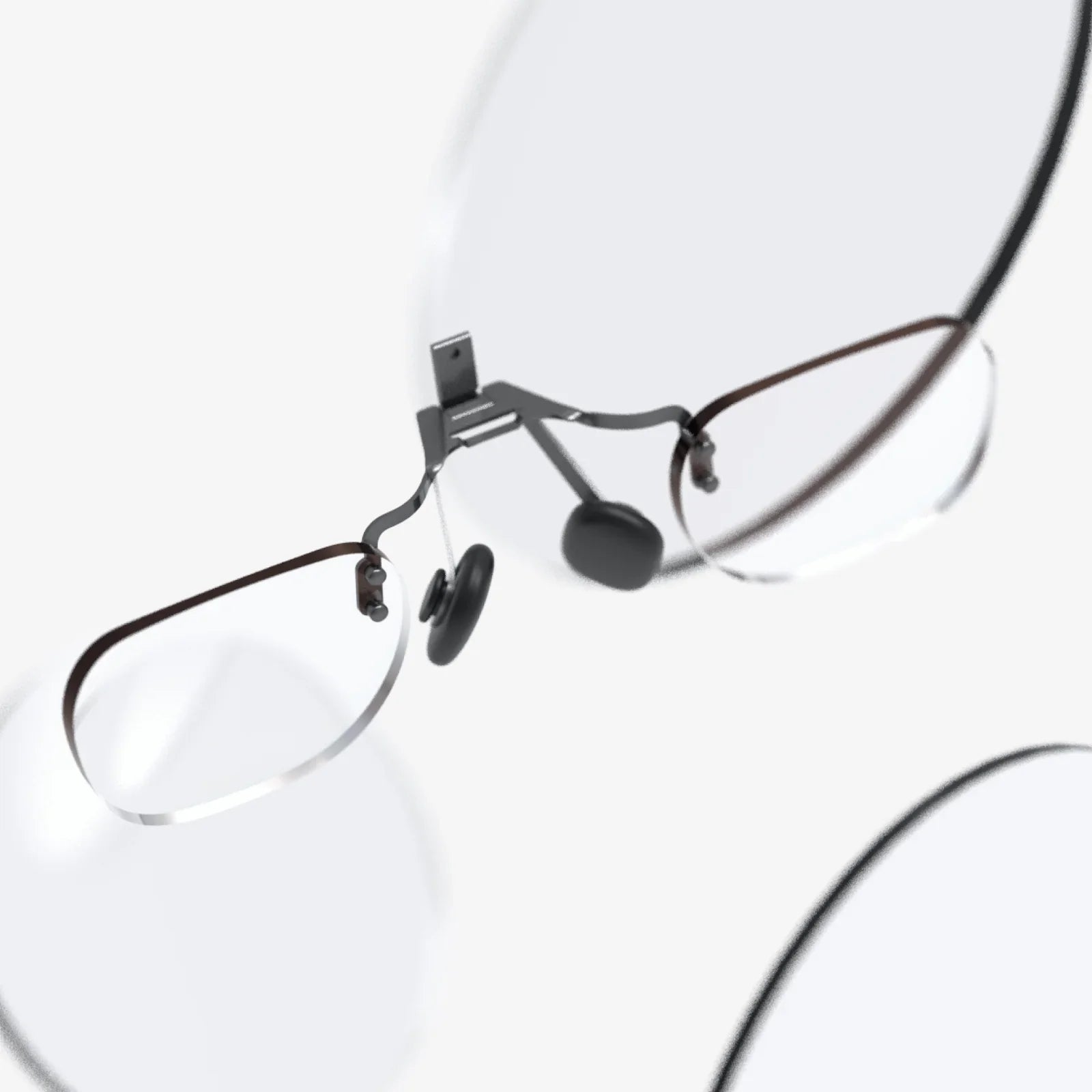
Imagine a world where your computer monitor isn't a piece of glass and metal on your desk but a dynamic, high-resolution overlay on reality itself, accessible anytime, anywhere. This is the promise of the augmented reality glasses monitor, a technological leap that is quietly dismantling our centuries-old reliance on static, rectangular screens. We are standing on the precipice of a fundamental shift in human-computer interaction, moving from looking at a device to looking through a device into an enriched world. This isn't just an upgrade; it's a revolution in how we perceive and interact with digital information, and it's happening right before our eyes.
From Sci-Fi to Reality: The Evolution of the Digital Display
The history of personal computing is, in many ways, the history of the monitor. From the bulky, monochrome cathode-ray tubes of the 1970s to the sleek, ultra-high-definition OLED panels of today, the screen has been our immutable window into the digital realm. Yet, despite incredible advances in resolution, color accuracy, and form factor, the core concept has remained unchanged: a flat, confined pane of glass. The augmented reality glasses monitor shatters this paradigm, proposing a future where the display is untethered, contextual, and integrated seamlessly into our field of view. It represents the next logical step in a long journey towards more intuitive and immersive interfaces.
The concept of augmenting reality with data is not new. Aviation pioneers used primitive head-up displays (HUDs) decades ago, projecting crucial flight information onto the cockpit windshield. However, the miniaturization of components like micro-LEDs, waveguides, and spatial sensors has finally made it possible to condense this powerful technology into a form factor resembling everyday eyewear. This convergence of optics, computing, and sensor technology is what transforms a novel concept into a viable monitor replacement.
Deconstructing the Illusion: How AR Glasses Create a Monitor in Thin Air
At its core, an augmented reality glasses monitor functions through a sophisticated interplay of hardware and software. Unlike virtual reality, which completely replaces your vision with a digital environment, AR seeks to supplement the real world. Here's a breakdown of the key components that make this possible:
- Micro-Displays: These are tiny, incredibly high-resolution screens, often using technologies like Micro-OLED or Laser Beam Scanning, that generate the initial image. They are the equivalent of the pixel matrix in a traditional monitor, but on a microscopic scale.
- Optical Waveguides: This is the true magic. These are transparent lenses etched with nanoscale precision that act like holographic mirrors. They capture the light from the micro-displays and "pipe" it across the lens directly into the user's eye. This allows you to see the digital image superimposed on the real world without blocking your view.
- Spatial Mapping Sensors: An array of cameras, LiDAR scanners, and depth sensors constantly scan the environment. They create a real-time 3D map of the room, understanding the geometry of surfaces, the position of objects, and even hand gestures. This allows the digital content to "lock" onto the physical world.
- Powerful Onboard Compute: All this data processing requires significant power. A miniaturized processing unit within the glasses frame handles the complex tasks of simultaneous localization and mapping (SLAM), gesture recognition, and rendering the graphics.
When you command a virtual browser window to appear, the processors render it, the micro-displays generate it, the waveguides project it onto your retina, and the spatial sensors ensure it stays pinned to the wall you placed it on, even as you move your head. The result is a persistent, stable, and interactive screen that only you can see.
The Ultimate Workspace: Unleashing Productivity Without Boundaries
The most immediate and profound application for augmented reality glasses as a monitor is in the realm of productivity. The traditional desk-bound setup, with its limited number of screens and fixed location, is instantly obsolete.
- Infinite Screen Real Estate: Why be limited to two or three physical monitors? With AR, you can surround yourself with a panoramic array of windows—your email client on the left, your coding environment in the center, a reference guide on the right, and a video call hovering politely to the side. You can resize, move, and dismiss these windows with a gesture or a voice command, creating a truly custom and limitless workspace.
- Contextual Computing: Your digital workspace becomes aware of its surroundings. Instructions for repairing a piece of machinery can be overlaid directly onto the components themselves. A recipe can hover next to the mixing bowl as you cook. Architectural blueprints can be visualized on the empty construction site. The information is no longer isolated on a separate screen; it is contextualized within the task at hand.
- Portability and Privacy: Your entire multi-monitor setup is now with you always—on the train, in a coffee shop, or in a conference room. This enables a level of mobility and focus previously unimaginable. Furthermore, since the display is projected directly into your eyes, your work remains completely private, a boon for those handling sensitive information in public spaces.
Beyond the Desk: Transforming Industries and Experiences
The impact of this technology extends far beyond knowledge workers. Virtually every sector stands to be transformed.
- Healthcare: Surgeons can have vital signs, MRI scans, and procedural guides overlaid on their patient during an operation, without ever looking away from the surgical field. Medical students can practice on detailed, interactive holograms of human anatomy.
- Manufacturing and Field Service: Technicians can see schematics and receive step-by-step guidance while keeping their hands free to work. They can visually identify parts and access their service history instantly, drastically reducing errors and downtime.
- Education and Training: Learning becomes an interactive, immersive experience. History students can witness historical events unfold around them, and mechanics-in-training can see a 3D model of an engine's internals, taking it apart and putting it back together virtually.
- Social Connection and Entertainment: Imagine watching a movie with a friend on another continent, both of you seeing a massive, virtual screen on your respective living room walls. Or playing a board game where the pieces and game board are holograms on your table, visible to all players wearing glasses.
Navigating the Challenges: The Path to Ubiquity
For all its promise, the path to making augmented reality glasses monitors a mainstream reality is fraught with significant hurdles that engineers and designers are racing to overcome.
Technical Hurdles: The dream is a pair of glasses that are indistinguishable from regular eyewear—light, stylish, and with all-day battery life. We are not there yet. Challenges include achieving true all-day battery life without excessive weight, solving the "vergence-accommodation conflict" (where your eyes struggle to focus on images projected at a fixed depth), and expanding the field of view to more closely match human vision. Furthermore, creating displays bright enough to be visible in all lighting conditions, especially bright sunlight, remains a key focus of research.
The Social Hurdle: Technology is only adopted if it is socially acceptable. Walking around in public with a computerized face-worn device still carries a certain stigma and can create social barriers. The design must evolve to become a fashionable accessory people are proud to wear, not a piece of conspicuous tech gear. Normalization will be a gradual process, much like the adoption of Bluetooth earpieces or smartwatches.
The Interface Paradigm: We have spent decades perfecting the interface of the mouse, keyboard, and touchscreen. Interacting with floating holograms via hand gestures, voice, and gaze is a全新的 language. Designing intuitive, fatigue-free, and socially considerate control schemes is one of the most critical software challenges. We need interfaces that feel like magic, not a chore.
A Glimpse into the Future: Where Does This Lead?
The augmented reality glasses monitor is not the end goal; it is a crucial stepping stone. It represents the transition device that will acclimatize us to a world where digital and physical are perpetually intertwined. As the technology matures, we will stop thinking of them as "glasses" at all. They will become a constant, intelligent companion—a fundamental layer of our perception.
Looking further ahead, the technology will likely evolve beyond glasses. Research into contact lenses with embedded displays and even more direct neural interfaces suggests a future where the "monitor" is projected directly into our visual cortex, eliminating the need for any external hardware whatsoever. The distinction between being online and offline will blur into irrelevance, as information becomes an ambient resource, as readily available as the air we breathe.
The journey from the command-line interface to the graphical user interface was monumental. The jump from the GUI to the natural, spatial interface powered by augmented reality is arguably even more profound. It promises to make technology more human-centric, contextual, and empowering. The age of hunched shoulders and screen-induced eye strain is slowly coming to a close, making way for a world where we stand tall, engage with our environment, and interact with data as naturally as we interact with each other. The monitor, as we know it, is fading away, and an entirely new way of seeing and knowing the world is coming into focus.
This isn't just about replacing your screens; it's about reimagining your entire relationship with technology, freeing your digital life from its rectangular prisons and letting it breathe in the world around you. The future isn't on a screen—it's all around you, waiting to be augmented.
Share:
What Is a Virtual Monitor - The Ultimate Guide to Digital Workspace Expansion
The Future of Virtual Offices: Redefining Work, Space, and Human Connection