


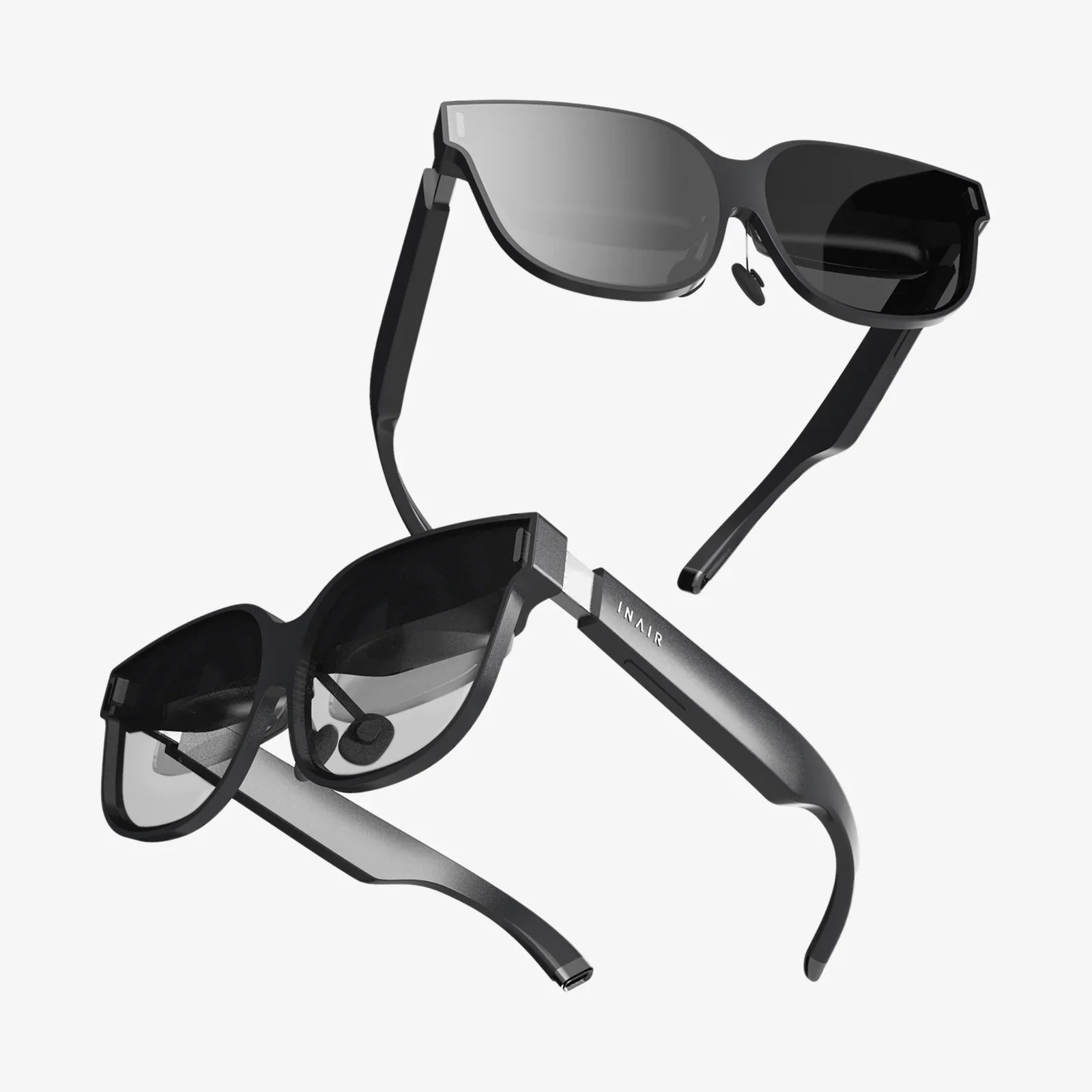
Imagine a world where information is not confined to a screen but is painted onto the very fabric of reality. Where the line between the digital and the physical blurs into irrelevance, and your entire field of vision becomes a dynamic, interactive canvas. This is not a distant science fiction fantasy; it is the imminent future being built today, and it will be delivered through a device that looks deceptively simple: augmented reality glasses.
Beyond the Hype: Defining the True Nature of AR Glasses
To understand the revolution, we must first move beyond simplistic definitions. Augmented reality glasses are not merely wearable displays. They are sophisticated sensory and computational systems designed to perceive, understand, and augment the user's environment in real-time. Unlike virtual reality, which seeks to replace the real world with a simulated one, AR aims to enhance it. The core principle is superposition: layering contextually relevant digital information—text, images, 3D models, animations—onto the user's perspicuous view of their surroundings.
The magic of these devices lies in their intricate hardware symphony. At their heart are several critical components working in concert:
- Optical Systems: This is the window through which the user sees the merged world. Waveguide technology, often using materials like holographic optical elements, is paramount. These transparent lenses channel light from micro-displays located at the temples into the user's eye, projecting a sharp digital image that appears to float in space at a specific depth. The challenge is achieving a wide field of view, high resolution, and brightness suitable for both dim interiors and bright sunlight, all while keeping the form factor sleek and socially acceptable.
- Spatial Mapping Suite: For digital content to feel anchored in the real world, the device must understand the environment with incredible precision. This is achieved through a combination of technologies: stereoscopic cameras for depth sensing, LiDAR scanners that fire out grids of invisible laser dots to measure distances and create a 3D point cloud of the space, and Simultaneous Localization and Mapping (SLAM) algorithms. SLAM allows the glasses to simultaneously map an unknown environment and track their own position within it, ensuring a virtual cat sits convincingly on your real sofa and doesn't drift through it.
- Processing Power: The computational demand is staggering. It involves processing multiple high-resolution video feeds, running complex computer vision models to identify objects and surfaces, rendering high-fidelity graphics, and handling connectivity—all in milliseconds to prevent latency-induced nausea. This requires a blend of onboard processors, often with dedicated chips for AI tasks, and offloaded computation to a paired device or edge cloud servers.
- Control Interface: Without a traditional keyboard or mouse, interaction must be intuitive. This is solved through a combination of voice commands (powered by natural language processing), hand-tracking cameras that interpret gestures as clicks, drags, and swipes, and even subtle neural interfaces or capacitive touchpads built into the frame.
The Invisible Engine: Software and the AR Cloud
Hardware is nothing without the software that brings it to life. The operating system for augmented reality glasses is a paradigm shift in computing. It's a spatial OS that treats the world as its desktop. This software layer manages everything from persistent digital content—imagine leaving a virtual note on a friend's fridge that only they can see—to multi-user experiences where several people can see and interact with the same digital object simultaneously.
The most critical software concept is the AR Cloud. Often described as a digital twin of the real world, the AR Cloud is a persistent, 3D map of the world that is continuously updated and shared across devices. It is the infrastructure that allows digital content to have a permanent, shared location. If you place a virtual statue in a town square, the AR Cloud ensures that every other user who looks at that spot through their glasses sees it in exactly the same place. This shared spatial canvas is what will unlock truly collaborative and persistent augmented experiences, transforming our shared spaces into hybrid digital-physical realms.
Transforming Industries: The Professional Paradigm Shift
While consumer applications capture the imagination, the most immediate and profound impact of augmented reality glasses is occurring in the enterprise and industrial sectors. Here, the value proposition is clear: they provide hands-free access to information and expertise exactly when and where it is needed, drastically improving efficiency, safety, and accuracy.
- Manufacturing and Field Service: A technician performing a complex repair on an aircraft engine can see animated, step-by-step instructions overlaid directly onto the components they are working on. They can stream their first-person view to a remote expert thousands of miles away, who can then draw arrows and circles directly into their visual field to guide them. This reduces errors, slashes training time, and minimizes downtime.
- Healthcare and Medicine: Surgeons can visualize a patient's anatomy—from MRI scans to real-time vital signs—floating above the operating table, eliminating the need to look away at distant monitors. Medical students can learn anatomy by walking through life-sized, interactive 3D models of the human body. Paramedics could receive critical guidance and patient data en route to the hospital.
- Design and Architecture: Architects and interior designers can walk clients through a full-scale, photorealistic holographic model of a building long before the foundation is poured. They can change materials, move walls, and adjust lighting with a gesture, experiencing the space not on a screen, but with their whole body.
- Logistics and Warehousing: Warehouse workers fulfilling orders see the most efficient picking path illuminated on the floor before them, with digital arrows guiding them to the correct shelf. The exact item and quantity needed are highlighted, streamlining the process and virtually eliminating mis-picks.
The Consumer Horizon: Redefining Daily Life
When the technology matures and becomes consumer-ready, augmented reality glasses will redefine our daily rituals and social interactions in ways we are only beginning to comprehend.
- The Demise of the Screen: The smartphone's hegemony will wane. Instead of pulling a device from your pocket, notifications, messages, and incoming calls will appear as subtle, context-aware holograms in your periphery. Navigation will involve arrows painted onto the street, not a map on a phone. The world itself becomes the interface.
- Contextual and Personalized Information: Look at a restaurant, and see its reviews and today's specials materialize next to the door. Look at a historical monument, and witness a reenactment of its history unfold around you. Meet someone at a conference, and a discreet cue could display their name and how you're connected, banishing social awkwardness.
- New Realms of Entertainment and Social Connection: Entertainment will become truly immersive. Instead of watching a movie on a rectangle, you could be sitting in the virtual living room of the characters. Social media will evolve into a shared spatial experience where you and a friend, despite being in different countries, can play a board game on your real table or watch a virtual fireworks display explode in the sky above your respective cities.
The Inevitable Challenges: A Society Under Glass
This powerful technology does not arrive without significant challenges and profound ethical questions that society must urgently address.
- The Privacy Apocalypse: Augmented reality glasses, with their always-on cameras and microphones, represent the most pervasive surveillance apparatus ever conceived. The potential for abuse by corporations and governments is staggering. Who owns the data of what you look at throughout the day? How do we prevent a world where our every glance is tracked, recorded, and monetized? Robust regulatory frameworks, perhaps inspired by concepts of digital anonymity in public spaces, will be essential.
- The Digital Divide 2.0: This technology could create a new, extreme class divide: those who can afford to see an augmented world filled with information and advantage, and those who are trapped in an un-augmented reality. Access to this digital layer could become as critical as access to the internet is today.
- Reality Filtration and Advertising Overload: Will we have the ability to filter out unwanted digital intrusions? If not, our visual reality could become a dystopian nightmare of personalized advertising, spam, and digital graffiti. The right to see the world unadorned may become a fundamental human right we must fight for.
- Psychological and Social Effects: What is the long-term psychological impact of constantly mediating reality through a digital layer? Will it enhance our understanding of the world, or will it cause us to disengage from the subtle, un-augmented beauty of the physical world? How will it change human interaction when we are never quite sure if someone is present with us or distracted by a private digital stream?
The journey of augmented reality glasses is just beginning. The path forward is not merely one of technological refinement, making them smaller, lighter, and more powerful. It is a societal journey. It demands a parallel development of ethical standards, privacy-preserving technologies, and new social contracts. We are building a mirror world, a digital twin of our reality that we will soon perceive as inseparable from the original. The promise is a world of limitless information, boundless creativity, and enhanced human capability. The peril is a loss of privacy, a fragmentation of shared experience, and an overload of the senses. The ultimate design challenge is not in the waveguides or the processors; it is in designing this new layer of reality itself to be humane, equitable, and truly for the benefit of all. The spectacles are being crafted; it is now up to us to decide what we will see through them.
Share:
Augmented Reality Apps for VR Headset: Blending Worlds and Redefining Reality
Android XR Glasses for Sale: Your Portal to the Future of Computing