


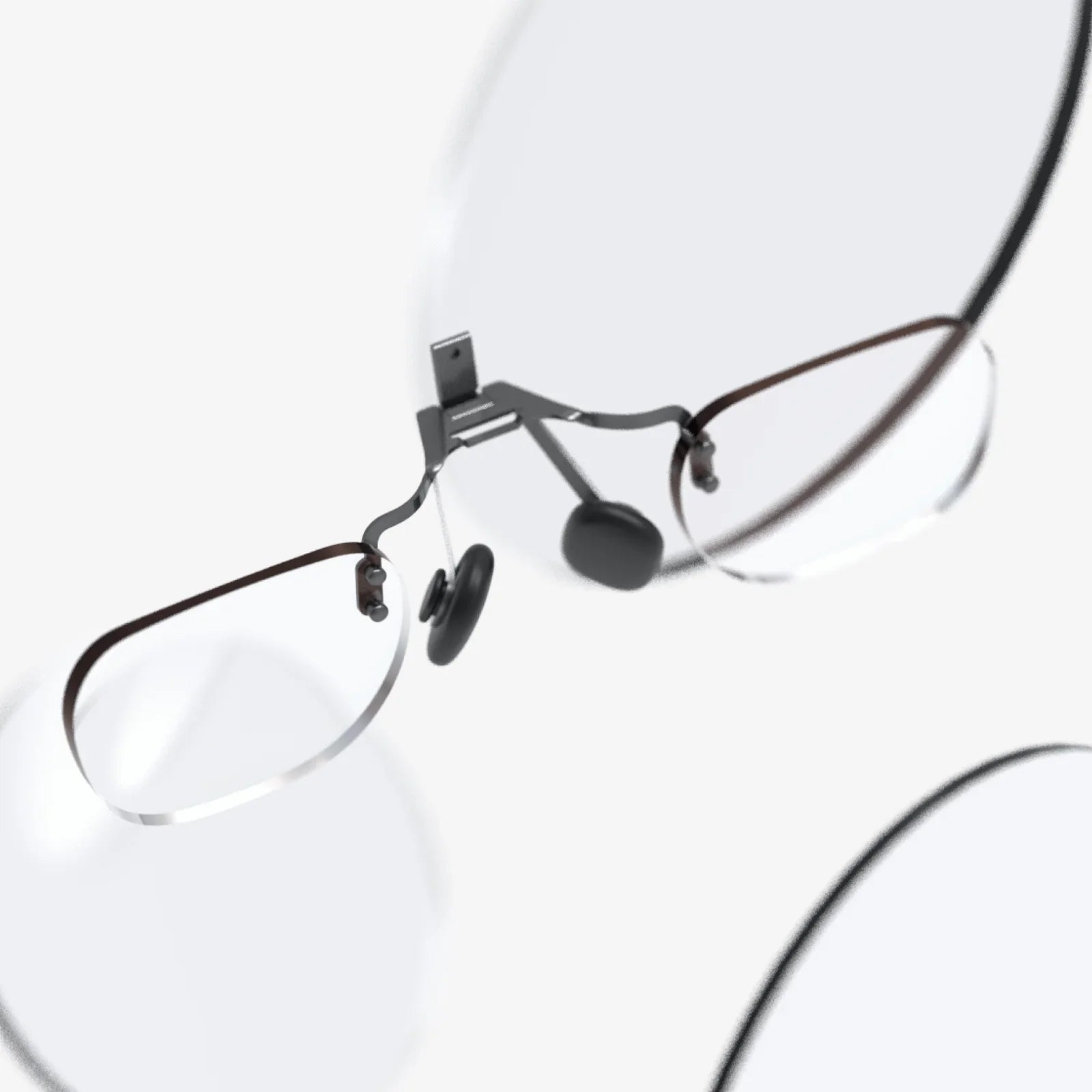
Imagine walking through a ancient Roman ruin, not with a headset that blocks out the world, but with sleek glasses that seamlessly reconstruct the crumbling stones into a bustling, vibrant forum, with senators debating and merchants hawking their wares, all while you still feel the Mediterranean sun on your skin. This isn't a distant sci-fi fantasy; it's the tangible future being built today, a future where the digital and physical universes don't just coexist but coalesce. The year 2025 is poised to be the inflection point where the separate paths of Augmented Reality (AR) and Virtual Reality (VR) finally converge, giving birth to a new, hybrid paradigm that will fundamentally alter the fabric of our daily lives.
The Great Convergence: From Separate Realities to a Unified Experience
For years, AR and VR have been viewed as siblings with distinctly different ambitions. VR offered total immersion, a complete escape into a digital realm, but at the cost of isolating the user from their physical environment. AR, in contrast, layered digital information onto the real world, enhancing it rather than replacing it, but often with limited depth and interactivity. The roadmap to 2025 is not about one technology winning over the other; it's about their inevitable merger. The driving force behind this is a suite of technological advancements reaching maturity simultaneously.
Next-generation wearables will shed their bulky, tethered forms. We are moving towards lightweight, socially acceptable glasses powered by exponentially more powerful and efficient processors. These devices will employ advanced sensor fusion—combining high-fidelity cameras, LiDAR, inertial measurement units (IMUs), and microphones—to understand and map the environment with centimeter accuracy in real-time. This precise spatial awareness is the bedrock upon which persistent digital content can be anchored to our world, not just as a fleeting overlay, but as a permanent, interactive layer of reality.
The Hardware Revolution: Invisible, Powerful, and Always-On
By 2025, the hardware dividing line between AR and VR will have effectively dissolved. The devices we use will be context-aware chameleons. In a fully immersive mode, they can employ electrochromic lenses or advanced light field displays to dynamically occlude the real world, plunging you into a virtual meeting or a game with perfect fidelity. With a gesture or voice command, the same device can transition to a transparent AR mode, allowing the digital and physical to blend.
Key to this will be the resolution and field of view (FOV) of displays, which will finally approach the human visual periphery, eliminating the distracting "binoculars effect" of earlier devices. Furthermore, breakthroughs in varifocal and light field technology will solve the vergence-accommodation conflict, a major source of eye strain and discomfort in current headsets. Your eyes will naturally focus on digital objects at different depths, making them feel as solid and real as the chair in your room. Haptic feedback will evolve beyond simple controller vibrations to include gloves and even full-body suits, providing a tangible sense of touch for digital objects, completing the illusion of presence.
The Software and Connectivity Backbone: 5G, AI, and the Spatial Web
Hardware is nothing without the software and connectivity to power it. The widespread deployment of 5G and eventually 6G networks will be the circulatory system for this new reality. These networks offer the high bandwidth and ultra-low latency required to stream incredibly complex, photorealistic models and environments to devices without requiring overwhelming local processing power. Complex rendering can be offloaded to edge cloud servers, enabling thinner, lighter glasses while delivering stunning visual quality.
Artificial Intelligence is the brain of this operation. AI algorithms will be responsible for real-time object recognition, semantic understanding of environments, and predictive tracking. Your device won't just see a table; it will understand it's a wooden dining table, know its dimensions, and allow you to place a persistent digital chessboard on it that remains there for your next visit. This collective, AI-interpreted understanding of the world is what many are calling the "Spatial Web" or the "Mirrorworld"—a 1:1 digital twin of our physical reality, continuously updated and inhabited by data, avatars, and digital artifacts.
Transforming the World of Work and Enterprise
The enterprise sector will be the earliest and most profound beneficiary of this convergence. The concept of the "virtual office" will evolve from a grid of video calls into a persistent, shared spatial environment. Architects and engineers will walk through life-sized, full-scale holographic models of their designs, making changes in real-time with colleagues from across the globe. A factory technician, wearing AR glasses, will see animated repair instructions overlaid directly on a malfunctioning machine, with a remote expert able to see their view and draw annotations into their space to guide them.
This will dramatically reduce errors, training time, and the need for travel, while democratizing expertise. Fields like remote surgery, complex data visualization for financial analysts, and immersive training simulations for high-risk jobs will become standard practice, increasing safety and efficiency on an unprecedented scale.
Redefining Social Connection and Storytelling
Social interaction will be the next frontier. Platforms will move beyond flat screens to shared spatial experiences. Instead of watching a concert on a monitor, you could have a virtual "seat" in the front row, seeing the performance as a holographic projection in your living room or alongside the avatars of your friends, who are physically in their own homes across the country. The sense of shared presence will be profound.
Storytelling and entertainment will become participatory and contextual. Imagine a mystery story that unfolds in your own city, where clues are hidden as digital artifacts in your local park, and characters appear as holograms on your street corner. Gaming will completely dissolve the boundary between the game world and your world, turning your home into a dungeon to explore and your neighborhood into a global playground shared with other players.
Navigating the Inevitable Challenges
This future is not without its significant challenges and ethical dilemmas. The concept of a "digital identity" will become critical. Your avatar, your digital possessions, and your privacy settings will need to be portable and secure across different platforms and experiences, a challenge the industry is only beginning to address.
The potential for new forms of addiction, misinformation, and reality distortion is immense. A persistent layer of advertising or biased information overlaid on people and places could create powerful subliminal influences. The digital divide could evolve into a "reality divide," separating those who can afford access to these enhanced experiences from those who cannot. Establishing a clear ethical framework, robust cybersecurity, and thoughtful digital etiquette will be as important as the technology itself to ensure this new reality is built for the benefit of all humanity.
The door to a world once confined to our screens is swinging open, inviting us to step into a reality where every surface can be a screen, every object can hold a story, and human connection transcends physical distance. The choices we make today will determine whether this new layer of existence becomes a distracting noise or the most powerful tool for creativity, understanding, and togetherness we have ever invented. The future is not something we enter; it's something we build, and by 2025, we will be building it with both hands, in both realities.
Share:
Mobile Augmented Reality AR Market: A Portal to a New Digital Dimension
AI AR VR Series: The Converging Technologies Reshaping Reality