


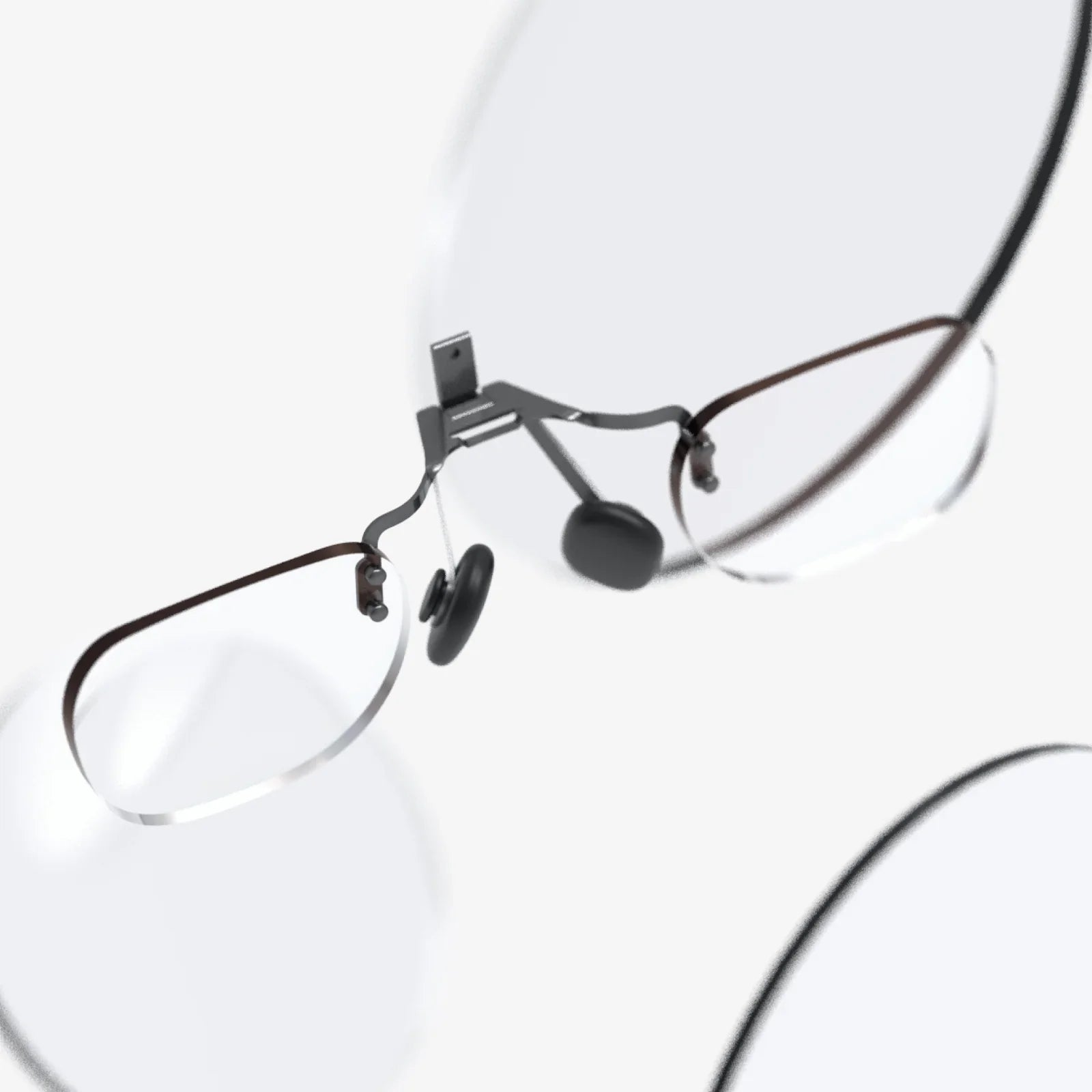
Imagine a world where your workspace isn't confined to the physical monitors on your desk, where digital art isn't limited by canvas size, and where architects can walk clients through unbuilt structures as if they were already standing in them. This is no longer the realm of science fiction but the tangible present and explosive future of better display virtual display technology. We are standing at the precipice of a visual revolution, one that promises to fundamentally alter how we create, consume, and interact with digital information by decoupling it from the constraints of physical hardware.
The Philosophical Shift: From Hardware to Experience
For decades, the pursuit of a 'better display' was a fundamentally physical endeavor. It was a race for more pixels packed into tighter spaces, for higher nit values producing brighter images, and for thinner bezels creating seamless edges. The goal was a superior piece of hardware—a tangible object you could see and touch. Virtual display technology represents a paradigm shift. It redefines 'better' not by the quality of the glass and LEDs in front of you, but by the flexibility, scalability, and immersiveness of the visual experience it generates.
This technology leverages advanced software, powerful processing, and often, wearable hardware like head-mounted displays, to project digital screens and interfaces into a user's field of view. These are not bound by a physical frame. They can be resized, reshaped, moved, and layered with a thought or a gesture. The 'better display' is now an intelligent, dynamic, and context-aware window into any digital dimension, limited only by the software that creates it and the imagination of the user.
Core Technologies Powering the Virtual Revolution
The leap from concept to reality is powered by a convergence of several cutting-edge technologies, each playing a critical role in stitching the digital and physical worlds together seamlessly.
High-Resolution Microdisplays and Optics
At the heart of any head-worn virtual display system are micro-displays—tiny, incredibly dense screens that project images directly into the user's eyes through a complex system of lenses and waveguides. The quest for a 'better display' here is measured in pixels-per-degree (PPD), a metric that defines the sharpness and clarity of the virtual image. Early systems suffered from the 'screen door effect,' where users could see the gaps between pixels. Today, advancements have all but eliminated this, creating crisp, continuous virtual screens that feel as real as their physical counterparts.
Advanced Tracking and Spatial Computing
For a virtual display to feel stable and integrated into the user's world, the system must understand its environment and its own position within it. This is the domain of inside-out tracking, using cameras and sensors to map the room and six-degrees-of-freedom (6DoF) tracking to understand the precise movement of the user's head. This allows virtual screens to be 'pinned' to a wall or desk, remaining locked in place as the user moves around, creating a persistent and reliable digital workspace.
Computational Power and Low-Latency Data Transmission
Rendering multiple high-resolution virtual displays in real-time requires immense computational power. This processing can happen on a connected workstation, a powerful mobile processor within the device itself, or increasingly, be streamed from the cloud. The critical factor is latency—the delay between a user's input and the visual response. Any perceptible lag shatters the illusion and causes discomfort. The relentless march of processor technology and high-speed data protocols is making high-fidelity, low-latency virtual displays a commercial reality.
Transforming Industries: Use Cases Beyond Imagination
The theoretical applications of virtual displays are vast, but their practical impact is already being felt across numerous professional and creative fields.
The Ultimate Workspace: Productivity Unchained
For knowledge workers, virtual displays offer liberation from the multi-monitor setup. Instead of three physical screens, a professional can don a lightweight headset and instantly be surrounded by a curated array of virtual desktops—a email client here, a coding environment there, a reference browser floating off to the side. This environment is portable, consistent, and infinitely customizable. It travels with the user, turning any coffee shop, airport lounge, or home office into an ideal, distraction-free cockpit for digital work.
Design and Engineering: Prototyping in the Air
Industrial designers, architects, and engineers are using virtual displays to visualize and manipulate 3D models at full scale. An automotive designer can examine a full-size virtual prototype of a car's interior, checking sight lines and ergonomics without ever milling a single piece of clay. An architect can walk a client through the immersive, life-size plans of a new building, making changes to the virtual structure in real-time based on feedback. This 'better display' is not just for viewing; it's an interactive medium for creation.
Healthcare and Medicine: Seeing the Unseeable
In medicine, virtual displays are becoming a powerful tool for both diagnosis and surgery. A surgeon can have vital signs, MRI scans, or ultrasound imagery overlaid directly onto their field of view during a procedure, keeping their focus entirely on the patient rather than glancing at distant monitors. Medical students can practice complex procedures on detailed virtual anatomies, reducing risk and improving learning outcomes. The technology allows professionals to see data and anatomy in context, enhancing precision and understanding.
Education and Training: Immersive Learning
Virtual displays can transport students to ancient Rome, the surface of Mars, or inside the human circulatory system. This experiential learning creates deeper engagement and retention than any textbook or traditional screen could offer. Training for high-stakes professions, from aircraft mechanics to emergency responders, can be conducted safely and repeatedly in photorealistic virtual environments, preparing individuals for real-world scenarios without real-world consequences.
The Human Factor: Challenges and Considerations
Despite the exciting potential, the path to widespread adoption of virtual displays is not without its obstacles. Addressing these human-centric challenges is crucial for the technology to move from a niche tool to a mainstream platform.
Ergonomics and Comfort
The hardware must become lighter, more comfortable, and less obtrusive for all-day wear. Current generations are a vast improvement over their predecessors, but the ideal form factor—something akin to a pair of everyday glasses—is still on the horizon. Battery life is another critical factor; the power required to drive high-resolution displays and spatial computing is significant, and users will not tolerate being tethered to a wall outlet for hours on end.
Social Acceptance and the 'Cyborg' Stigma
Walking into a meeting or a public space wearing a head-mounted display is still a conspicuous act. There is a social barrier to overcome, a stigma associated with being disconnected from immediate physical surroundings. The technology will need to evolve to better signal user intent (e.g., transparent lenses that show the user's eyes) and facilitate more natural interactions with people who are not using the technology.
Privacy and Data Security
These devices, by their very nature, are equipped with cameras and sensors that are constantly scanning the environment. This raises profound questions about data collection. What happens to the spatial maps of your home or office? Could this data be used for unauthorized surveillance? Establishing clear, transparent, and robust data privacy frameworks is not just a legal necessity but a prerequisite for earning the trust of consumers and enterprises.
The Horizon: What Does the Future Hold?
The trajectory of virtual display technology points toward a future where the line between the digital and physical is not just blurred but erased. We are moving towards photorealistic graphics, driven by real-time ray tracing, that are indistinguishable from reality. Haptic feedback technology will evolve to allow us to 'feel' virtual interfaces. Brain-computer interfaces, though further out, hint at a future where we might control and manipulate these displays with neural commands alone.
The ultimate goal is not to replace the world with a virtual one, but to augment our reality with a graceful, useful, and intelligent digital layer. The 'better display' of tomorrow will be the world itself, enhanced with contextually relevant information, beautiful digital art, and powerful tools that appear exactly when and where we need them.
The screens that have defined the digital age are beginning to fade away, not into obsolescence, but into a new, more powerful form. They are shedding their physical shells to become boundless, intelligent, and deeply personal companions in our daily lives. This isn't just an upgrade to your monitor; it's an upgrade to your reality, offering a canvas limited only by the boundaries of human creativity itself. The era of staring at a glass rectangle is ending; the era of living within a dynamic digital universe is just beginning.
Share:
Multi Screen Desktop Computer: The Ultimate Guide to Unlocking Unprecedented Productivity
3D Reality Goggles: A Portal to New Worlds and the Future of Human Experience