


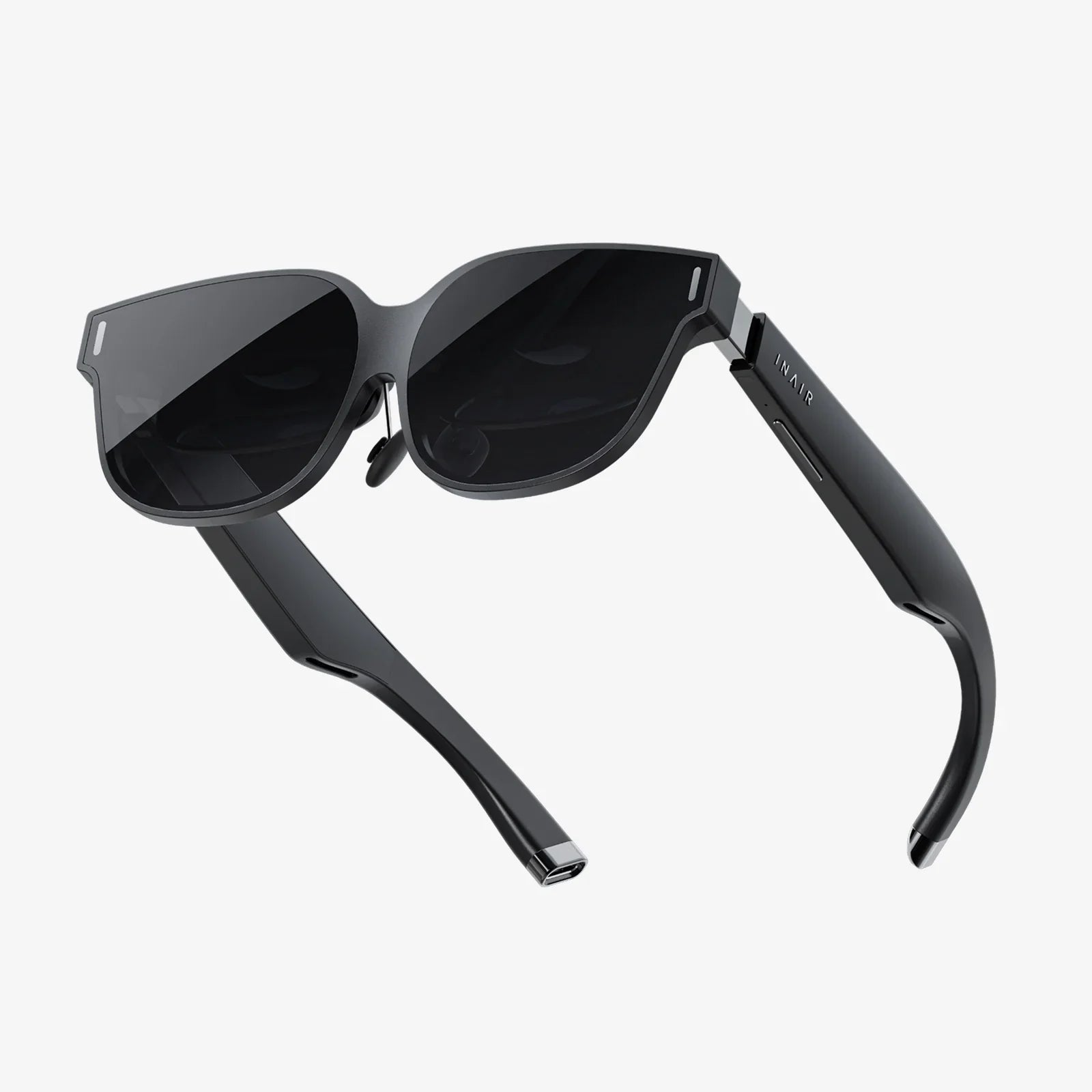
Imagine a world where digital information doesn't live on a screen in your hand, but is seamlessly painted onto the fabric of your reality—a world where your glasses can translate street signs, overlay navigation arrows onto the pavement, or bring a historical figure to life in the middle of a museum. This is the promise of augmented reality glasses, a technology whose history is not a recent phenomenon but a decades-long saga of brilliant failures, breathtaking prototypes, and a relentless pursuit of a vision first born in the pages of science fiction. The path from fantastical concept to a tangible device on your face is a story worth telling, a chronicle of human ingenuity that is only now beginning to reach its potential.
The Seeds of an Idea: Fiction Before Function
Long before engineers and programmers could even dream of the necessary components, storytellers and inventors were conceptualizing the fusion of the real and the virtual. The foundational ideas for augmented reality glasses were sown in the rich soil of imagination.
In 1901, L. Frank Baum's classic novel, The Master Key, introduced the concept of "character markers," a set of spectacles that could reveal a person's inner character—a moral augmented reality, if you will. This was perhaps the first literary mention of glasses that could overlay information onto the real world. Decades later, the concept was cemented in popular culture by science fiction auteurs. In 1968, Stanley Kubrick's 2001: A Space Odyssey depicted astronauts using data-filled displays, while countless other stories envisioned a future where information was instantly accessible and visually integrated into our field of view. These narratives did more than just entertain; they provided a blueprint and an inspiration for a generation of scientists and technologists.
The Dawning Era: Head-Mounted Displays and the Birth of AR
The transition from fiction to function began not with consumer gadgets, but within the cloistered walls of government and university research laboratories. The goal wasn't entertainment; it was solving complex problems for pilots, mechanics, and soldiers.
The true genesis of head-mounted display technology is widely credited to Ivan Sutherland. In 1968, at Harvard University, Sutherland and his student Bob Sproull created what he called "The Sword of Damocles." This was not AR as we know it today, but rather a head-mounted display (HMD) that presented simple computer-generated wireframe graphics. The system was so monstrously large and heavy that it had to be mechanically counterbalanced from the ceiling, hence its ominous name. It was a primitive, terrifying, and utterly revolutionary device. Sutherland himself called it "the ultimate display," envisioning a window into a virtual world. While it was primarily a virtual reality system, its principles of head-tracked, stereoscopic 3D graphics laid the absolute cornerstone for all future augmented and virtual reality headsets.
Throughout the 1970s and 1980s, research continued, primarily funded by the U.S. Air Force and NASA. The focus was on creating heads-up displays (HUDs) for fighter pilots, projecting critical flight data onto their cockpits so they wouldn't have to look down at their instruments. This was a form of augmented reality, but it was fixed within the cockpit environment. The challenge was making this technology mobile, untethering it from the airplane and putting it onto a person's head.
Defining the Dream: The Formative 1990s
The 1990s marked a critical turning point. The technology finally got its name, and the first true AR systems that we would recognize today began to emerge from research labs.
In 1990, Boeing researcher Tom Caudell, while working on a project to simplify the assembly of aircraft wiring harnesses, coined the term "augmented reality." He and his colleague David Mizell proposed using a head-mounted, see-through display to overlay digital diagrams and instructions onto the physical wiring boards, thereby guiding workers through the complex process. This was a practical, industrial application that perfectly demonstrated the value of AR.
This decade also saw the creation of some of the most influential early AR prototypes. In 1992, Louis Rosenberg developed the Virtual Fixtures system for the U.S. Air Force. This was a complex robotic system that used an exoskeleton and a see-through HMD to allow users to manipulate objects in a remote environment, with virtual visual guides enhancing their precision—a pioneering example of AR for telepresence and training.
Perhaps the most significant milestone of the era came in 1999 with the work of Hirokazu Kato, who released the ARToolKit. This open-source software library allowed developers to use video tracking to overlay virtual imagery onto physical objects, using simple black-and-white printed markers. For the first time, AR development was democratized. Researchers and hobbyists around the world could now experiment with AR without needing millions of dollars in military funding, sparking a wave of innovation and academic research that continues to this day.
The Mobile Bridge: The 2000s and the Smartphone Revolution
The early 2000s were a period of quiet refinement. AR glasses remained bulky, expensive, and confined to industrial and research applications. However, the seeds for their future were being planted in an unexpected place: the mobile phone.
The rise of smartphones in the late 2000s provided a perfect storm of enabling technologies for AR. Suddenly, everyone had a powerful computer in their pocket, complete with a high-resolution screen, a camera, GPS, an accelerometer, and a gyroscope. Developers realized they could use the phone's camera to capture the real world and its sensors to understand the device's position and orientation, allowing them to overlay graphics onto the screen. This was "markerless" AR, using the world itself as the canvas.
Apps became the new vehicle for AR experiences. While not glasses, they introduced millions of people to the core concept of augmented reality through games that placed characters on their kitchen table or navigation apps that superimposed directions onto a live street view. This widespread adoption was crucial. It proved there was a market for AR, acclimated the public to the technology, and forced rapid advancements in computer vision and processing power—all essential ingredients for the next generation of dedicated AR glasses.
A New Hope: The Modern Era and the Race to Your Face
Building on the smartphone's foundation, the 2010s witnessed an explosion of activity aimed squarely at creating viable consumer AR glasses. The race was officially on, marked by a pivotal moment that captured the world's attention.
In 2013, a startup unveiled a stunning prototype of high-tech glasses through a breathtaking demo video. While the product itself would later face well-documented challenges and ultimately fail to become a consumer hit, its impact was seismic. It was the first time a pair of AR glasses looked sleek, modern, and desirable. It moved the concept out of the realm of science fiction and military hardware and into the realm of consumer technology and fashion. It showed the world what was possible and ignited the ambitions of the entire tech industry.
This event triggered an arms race. Tech giants established dedicated divisions for AR research and development, acquiring startups and pouring billions into solving the immense technical challenges: creating displays bright enough to be seen in daylight but small enough to fit in a glasses frame, developing new waveguides and holographic optics to project images onto the lenses, perfecting spatial mapping to understand the user's environment, and managing the intense thermal and power constraints. The focus shifted from mere possibility to practicality, wearability, and finding a "killer app" that would make them indispensable.
The State of the Art and the Invisible Hurdles
Today, the landscape of augmented reality glasses is stratified. On one end, we have powerful enterprise-grade devices. These are used by field service technicians to get remote expert guidance, by warehouse workers for hands-free order picking, by surgeons for visualizing medical scans during procedures, and by architects for visualizing buildings on empty plots of land. They are rugged, capable, and delivering tangible value, justifying their high cost.
On the consumer end, the market is still evolving. Current offerings often take the form of simpler smart glasses focused on audio and notifications, or more advanced devices targeted primarily at developers and early adopters. The holy grail of a lightweight, affordable, all-day wearable that seamlessly blends the digital and physical worlds for the average consumer remains just out of reach, but the progress is undeniable.
The remaining challenges are profound. Beyond the technical hurdles of battery life and display technology, there are major questions around design, social acceptance, and privacy. Will people be willing to wear glasses with cameras in social situations? How do we prevent these devices from becoming the ultimate surveillance tool? Establishing norms and ethical guidelines is as important as refining the silicon and algorithms.
Gazing into the Future: The Next Chapter
The historical arc of augmented reality glasses points toward a future where they become as ubiquitous as smartphones. The next breakthroughs will likely come in materials science, with meta-optics and new nanofabrication techniques creating thinner, more efficient lenses. Artificial intelligence will play a massive role, acting as an intelligent filter for the world, proactively providing only the most relevant and useful information. The concept of the "spatial web" or "metaverse" suggests a future where digital objects and information have a persistent place in the real world, accessible and interactive through AR glasses.
We are moving toward a world where the physical and digital realms are no longer separate. This integration promises to revolutionize how we learn, work, connect, and play. It will change everything from how we navigate cities to how we care for our health, offering contextually aware information exactly when and where we need it.
The journey of augmented reality glasses, from the terrifying Sword of Damocles to the sleek prototypes of today, is a testament to a stubborn and enduring vision. It's a history not just of circuits and code, but of human imagination—a relentless effort to build a better window to our world and to the worlds we have yet to create. The next time you see someone wearing a pair of high-tech spectacles, remember you are not just looking at a product, but at the latest chapter in a story over half a century in the making, a story that is finally moving from the lab to the streets, and is poised to redefine reality itself.
Share:
Best Earphones for Virtual Meetings: Your Ultimate Guide to Crystal-Clear Communication
Full Screen Virtual Monitor The Ultimate Guide to a Borderless Digital Workspace