


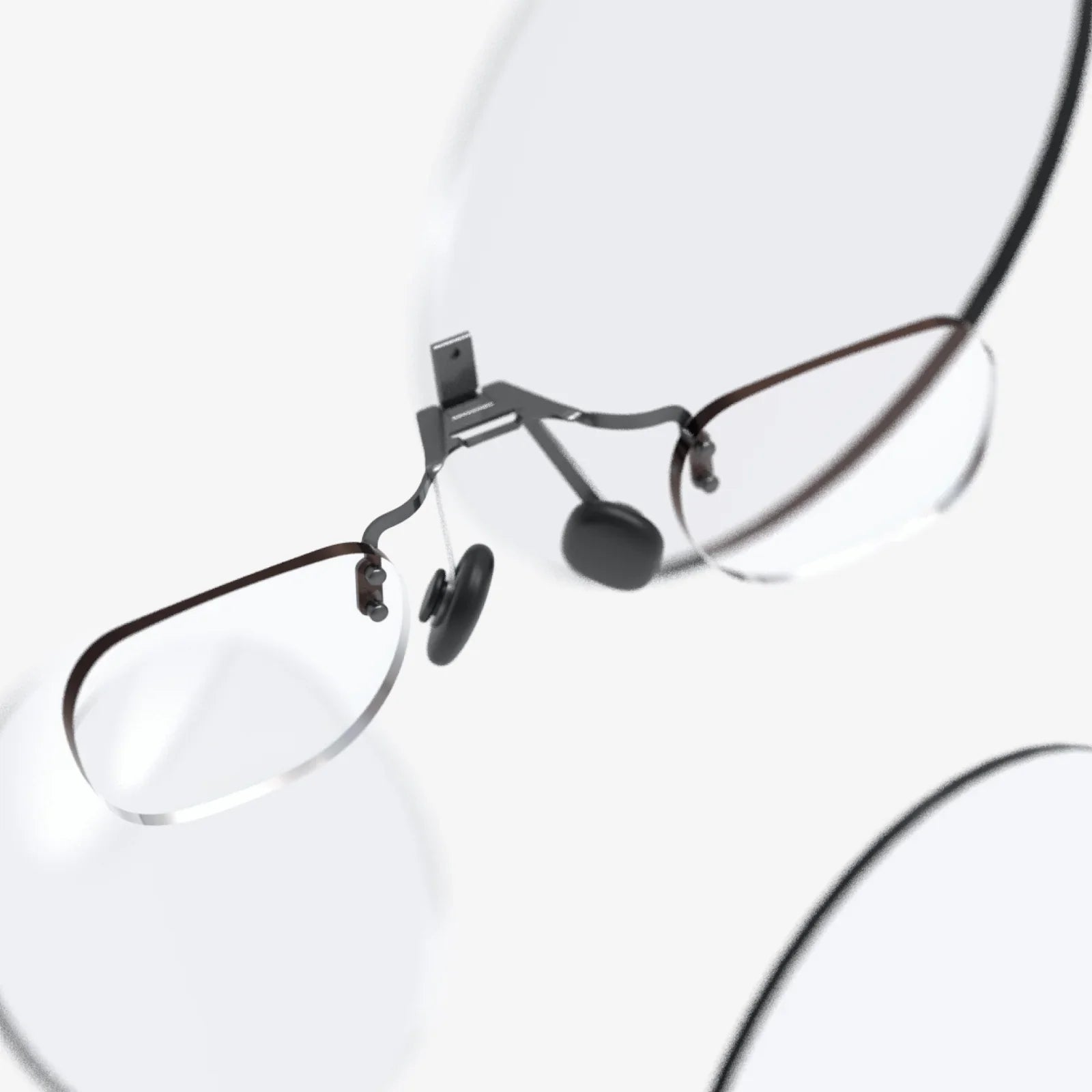
Imagine a world where the line between the digital and the physical doesn't just blur—it disappears. Where information doesn't live on a screen in your pocket but is painted onto the very fabric of your reality, accessible with a glance, a gesture, or a spoken word. This is the promise, and increasingly the reality, of innovative augmented reality. It’s a technological leap that is poised to reshape everything from how we work and learn to how we connect and create, moving far beyond novelty filters into a foundational shift in human-computer interaction. The future is not just something we will look at on a display; it is something we will live and breathe, layered seamlessly over our own world.
Beyond the Gimmick: The Core of AR Innovation
For many, their first encounter with augmented reality was a whimsical face filter or a popular game that placed digital creatures in local parks. While these applications captured the public's imagination, they merely scratched the surface of the technology's potential. Innovative augmented reality is not about superimposing a static digital object onto a camera feed; it is about creating persistent, interactive, and context-aware digital experiences that understand and respond to the real world.
The innovation lies in the sophisticated convergence of several advanced technologies. Modern AR systems leverage complex computer vision algorithms that can map a room in real-time, understanding the geometry of surfaces, the position of objects, and even the quality of light. Simultaneous Localization and Mapping (SLAM) technology allows devices to understand their position within a space without prior knowledge, creating a dynamic digital twin of the environment. This spatial awareness is what separates a gimmick from a genuine tool. When a digital character can realistically hide behind your physical sofa, or an instruction manual can visually highlight the exact screw on a machine that needs tightening, the experience becomes truly immersive and functional.
Furthermore, the integration of artificial intelligence and machine learning has supercharged AR's capabilities. AI can identify objects within the camera's view—is that a specific model of car, a type of plant, or a historical monument?—and retrieve relevant information to display instantly. Machine learning enables gesture and voice control, creating intuitive interfaces that free users from traditional input devices. This powerful combination of spatial computing and AI is the engine driving the most groundbreaking AR applications today, transforming abstract data into a tangible, interactive overlay on our lives.
Revolutionizing Industry: The AR-Powered Workforce
While consumer applications are flashy, some of the most impactful innovations in augmented reality are happening on factory floors, in operating rooms, and at construction sites. Here, AR is not for entertainment; it is a critical tool for enhancing efficiency, safety, and precision, delivering a rapid return on investment.
Transforming Manufacturing and Maintenance
In complex manufacturing and repair environments, AR heads-ups displays can project schematics, torque values, and step-by-step instructions directly into a technician's field of view. A worker servicing a jet engine, for instance, can see digital arrows pointing to specific components, animated videos showing the disassembly process, and real-time data from connected Internet of Things (IoT) sensors overlaid on the physical machinery. This hands-free access to information drastically reduces errors, slashes training time for new employees, and improves overall safety by allowing workers to keep their focus on the task at hand rather than constantly glancing down at a paper manual or tablet.
Advancing Medical Practice and Training
The field of medicine is experiencing a paradigm shift thanks to innovative AR. Surgeons can now wear AR glasses that overlay critical patient information, such as heart rate and blood pressure, without looking away from the operating field. More profoundly, AR can project 3D reconstructions of a patient's anatomy from CT or MRI scans directly onto their body, acting as a navigational guide during complex procedures. This provides an unparalleled “X-ray vision,” allowing for more precise incisions and better outcomes. For medical training, AR enables students to interact with detailed, life-size holograms of the human body, practicing procedures and understanding anatomy in ways that textbooks or cadavers could never allow.
Designing and Building the Future
Architects, engineers, and construction professionals are using AR to bridge the gap between the blueprint and the physical world. With AR, they can project full-scale 3D models of their designs onto an empty construction site, allowing clients and teams to “walk through” a building before a single foundation is poured. This facilitates better design decisions, early detection of potential clashes between systems (e.g., plumbing and electrical conduits), and more accurate construction. This ability to visualize the finished product in situ minimizes costly changes and delays, revolutionizing the entire design-build lifecycle.
Reshaping Commerce and Retail
The way we shop is being fundamentally reimagined through innovative augmented reality. The dreaded “buyer's remorse” associated with online shopping is being eliminated by AR's try-before-you-buy capabilities. Customers can use their smartphones or tablets to see how a new sofa would look in their living room, accurately gauging its size, color, and style against their existing décor. Similarly, AR allows users to ‘try on’ glasses, makeup, and clothing virtually, increasing consumer confidence and reducing return rates for retailers.
This technology is also creating immersive in-store experiences. Pointing a device at a product on a shelf could trigger an AR experience showing detailed specifications, demonstration videos, or user reviews. For the fashion industry, AR mirrors in fitting rooms can allow shoppers to see an outfit in different colors or styles without physically changing, streamlining the decision-making process. This fusion of the digital and physical retail spaces is creating a more engaging, informative, and personalized shopping journey.
The New Frontiers of Education and Storytelling
Innovative augmented reality has the power to turn any space into a dynamic classroom or a captivating theater. Educational AR applications can bring textbooks to life; a chapter on astronomy can see students navigating the solar system in their classroom, while a history lesson can include AR reenactments of famous events on the school playground. This interactive, visual learning promotes deeper understanding and retention by transforming abstract concepts into tangible experiences.
In the realm of art and storytelling, AR is creating entirely new narrative forms. Museums are overlaying digital information, reconstructions, and animations onto exhibits, providing richer context for artifacts. Artists are creating site-specific digital sculptures and paintings that can only be viewed through an AR device, challenging our notions of art and its canvas. This technology allows for stories to be told in and about a location, creating a powerful connection between narrative and place that was previously impossible.
Navigating the Challenges: The Path to Ubiquity
Despite its immense potential, the path to widespread adoption of innovative augmented reality is not without significant hurdles. For the technology to move from specialized professional use to a seamless part of daily life, several challenges must be addressed.
Hardware Limitations: Truly immersive AR requires devices that are socially acceptable, comfortable to wear for long periods, and provide a high-fidelity visual experience. Current hardware often struggles with limited field of view, battery life, and processing power. The ultimate goal is a pair of sleek, lightweight glasses that can deliver high-resolution graphics without tethering to a powerful computer, a feat that requires advancements in display technology, battery efficiency, and miniaturization.
Spatial Awareness and Interaction: For AR to feel truly magical, digital objects must interact with the physical world in believable ways. This means perfecting occlusion (where a real object blocks a digital one), understanding complex physics like reflection and shadow, and enabling nuanced gesture and eye-tracking controls. These are immense computational challenges that are at the forefront of AR research and development.
The Privacy Paradigm: AR devices, by their very nature, are equipped with cameras and sensors that constantly scan their environment. This raises profound questions about data collection, user privacy, and surveillance. Who has access to the video feed from your glasses? How is data about your home and habits being used? Establishing clear, transparent, and ethical guidelines for data security and privacy is paramount to earning public trust.
The Digital Divide: As with any transformative technology, there is a risk that AR could exacerbate existing social and economic inequalities. Ensuring equitable access and preventing the creation of an information gap between those who can afford advanced AR tools and those who cannot will be a critical societal challenge.
A Glimpse into the AR-Driven Future
Looking ahead, the trajectory of innovative augmented reality points toward a world where the technology becomes an invisible, indispensable utility. We are moving toward a future of the “permanent personal assistant,” where contextual information is always available to enhance our cognitive and physical abilities. Navigation will involve arrows painted onto the street, language barriers will dissolve with real-time translation overlaid on signs and conversations, and connecting with friends in a crowded place will be as simple as seeing their name floating above their head.
The concept of the “metaverse,” a persistent network of shared digital spaces, is intrinsically linked to AR. Rather than being a purely virtual reality to escape into, the most compelling vision of the metaverse is one that is anchored and enhanced by our physical reality—a world where digital art is displayed on your walls, meetings are held with remote colleagues appearing as holograms around your table, and games are played across your entire neighborhood. AR is the portal that will make this layered existence not only possible but natural and intuitive.
The potential is limitless, bounded only by our imagination and our commitment to developing this technology responsibly. We are standing at the precipice of a new era of human experience, one where our reality becomes a customizable, interactive, and infinitely enriched canvas. The next great interface won't be a new piece of glass; it will be the world itself, and we are only just beginning to learn how to paint on it.
This isn't just the next step in tech evolution; it's the beginning of a fundamental rewiring of human perception, offering a glimpse into a future where the digital and physical coexist so harmoniously that you'll wonder how you ever navigated the world without that seamless, intelligent layer of information guiding your every move. The world is about to get a major upgrade, and it will change everything.
Share:
AI Glasses Canada: The Future of Wearable Tech on Your Face
Best Augmented Reality Devices 2025: The Ultimate Guide to the Future on Your Face