


Imagine a world where your digital and physical realities are so seamlessly intertwined that the line between them ceases to exist—this is no longer the stuff of science fiction, but the palpable future being built in labs and startups across the globe in 2025. The convergence of artificial intelligence, advanced optics, and neural interfaces is accelerating at a breathtaking pace, promising to fundamentally alter how we work, connect, learn, and perceive the world around us. The next era of human-computer interaction is dawning, and it’s arriving not through a screen, but through the very air we breathe.
The Hardware Revolution: Beyond Bulky Headsets
The most immediate and visible shift in 2025 is the radical evolution of hardware. The dream of sleek, socially acceptable, and all-day wearable devices is rapidly becoming a reality.
Optical Breakthroughs: Waveguide technology has seen monumental improvements. New metasurface lenses, engineered at the nanoscale, manipulate light with unprecedented efficiency. This allows for dramatically thinner and lighter form factors, finally moving away from the cumbersome visors of the past. These advanced optics also solve the longstanding issue of vergence-accommodation conflict (VAC), which caused eye strain and visual fatigue. Now, digital objects can more naturally occupy physical space, appearing at fixed depths that the human eye can comfortably focus on, a critical step for prolonged use.
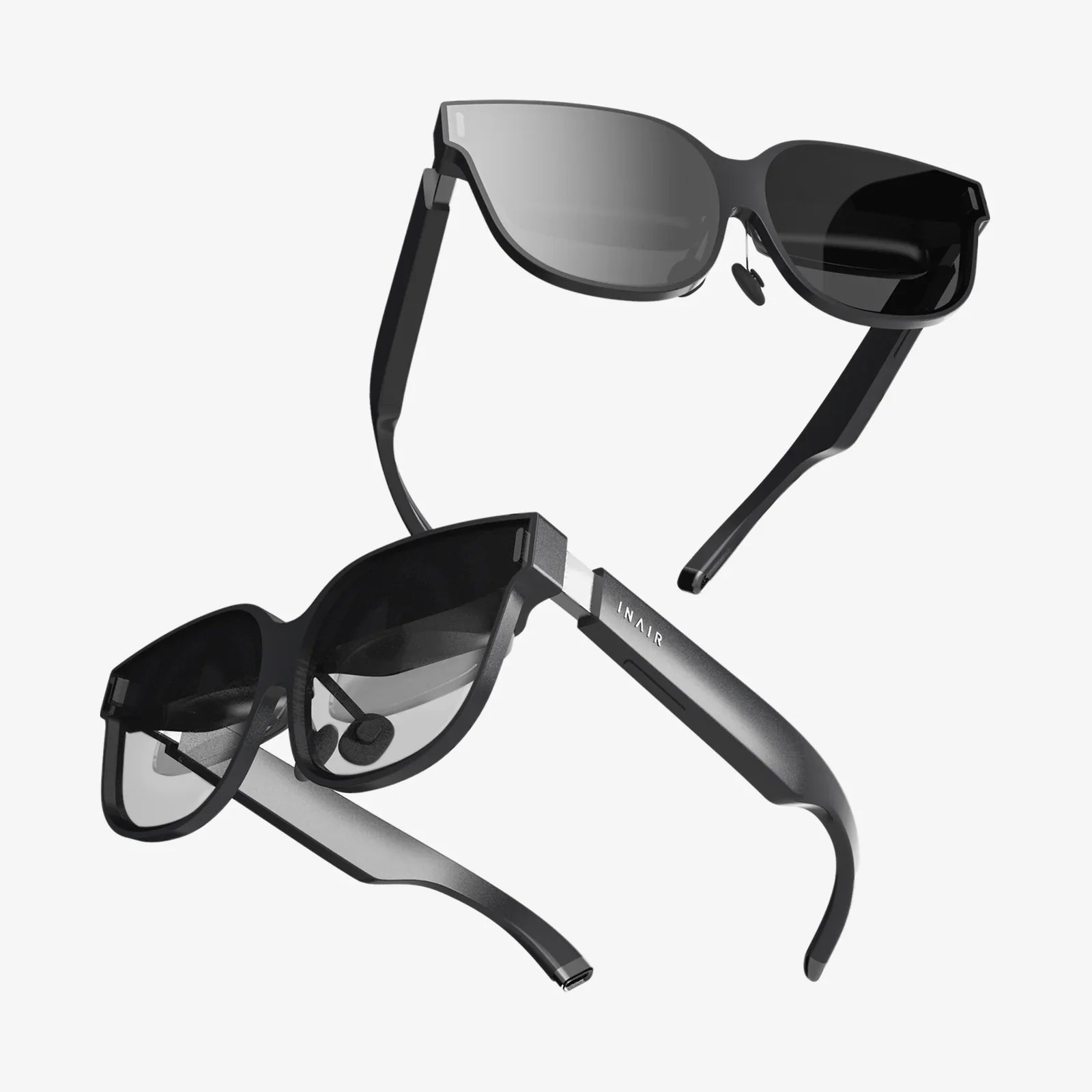
The Form Factor Split: The market is crystallizing into two distinct paths. On one end, we have high-performance mixed reality headsets powered by on-device AI chipsets. They are still the most powerful, offering full-color, high-resolution passthrough with incredibly low latency, making the blended reality experience truly convincing. On the other end, we see the meteoric rise of AR-enabled smart glasses. These resemble standard eyewear but project contextual information, notifications, and simple holograms directly onto the retina via micro-LED projectors. Their all-day battery life and unassuming design are key to driving mass adoption beyond niche enthusiasts.
Sensory Expansion: Haptics have evolved far beyond simple controller vibrations. We now see widespread adoption of ultra-haptics technology, which uses targeted ultrasound waves to create the sensation of touch in mid-air. Users can feel the texture of a virtual button or the recoil of a digital tool. Furthermore, wearable haptic suits and gloves are becoming more refined and affordable, providing full-body tactile feedback for deeply immersive training and social experiences.
The AI Engine: The Invisible Brain Powering XR
If the hardware is the body of AR/VR/MR, then artificial intelligence is its brain. In 2025, AI is not just an enhancement; it is the fundamental fabric that makes advanced spatial computing possible.
Scene Understanding and Semantic Recognition: Early AR systems could place objects in a room but didn't truly understand it. Today's devices use on-device neural processing to perform real-time semantic segmentation. Your glasses don't just see a flat surface; they instantly recognize it as a "wooden table," a "marble countertop," or a "fabric couch." They understand spatial audio, differentiating between a person speaking, a TV in the background, and a running faucet. This deep environmental understanding allows digital content to interact with the physical world intelligently—a virtual ball can convincingly bounce off a real sofa, and a digital character can sit naturally in an empty chair.
Generative Worlds and Avatars: AI is now the ultimate world builder. Procedural generation, supercharged by diffusion models, allows for the creation of vast, complex, and unique virtual environments in milliseconds. More impressively, generative AI for avatars has reached photorealistic quality. These avatars are not pre-animated; they are driven in real-time by the user's voice, facial expressions, and body language, captured by tiny embedded sensors. This enables authentic, emotionally resonant communication in virtual spaces, making remote interactions feel startlingly present and human.
Personalized Spatial Agents: The concept of a digital assistant has been transformed. Instead of a voice from a smart speaker, users interact with embodied AI agents that exist in their AR or VR space. These agents can visually point out objects, pull up relevant information overlaid on the real world, and guide complex tasks hands-free, from repairing machinery to learning a new recipe in the kitchen.
The Connectivity Backbone: 5G-Advanced and Ambient Computing
The computationally intensive nature of these experiences demands a robust and invisible network. The rollout of 5G-Advanced networks in 2025 provides the essential backbone.
This enhanced standard offers significantly lower latency (under 5ms) and higher reliability, crucial for ensuring that virtual elements don't lag behind the real world. It enables cloud rendering, where the heavy graphical processing is handled by remote servers, allowing even lightweight glasses to display high-fidelity content. This moves us towards a model of ambient computing, where powerful computing is everywhere yet nowhere, accessed effortlessly through our wearables without being tethered to a local machine.
Enterprise and Industrial Transformation
While consumer applications capture the imagination, the most profound impact in 2025 continues to be in enterprise and industry. The return on investment is clear and measurable.
Design and Prototyping: The design process has been revolutionized. Automotive and aerospace engineers from different continents can collaborate in real-time around a full-scale, photorealistic 3D model of a new engine. They can walk around it, disassemble it virtually, and run simulations to test airflow or stress points, saving millions in physical prototyping costs and accelerating time to market.
Remote Assistance and Training: A field technician repairing a wind turbine can wear AR glasses that allow an expert thousands of miles away to see their field of view. The expert can then annotate the technician's reality with arrows, diagrams, and instructions, literally guiding their hands. This "see-what-I-see" capability drastically reduces downtime, errors, and the need for expert travel. Similarly, MR training simulations for surgeons, pilots, and emergency responders provide risk-free, high-stakes practice that was previously impossible.
The Digital Twin: Factories, supply chains, and even entire cities are being mirrored in real-time by sophisticated digital twins. Managers can don a headset and walk through a virtual, data-rich replica of their operation. They can visualize efficiency heatmaps, track the movement of goods, and run "what-if" scenarios to optimize layouts and workflows before implementing any physical change.
The Social and Consumer Landscape: Building the Metaverse Anew
The hype cycle of the early 2020s has given way to more pragmatic and compelling social applications. The focus has shifted from building a single, monolithic metaverse to fostering interconnected spatial experiences.
Reimagined Social Connection: Social platforms are moving beyond flat video calls. Friends can gather in a virtual living room to watch a movie on a giant virtual screen, their photorealistic avatars conveying genuine laughter and reaction. Families separated by geography can share experiences like cooking together or touring a museum exhibit, feeling a true sense of shared presence.
Live Events and Entertainment: The concept of a front-row seat has been redefined. Music fans from across the globe can put on a headset and appear as avatars in a virtual concert venue, experiencing a live performance together. Sporting events are enhanced with AR overlays showing real-time stats and player data, viewable either at home through glasses or on-site in the stadium.
Spatial Commerce: Shopping is becoming an interactive experience. Using your smart glasses, you can visualize how a new sofa would look and fit in your actual living room, see how a pair of shoes matches your outfit, or even "try on" digital makeup. This drastically reduces purchase uncertainty and bridges the gap between online and in-store retail.
Ethical Considerations and The Path Forward
With such powerful technology comes immense responsibility. The developments of 2025 have thrust several critical issues into the spotlight.
Data Privacy and Security: These devices are arguably the most intimate data collection tools ever created. They have persistent cameras and microphones, map the geometry of our homes, and track our eye movements, gestures, and biometric responses. The industry is grappling with establishing robust ethical frameworks and privacy-by-design principles to ensure this data is not exploited. Questions of who owns the digital map of your home and how that data is used and stored remain paramount.
The Reality Divide: As these technologies become more powerful, a new socioeconomic challenge emerges: access. There is a risk of creating a divide between those who can afford to augment their reality with powerful digital information and those who cannot. Ensuring equitable access and preventing a new form of digital exclusion is a critical societal conversation.
Mental Health and Reality Blur: The ability to create perfect, idealized virtual worlds or to constantly augment reality with stimulating information raises questions about addiction, escapism, and our relationship with the un-augmented physical world. Establishing digital well-being practices and understanding the long-term psychological effects of persistent immersion will be a key focus for researchers in the coming years.
The trajectory is clear: AR, VR, and MR are not converging into a single device but into a seamless spectrum of experiences, accessible through the right device for the right context. The technology is shifting from a novelty to a utility, from something we use to something we wear and experience as a natural extension of our senses. The real world is becoming our new operating system, and in 2025, we are finally learning how to code it. The future is not on its way; it's already here, waiting for us to put on our glasses and see it.
Share:
AR Technology Goggles: The Invisible Computer Reshaping Reality
AR Technology Goggles: The Invisible Computer Reshaping Reality