


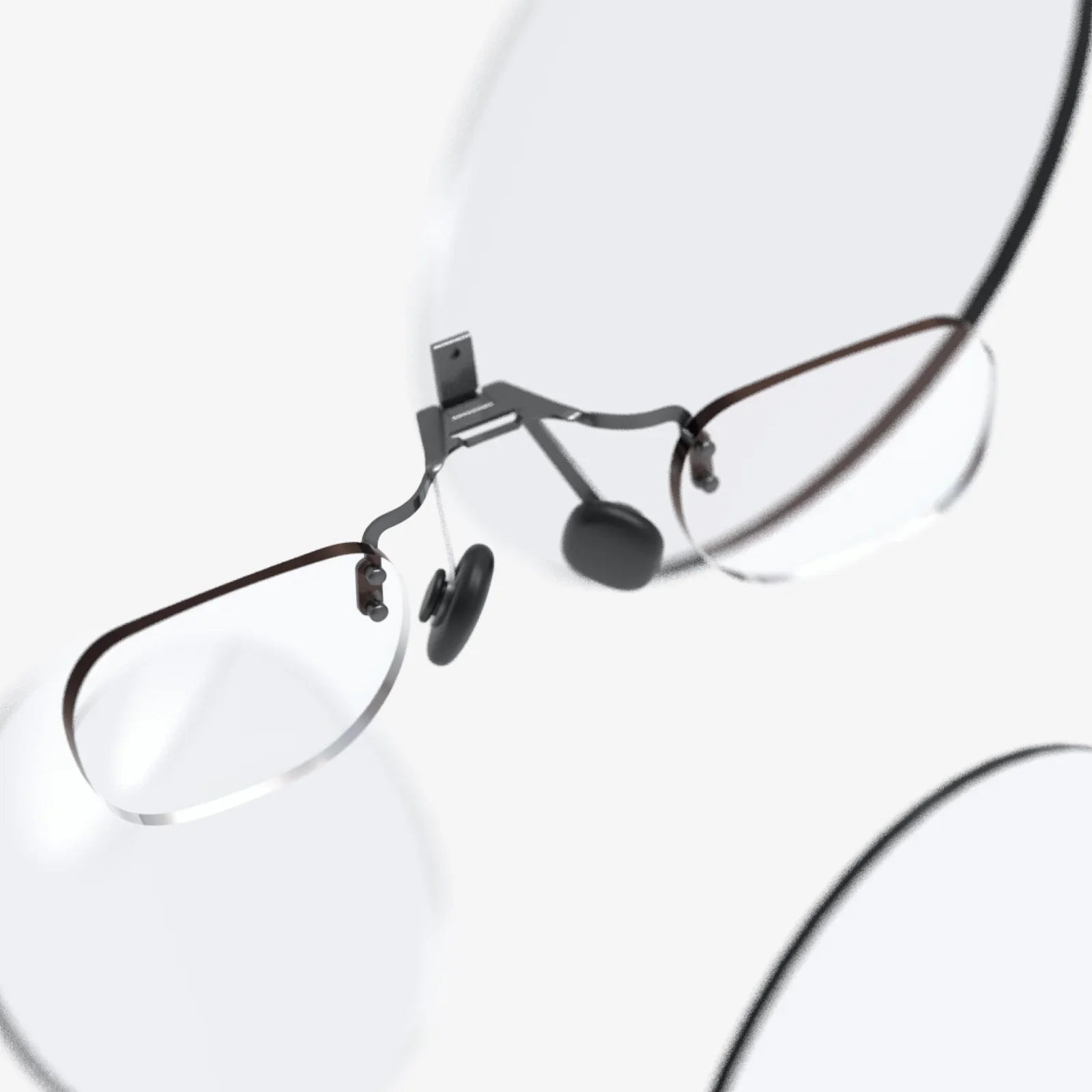
Imagine a world where digital information doesn’t live on a screen in your hand but is seamlessly woven into the very fabric of your reality. Directions float effortlessly on the street ahead, a colleague’s avatar joins your meeting from across the globe as if sitting across the table, and forgotten names discreetly appear beside the faces of old acquaintances. This is the dazzling promise of Augmented Reality (AR) glasses. But for decades, this vision has been trapped behind a formidable technological barrier: the display. How do you create brilliant, high-resolution imagery that is bright enough to be seen in broad daylight, yet small and efficient enough to fit into a form factor no larger than ordinary eyewear? The answer, emerging from the frontiers of display innovation, is a technology so small it’s measured in microns, yet so powerful it holds the key to unlocking the AR revolution. That technology is Micro-LED.
The Daunting Challenge of AR Displays
To understand why Micro-LED is such a game-changer, one must first appreciate the immense engineering hurdles that AR glasses present. Unlike Virtual Reality (VR) headsets, which block out the real world and project images onto enclosed screens, AR glasses must overlay digital content onto the user’s clear view of their physical environment. This creates a unique set of non-negotiable demands for the display engine, often called the "optical engine" or "light engine."
First and foremost is luminance, or brightness. To be visible against the glare of the sun outdoors or a brightly lit office, the imagery projected by AR glasses must be exceptionally bright. Conventional display technologies struggle immensely here, often requiring so much power that they become impractical for all-day wearable use.
Second is resolution and pixel density. For text to be legible and graphics to appear sharp and not pixelated, the display must pack an enormous number of tiny pixels into a minuscule area. If pixels are too large, the image will look chunky and unconvincing, shattering the illusion of immersion.
Third is power efficiency and thermal management. A device meant to be worn on one’s face all day cannot house a large, hot battery or require active cooling fans. The display technology must be incredibly frugal with power to ensure reasonable battery life without generating uncomfortable heat.
Finally, there is the overarching constraint of form factor. The entire optical system—light source, combiners, waveguides, and processors—must be miniaturized to fit into the slim arms and frames of something resembling regular glasses. This is perhaps the most difficult challenge of all. Traditional display solutions have consistently failed to meet all these criteria simultaneously, acting as the primary bottleneck preventing AR glasses from becoming a mainstream consumer product. They have forced manufacturers to make severe compromises, resulting in devices that are either too dim, too power-hungry, too large, or prohibitively expensive.
What Exactly is Micro-LED Technology?
Micro-LED (often abbreviated as µLED) is a revolutionary display technology that, at its core, represents a fundamental rethinking of how we create light with semiconductors. While it shares the "LED" name with the common LED lights and OLED displays, its architecture and performance are in a league of their own.
A Micro-LED is an inorganic light-emitting diode that is microscopic in size, typically less than 50 micrometers on each side—smaller than a human hair. Each of these microscopic diodes is a standalone, self-emissive pixel. This means each individual red, green, and blue sub-pixel produces its own light directly, with no need for a separate backlight unit (like in LCDs) or an organic film (like in OLEDs).
The fundamental structure involves epitaxially grown semiconductor materials, most commonly based on gallium nitride (GaN) for blue and green pixels and gallium arsenide (GaAs) for red pixels. These tiny chips are then mass-transferred onto a driver backplane, which controls each pixel independently. This self-emissive nature is the source of Micro-LED's extraordinary advantages, offering a combination of benefits that no other display technology can match in totality.
Why Micro-LED is the Ideal Engine for AR Glasses
The properties of Micro-LED technology align almost perfectly with the stringent requirements for AR glasses, solving the core problems that have plagued other display approaches.
Unmatched Brightness and Luminance Efficiency
Micro-LEDs are incredibly efficient at converting electrical energy into light. They can achieve luminous efficacy figures that dwarf both LCD and OLED technologies. This means they can generate the intense brightness needed for outdoor AR use—often exceeding 1,000,000 nits in raw output before coupling with waveguides—while consuming a fraction of the power. This high efficiency directly translates to longer battery life, a critical factor for wearable devices.
Exceptional Contrast and True Blacks
Since each Micro-LED pixel is self-emissive and can be turned completely off independently, the technology delivers a theoretically infinite contrast ratio. When a pixel is off, it emits zero light, resulting in a perfect, deep black. This creates incredibly vivid and lifelike imagery, as dark scenes are not washed out by backlight bleed. For AR content, this ensures that digital elements appear solid and crisp against any background.
Supreme Miniaturization and Pixel Density
The microscopic size of individual Micro-LED chips allows for the creation of displays with incredibly high pixel-per-degree (PPD) density, a key metric for visual acuity in near-eye displays. This enables the development of ultra-high-resolution displays compact enough to be integrated into the tiny projectors used in AR glasses. This miniaturization is essential for moving beyond the bulky, goggles-like prototypes of the past towards a truly glasses-like form factor.
Enhanced Reliability and Longevity
Unlike OLED displays, which use organic materials that can degrade over time—potentially leading to burn-in and color shifts—Micro-LEDs are based on inorganic semiconductor materials. These materials are far more stable, offering superior longevity, robustness, and resistance to degradation. This ensures the display performance remains consistent over the intended lifespan of the product, which is crucial for a high-value consumer electronics device.
Wide Color Gamut and Fast Response Time
Micro-LEDs are capable of producing a very wide color gamut, covering well over the DCI-P3 standard, resulting in rich, saturated, and accurate colors. Furthermore, they have a sub-microsecond response time, which is orders of magnitude faster than LCDs and even faster than OLED. This eliminates motion blur entirely, making them perfect for displaying fast-moving content and dynamic AR animations without any smearing or artifacts.
The Hurdles on the Path to Adoption
Despite its immense promise, the widespread integration of Micro-LED tech in AR glasses is not without significant challenges. The primary obstacle lies not in the fundamental science but in the immensely complex and costly manufacturing processes.
The Mass Transfer Challenge
The most daunting task is assembling billions of microscopic LED chips—each representing a red, green, or blue sub-pixel—onto a circuit board with perfect alignment and yield. This process, known as mass transfer, is akin to picking up millions of grains of sand with perfect precision and placing them exactly where they need to go on a surface the size of a postage stamp. Current techniques, using specialized stamp-like mechanisms or laser-assisted transfer, are improving but remain slow, expensive, and prone to defects. A single misplaced or non-functioning pixel can ruin an entire display module.
The Red Efficiency Problem
While blue and green Micro-LEDs based on gallium nitride are highly efficient, achieving high-efficiency red Micro-LEDs has proven more difficult. Alternative materials like aluminum indium gallium phosphide (AlInGaP) are often used for red, but they can suffer from efficiency droop at the very small scales required and may have different structural properties, complicating the monolithic integration process. Solving the "red problem" is a major focus of ongoing research and development.
Cost and Scalability
All these manufacturing complexities contribute to an extremely high cost per display. The capital expenditure for setting up a Micro-LED production line is enormous. For Micro-LED tech in AR glasses to move from high-end enterprise and specialist applications to the consumer market, these costs must come down dramatically through improved yields, larger substrate sizes, and more automated, scalable production techniques.
The Future Landscape Powered by Micro-LED
The successful maturation of Micro-LED technology will do more than just improve AR glasses; it will fundamentally redefine their potential applications and catalyze new industries.
We will see the emergence of all-day wearable AR glasses that are indistinguishable from standard fashion eyewear, yet capable of projecting stunning, full-color information overlays. This will move AR from a held device to a worn constant, seamlessly integrating our digital and physical lives. In enterprise, technicians will have complex schematics and instructions overlaid directly onto machinery they are repairing. Surgeons will have vital signs and 3D anatomical guides visible within their field of view during operations.
Furthermore, the efficiency of Micro-LEDs will enable new paradigms in display design, such as retinal projection systems that draw even less power. As the technology scales and costs decrease, it will eventually trickle down from AR glasses to other applications, potentially revolutionizing everything from smartwatches and head-up displays in vehicles to ultra-large-scale video walls with unprecedented brightness and uniformity.
The journey of Micro-LED from the lab to our faces is a testament to the relentless pursuit of a better pixel. It is a complex, arduous, and breathtakingly precise endeavor. But the reward waiting at the end of this road is a transformation in how we perceive and interact with information itself. It is the key that will finally unlock the true potential of augmented reality, moving it from a promising concept to an indispensable part of our daily visual experience.
We stand on the verge of not just reading about the future, but of literally seeing it unfold before our eyes, powered by the invisible, microscopic glow of a million tiny lights.
Share:
What Is the Best AI Application? A Deep Dive into the Digital Revolution
Latest AR Glasses 2025: Redefining Reality and Reshaping Our Digital Future