


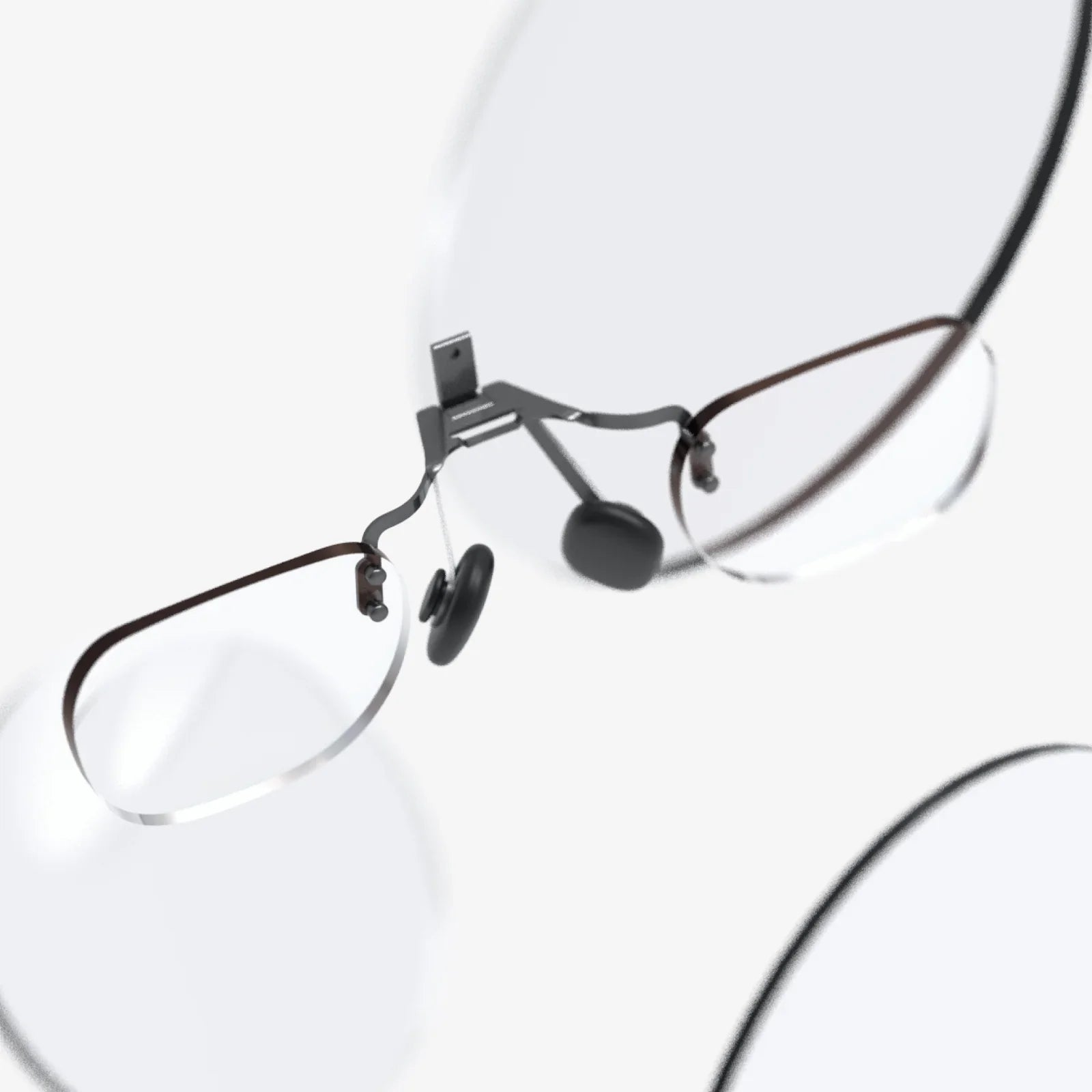
Imagine a world where your digital life doesn’t confine you to a screen but instead, seamlessly integrates with the world around you. This isn't a distant sci-fi fantasy; it's the tangible promise held within the latest generation of mini AR glasses. These devices, shrinking powerful technology into a form factor that whispers of the future, are poised to redefine our relationship with information, entertainment, and each other. This comprehensive review dives deep into this emerging category, moving beyond the hype to examine whether these miniature marvels truly deliver a glimpse of the next computing revolution or if they remain a compelling prototype for a future not yet realized.
The Evolution of Augmented Reality: From Clunky to Compact
The journey to today's mini AR glasses is a story of relentless miniaturization. Early augmented reality systems were often bulky, tethered helmets used primarily in industrial and military applications. They were powerful but inaccessible, more machine than accessory. The consumer market's first major foray came with headsets that, while revolutionary, were often described as cumbersome and socially isolating.
The pivotal shift has been the move towards normalcy in design. The goal is no longer to create a immersive cocoon but to develop a wearable that complements everyday life. This has driven innovation in micro-optics, waveguide displays, ultra-compact projection systems, and low-power processors. The result is a new class of device: glasses that are only marginally larger than standard prescription eyewear, yet capable of overlaying high-resolution digital content onto the user's field of view. This evolution from conspicuous headset to discreet glasses is the single most important factor making AR a viable all-day technology.
Defining the "Mini" AR Experience: Form Factor and Features
What exactly sets "mini" AR glasses apart? It’s a combination of physical design and intended use case.
Design Philosophy: The primary directive is discretion. These glasses prioritize a low weight (typically under 100 grams), a balanced fit to avoid uncomfortable pressure on the nose and ears, and a style that, while not yet indistinguishable from classic eyewear, doesn't scream "tech gadget." Many models feature slightly thicker arms to house the battery and electronics, but the front profile remains sleek.
Display Technology: Most mini AR glasses utilize Birdbath Optics or advanced waveguide technology. These systems project light into a tiny combiner lens, which then reflects the image into the user's eye. The key metric here is transparency; a good pair of AR glasses must offer a clear, unobstructed view of the real world, with digital content appearing brightly and sharply overlaid. Resolution, color accuracy, and brightness (measured in nits) are critical for readability, especially in outdoor environments.
The Tethered vs. Standalone Divide: Currently, most mini AR glasses are "companion devices." They lack their own full operating system and powerful processor, instead relying on a wired or wireless connection to a smartphone, computer, or dedicated processing puck. This offloads battery drain and computational heaviness, allowing the glasses themselves to stay light and cool. A select few are moving towards true standalone operation with integrated compute and battery, but this often comes at the cost of increased size and weight.
Real-World Performance: A Day in the Life
Reviewing these glasses means moving beyond spec sheets and into daily use. How do they actually perform?
Visual Fidelity: The experience of seeing a floating screen is nothing short of magical. A high-quality micro-OLED display can project the equivalent of a 100-inch screen from several meters away, with stunning color and detail perfect for watching movies or playing games. Text clarity is paramount for productivity; the best models offer a pixel density high enough to read small font easily without screen-door effect. However, challenges remain. Achieving a perfect focus across the entire display can be tricky, and some users may experience slight chromatic aberration at the edges. Brightness is the ultimate arbiter of usability—glasses with over 1000 nits can hold their own in direct sunlight, while dimmer models are confined indoors.
Battery Life and Thermal Management: This is a major pain point. As companion devices, the battery life is often a function of the source (your phone or a separate battery pack). Expect 3-5 hours of continuous video playback. The glasses themselves can get warm, particularly during high-brightness use, but should never become uncomfortably hot. Efficient thermal design is a hallmark of a well-engineered product.
User Interface and Interaction: Navigating the AR interface varies. Touchpads on the temple are common, allowing for swipes and taps to control menus. Some integrate voice assistants for hands-free operation. The most immersive experiences are paired with a separate handheld controller or even finger-tracking rings for more complex interactions in 3D space. The intuitiveness of this control scheme is crucial for mainstream adoption.
The Killer App: What Are They Actually Good For?
The technology is impressive, but its value is defined by its applications.
Portable Entertainment: This is the undisputed champion use case. Having a massive, private screen anywhere you go is a game-changer for travel, commuting, or simply lounging in bed without holding a tablet. It’s a immersive, personal theater that fits in a glasses case.
Productivity on the Go: For the digital nomad or multi-monitor enthusiast, the ability to have multiple virtual desktops floating in your environment is incredibly powerful. You can work on a plane, in a coffee shop, or even in your living room without being tied to a physical monitor. Compatibility with major operating systems for screen mirroring and virtual desktop streaming is essential.
Gaming: Cloud gaming services and AR/VR games find a compelling home on these glasses. They offer a more immersive experience than a phone screen and a more portable one than a full VR headset. The potential for location-based AR games is also immense.
Fitness and Navigation: Imagine cycling with turn-by-turn directions and performance metrics hovering in your periphery, or following a workout tutorial with the instructor demonstrating right in your living room. The hands-free, heads-up nature of AR is perfectly suited for these active scenarios.
Limitations and Considerations: The Fine Print
No technology is perfect, and mini AR glasses are still in their relative infancy.
Field of View (FOV): The most common compromise. Unlike VR headsets that fill your vision, AR glasses typically have a FOV similar to a large television floating in front of you. You must look *at* the content rather than having it surround you. A larger FOV is a major engineering challenge and is directly at odds with the goal of miniaturization.
Prescription Compatibility: For those who need vision correction, this is a significant hurdle. Some manufacturers offer custom prescription inserts, which add cost and complexity. Others simply aren't compatible, limiting their audience.
Social Acceptance and Privacy: Wearing technology on your face is inherently conspicuous. There are social etiquette questions to consider, and the faint glow of the screens can be visible to others in certain lighting conditions, which may not be desirable in all situations. Furthermore, built-in cameras, while useful for features like gesture control, raise legitimate privacy concerns for bystanders.
The Ecosystem: The software and app ecosystem is still developing. While screen mirroring is universal, native AR applications that truly understand and interact with the environment are still limited. The long-term success of the platform depends on developer support.
Who Are They For? Identifying the Early Adopter
Mini AR glasses are not yet a mainstream product for everyone. The ideal early adopter is a tech enthusiast who values cutting-edge innovation and has a specific use case in mind. They are perfect for:
- The Frequent Traveler: Who wants a portable entertainment system.
- The Productivity Power User: Who craves multiple screens without the physical footprint.
- The Avid Gamer: Eager to experience new forms of interactive media.
- The Developer and Creator: Building the next generation of AR experiences.
For the average consumer waiting for a seamless, all-day AR experience that replaces their smartphone, the technology needs another generation or two of refinement.
The Future is Clear, But Not Yet Perfect
The trajectory is undeniable. Advances in semiconductor technology, battery chemistry, and optical engineering will continue to drive these devices toward the ultimate goal: a pair of glasses that look entirely normal but provide the computational power of a supercomputer, overlaying contextual information onto our world in a way that feels intuitive and magical. We can expect improvements in FOV, the development of more powerful and efficient standalone models, and the creation of a robust ecosystem of applications that leverage contextual awareness.
The current generation of mini AR glasses delivers a convincing and often breathtaking proof-of-concept. They are a window into a future where our digital and physical realities are one. While they still carry the compromises of early technology—battery life, field of view, and a developing app ecosystem—their ability to untether us from screens and place information directly into our environment is a profound shift. They are not yet ready to replace your phone, your monitor, or your television, but they absolutely can augment them in powerful and delightful ways. For those willing to step onto the cutting edge, the view from here is spectacular.
Share:
IMG to 3D AI: The Revolutionary Technology Reshaping Reality
Air Silver AR Glasses: The Invisible Computer Revolutionizing Your World