


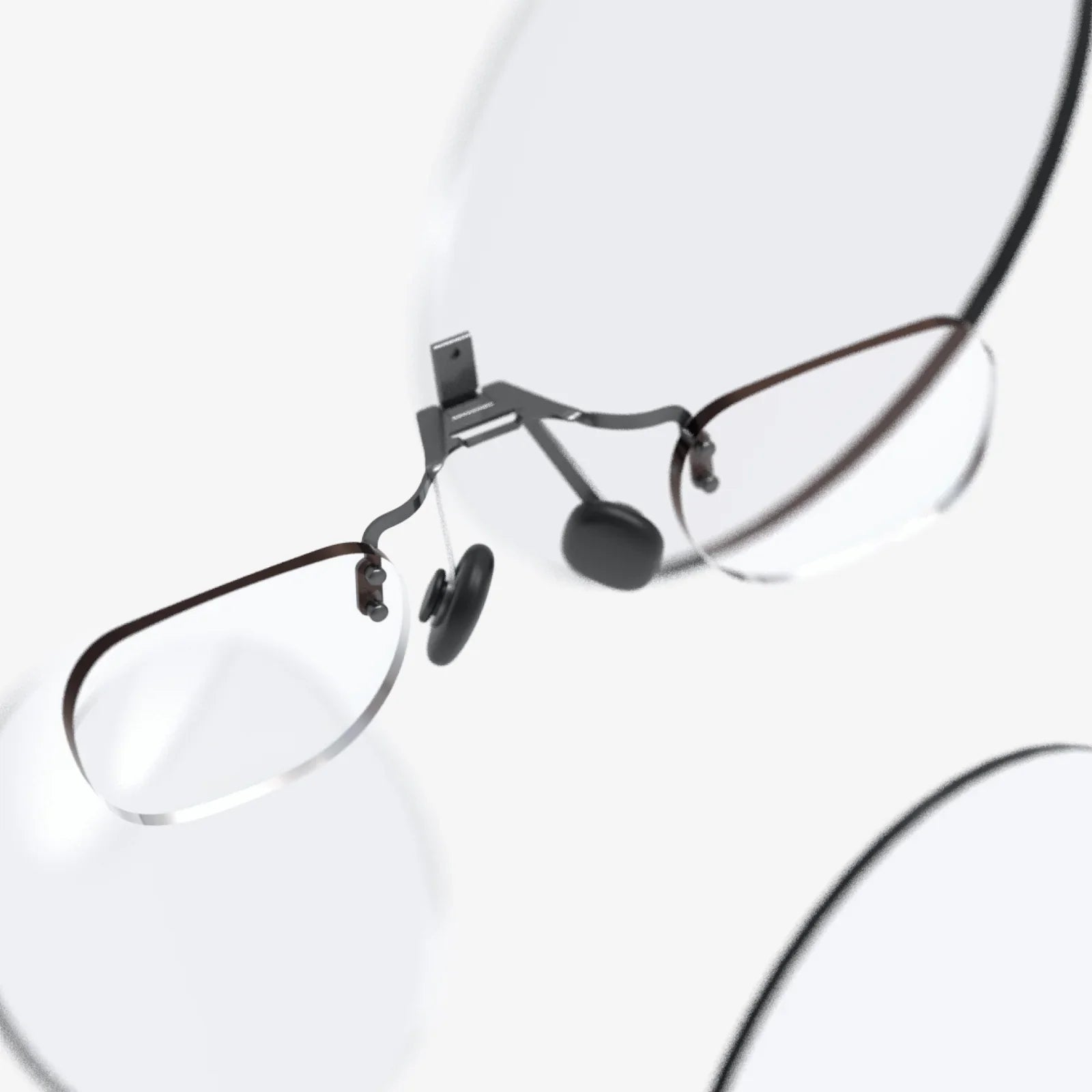
Imagine a world where your field of vision becomes a limitless canvas, where digital information doesn’t live on a screen in your hand but floats effortlessly in the space around you, interacting with your environment in real-time. This is the promise of augmented reality, and a new generation of sleek, sophisticated wearable technology is bringing this sci-fi fantasy into palpable reality. Among the vanguard of this revolution are devices known colloquially as Air Silver AR glasses, a moniker that evokes a sense of weightless, premium, and almost magical integration of technology into daily life. This isn’t about escaping into a virtual world; it’s about enhancing the one we already live in.
The Philosophical Shift: From Pockets to Eyeballs
For over a decade, the smartphone has been the undisputed center of our digital universe. It is a portal we constantly reach for, a black rectangle that demands our downward gaze and divided attention. This paradigm, while powerful, has created a fundamental disconnect between us and our surroundings. We navigate city streets with our eyes glued to a map on a screen, rather than observing the landmarks around us. We sit in meetings, physically present but mentally absent, scrolling through a separate digital stream.
Augmented reality, and specifically its embodiment in wearable glasses, proposes a radical alternative: what if the digital world came to us? Instead of pulling a device from our pocket, the device resides on our face, projecting its interface onto the world itself. This represents a shift from mediated interaction to integrated experience. The goal is not to add more screens to our lives, but to make the world itself the screen. The "Air" in Air Silver signifies this ambition—a technology so light, so unobtrusive, and so intuitive that it feels like a natural extension of our own senses, much like a pair of premium sunglasses.
Deconstructing the Technology: How They Create Magic
The seemingly effortless magic of overlaying digital content onto the physical world is a triumph of miniaturized engineering and sophisticated software. Several core technologies work in concert to create a cohesive AR experience.
Optical Systems: The Heart of the Illusion
At the core of any AR glasses is its optical system. This is the mechanism that paints the digital images onto your retina. Two primary technologies dominate:
- Waveguide Displays: This is the technology most associated with a sleek, "Air Silver" form factor. It involves etching incredibly fine patterns onto a transparent glass or plastic lens. Light from a micro-projector is injected into the edge of this waveguide. It then travels through the lens, bouncing off these etched patterns (a process called diffraction) until it is finally directed into the user’s eye. The result is a bright, sharp image that appears to hover in the distance, all while allowing the user to see the real world clearly through the transparent lens.
- Birdbath Optics: An alternative design that uses a beamsplitter (the "birdbath") and a reflective surface to fold the light path from a micro-display into the user’s eye. While often capable of delivering richer colors and higher contrast, this approach can sometimes result in a slightly bulkier design compared to waveguides.
The choice between these systems is a constant trade-off between visual fidelity, field of view, device size, and cost—the central challenge in making AR glasses both powerful and socially acceptable.
Spatial Mapping and Computer Vision: The Digital Nervous System
For digital objects to feel like they are truly part of your world, they can’t just float arbitrarily. They must understand and interact with the geometry of your environment. This is achieved through a suite of sensors, typically including:
- Cameras: To see the world from the user’s perspective.
- Depth Sensors: (e.g., LiDAR or time-of-flight sensors) To accurately measure distances and create a 3D mesh of the environment.
- Inertial Measurement Units (IMUs): Accelerometers and gyroscopes that track the precise movement and orientation of the headset.
This sensor data is fused in real-time by powerful algorithms to perform simultaneous localization and mapping (SLAM). This process allows the glasses to understand exactly where they are in a room and to anchor digital objects to physical surfaces. A virtual pet can sit convincingly on your real coffee table, and a navigation arrow can appear to be painted on the road ahead of you.
Processing and Connectivity: The Brain Behind the Eyes
The computational demand of AR is immense. It requires rendering complex 3D graphics, processing multiple high-bandwidth camera feeds, and running AI models for object recognition and gesture tracking—all in real-time and within the extreme power and thermal constraints of a device on your face.
This is managed through a combination of on-device processing, using specialized chipsets designed for AR workloads, and offloading heavier tasks to a connected companion device, like a smartphone or a dedicated compute puck, via high-speed wireless protocols like Wi-Fi 6E or Bluetooth LE Audio. This hybrid approach ensures the glasses themselves can remain as light and cool as possible—true to the "Air" ethos.
Beyond Novelty: Transformative Use Cases
The true value of this technology lies not in the wow factor of seeing a digital dinosaur in your living room, but in its profound utility across countless aspects of life.
The Future of Work and Productivity
Imagine an architect walking through a construction site, seeing the digital blueprints overlaid directly onto the unfinished structure, identifying potential clashes before they become costly errors. Envision a surgeon having vital signs, MRI data, and procedural guidance visually pinned to their patient during an operation, without ever looking away from the surgical field. For the remote field technician, instructions for repairing a complex machine are superimposed onto the machinery itself, highlighting exactly which bolt to turn and which wire to check.
This is the promise for enterprise: contextually relevant information, delivered hands-free and eyes-up, dramatically increasing efficiency, reducing errors, and enabling entirely new forms of collaboration and remote assistance.
Redefining Social Connection and Entertainment
Socially, AR glasses could dissolve the concept of a "video call" and replace it with a "holoportation" experience, where a life-sized, volumetric representation of a remote participant appears in your room as if they were physically present. You could watch a movie with a friend on another continent, both seeing a giant virtual screen on your respective walls, as if you were in the same theater.
Gaming will cease to be confined to a television or monitor. Your entire home can become a dungeon to explore, your coffee table a battlefield for miniature armies, and your city park a sprawling playground for global, location-based adventures. Entertainment becomes environmental and shared.
Everyday Augmentation: The Subtle Revolution
The most profound changes may be the most subtle. Walking through a foreign city, translations of street signs and menus appear instantly in your vision. Following a recipe in the kitchen, the next steps materialize right above your mixing bowl, hands-free. You glance at a landmark, and a small, elegant placard of historical information appears beside it. You can’t find your keys, and a digital breadcrumb trail highlights their location on the couch cushions. This is ambient computing at its finest—technology that assists, informs, and enriches without demanding your primary focus.
The Path to Ubiquity: Challenges on the Horizon
For the Air Silver AR vision to become a widespread reality, significant hurdles remain. The quest for the perfect balance of a wide field of view, high resolution, all-day battery life, and a socially acceptable form factor is the industry's holy grail. Furthermore, generating content that is genuinely compelling and not merely gimmicky is a massive creative challenge. But perhaps the most significant hurdles are not technical, but social and ethical.
Privacy concerns are paramount. Devices with always-on cameras and microphones worn in public spaces understandably raise alarms. Robust, transparent, and user-centric data handling policies, with clear visual indicators when recording is active, will be non-negotiable for public adoption. There is also the risk of a new digital divide, both in terms of access to the technology and the potential for overwhelming visual clutter or "attention capitalism," where our view of the world is auctioned off to the highest advertising bidder.
Navigating these challenges requires thoughtful design and proactive policy, ensuring that this powerful technology augments our humanity for the better, rather than detracting from it.
The dream of a seamless blend of bits and atoms is closer than ever. The development of wearable, elegant AR glasses represents more than just a new product category; it signifies a fundamental evolution in our relationship with technology. It’s a move away from isolated devices and toward a connected, intelligent layer of reality itself. While the journey ahead is long and fraught with complex questions, the destination is a world where technology fades into the background, empowering us to see our own world not as it is, but as it could be. The future isn't on a screen; it's all around you, waiting to be unlocked.
Share:
Mini AR Glasses Review: The Unseen Revolution in Personal Computing
VR AR Glass Company: The Architects of Our Digital Tomorrow