


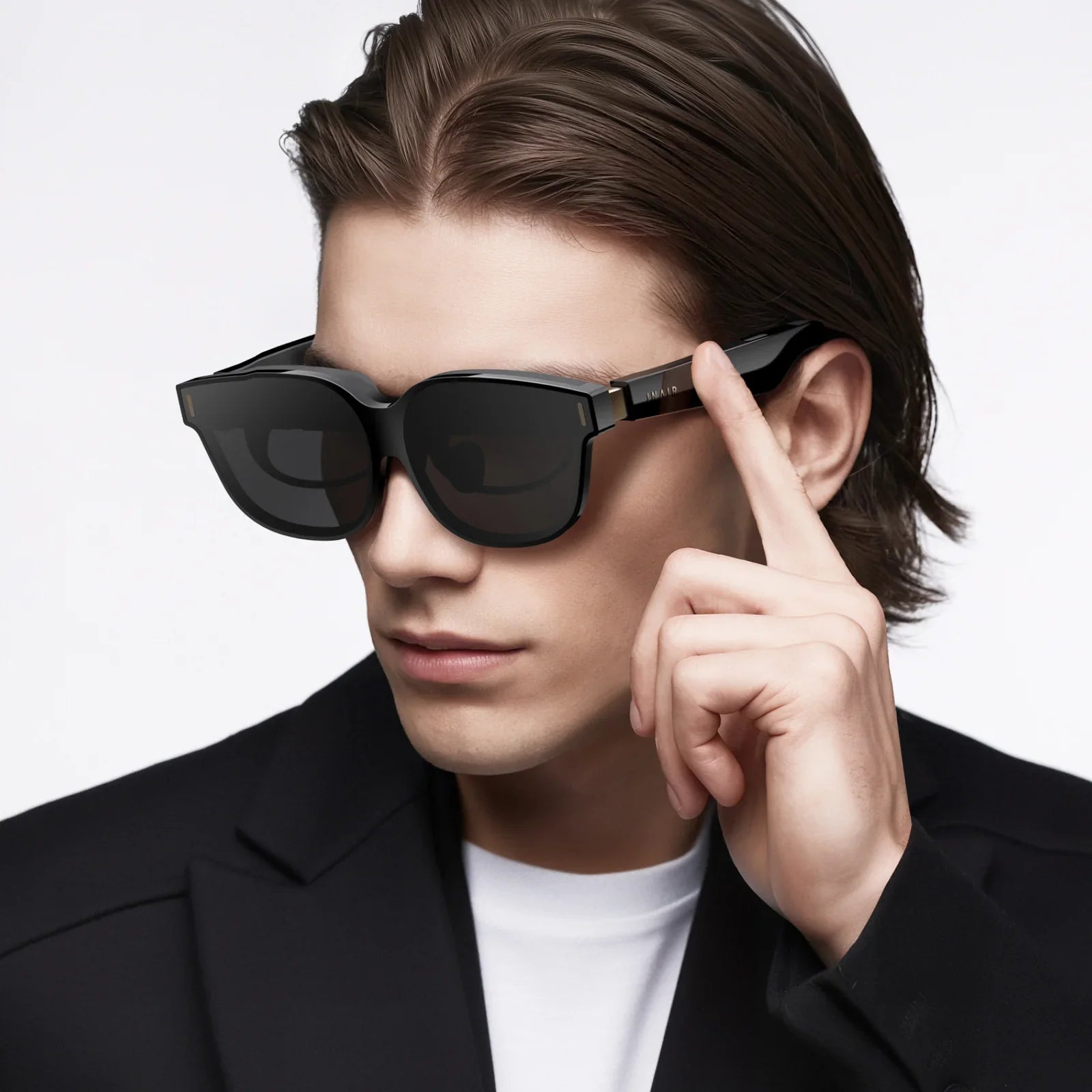
- by wangfred
Mixed Reality Headset: The Ultimate Portal to Blending Our Digital and Physical Worlds
- by wangfred
Imagine a world where your digital life doesn’t end at the edge of a screen, but flows seamlessly into your physical surroundings, enhancing everything you see, do, and create. This is the promise held within the sleek, futuristic form of the mixed reality headset, a device poised to redefine the very fabric of our daily existence. It’s more than just gadgetry; it’s a key, unlocking a universe where the boundaries between what is real and what is digital become beautifully, functionally blurred.
To truly appreciate the marvel of a mixed reality (MR) headset, one must first understand where it sits on the broader spectrum of immersive technologies. Often conflated with its cousins, virtual reality (VR) and augmented reality (AR), mixed reality is distinct in its capabilities and ambition.
On one end of the spectrum, we have the physical reality of the world we inhabit. On the opposite end lies a completely synthetic, virtual reality, a digital world that fully occludes the physical one, transporting the user elsewhere. Somewhere in the middle lies augmented reality, which overlays digital information—like a navigation arrow on your car’s windshield or a cartoon character on your living room floor via a smartphone—onto your view of the real world. The digital and physical elements coexist but do not truly interact.
Mixed reality is the next evolutionary step. It doesn’t just overlay digital content; it anchors it to the physical world, allowing for genuine interaction. A MR headset uses advanced sensors, cameras, and algorithms to understand the geometry of your environment. It can map your room, recognize surfaces, and understand depth. This allows a virtual character to jump onto your real-world coffee table and hide behind your sofa, or a digital solar system to hang in the center of your room, with planets you can walk around and examine from every angle. The digital content is aware of the physical world and responds to it in real-time. This is the magic of true mixed reality.
The seemingly effortless blending of worlds is a feat of engineering, made possible by a sophisticated fusion of hardware and software.
At the heart of every MR headset is a suite of sensors. This typically includes multiple high-resolution cameras, infrared projectors, depth sensors (like time-of-flight sensors), and inertial measurement units (IMUs) containing accelerometers and gyroscopes. Together, these components perform a constant, real-time dance of data collection. They scan the room, creating a precise 3D mesh map. They track the position of your head and hands with incredible accuracy, and they understand the lighting and spatial relationships of every object around you. This process, often called inside-out tracking, is what frees the user from external sensors and base stations, enabling untethered movement.
How do you make a digital object appear solid and real in your space? The answer lies in the complex optical systems within the headset. Most modern MR devices use a form of see-through display. Tiny, high-resolution micro-displays project light onto specially engineered lenses that sit between your eyes and the real world. These lenses, often waveguides, bend the light from the displays to overlay the image onto your view of the physical environment. The result is that virtual objects appear to occupy real space, with correct occlusion (a virtual ball rolling behind a real table leg) and realistic lighting and shadows.
All this sensor data and graphical rendering requires immense computational power. This is where the concept of spatial computing comes into play. It’s a paradigm where the computer no longer understands the world as a 2D screen but as a 3D space to be navigated and manipulated. Powerful processors, often a combination of a central processing unit (CPU) and a graphics processing unit (GPU), work in tandem to run the complex algorithms for simultaneous localization and mapping (SLAM), hand tracking, and rendering high-fidelity 3D graphics in real-time. This is the brain that makes the immersive illusion not only possible but also convincing and responsive.
While the entertainment potential is dazzling, the most profound impact of mixed reality headsets may be felt in professional and industrial sectors, where they are already solving real-world problems.
In engineering and architecture, MR is changing the design process. Instead of viewing a 3D model on a flat screen, designers and engineers can don a headset and step inside their creation. They can examine a full-scale prototype of a new engine, walking around it, peering into its components, and identifying potential design flaws long before a physical prototype is ever built. This saves enormous amounts of time and resources. On the factory floor, technicians can use MR guides that overlay precise assembly instructions directly onto the machinery they are working on, reducing errors and training time dramatically.
The medical field is embracing MR for both education and practice. Medical students can practice complex surgical procedures on hyper-realistic holographic patients, gaining valuable experience in a zero-risk environment. Surgeons can use MR to visualize a patient’s anatomy—such as CT or MRI scans—projected directly onto the patient’s body during pre-surgical planning or even in the operating room, providing an invaluable “X-ray vision” that enhances precision and safety.
MR headsets have the potential to obliterate the limitations of traditional video conferencing. Instead of looking at a grid of faces on a screen, teams can meet in a shared virtual space. Colleagues from across the globe can appear as lifelike avatars in your room, able to interact with the same 3D holographic model, point to specific features, and collaborate as if they were standing right next to you. This creates a sense of presence and shared context that is impossible to achieve with current technology, making remote work more effective and personal.
Despite its incredible potential, the widespread adoption of mixed reality is not without significant hurdles that developers and manufacturers must overcome.
For MR to become a mainstream productivity tool, the hardware must become more socially acceptable and comfortable for all-day wear. Current generations, while impressive, are still relatively bulky and can cause fatigue over extended periods. The goal is to create a device that approaches the form factor and weight of a pair of everyday eyeglasses, a challenge that requires breakthroughs in miniaturization, battery technology, and thermal management.
As with any new platform, the classic “chicken and egg” problem exists. Widespread adoption requires a rich library of compelling applications, but developers are hesitant to invest heavily in creating those applications until a large user base exists. Building immersive, interactive MR experiences is also inherently more complex than traditional app development, requiring new skills and design philosophies centered around spatial computing.
The very feature that makes MR powerful—its ability to continuously scan and understand your environment—raises serious privacy concerns. The data collected about a user’s home or office is incredibly detailed and sensitive. Robust security frameworks and clear, transparent data policies are non-negotiable. Users must have absolute control over their spatial data, with guarantees that it is processed securely and not exploited.
The trajectory of mixed reality points toward a future where the technology becomes increasingly invisible and intuitive. We can anticipate developments like more sophisticated haptic feedback, allowing users to “feel” digital objects, and brain-computer interfaces that could allow for control through thought alone. The ultimate goal is a seamless extension of our human capabilities, where technology fades into the background and the focus remains on the task, the creation, or the connection.
We are standing at the precipice of a new era of computing. The mixed reality headset is our first glimpse into a world where our digital and physical realities are not competing spaces, but a unified, enhanced continuum of human experience. It’s a tool for unlocking creativity, boosting productivity, and fostering connection on a scale we are only beginning to imagine. The door is now open; step through and see what’s possible.
Share:
Bigscreen Mixed Reality: The Ultimate Social Cinema Experience
What Is A Mixed Reality Device: The Ultimate Guide To The Future Of Digital Interaction