


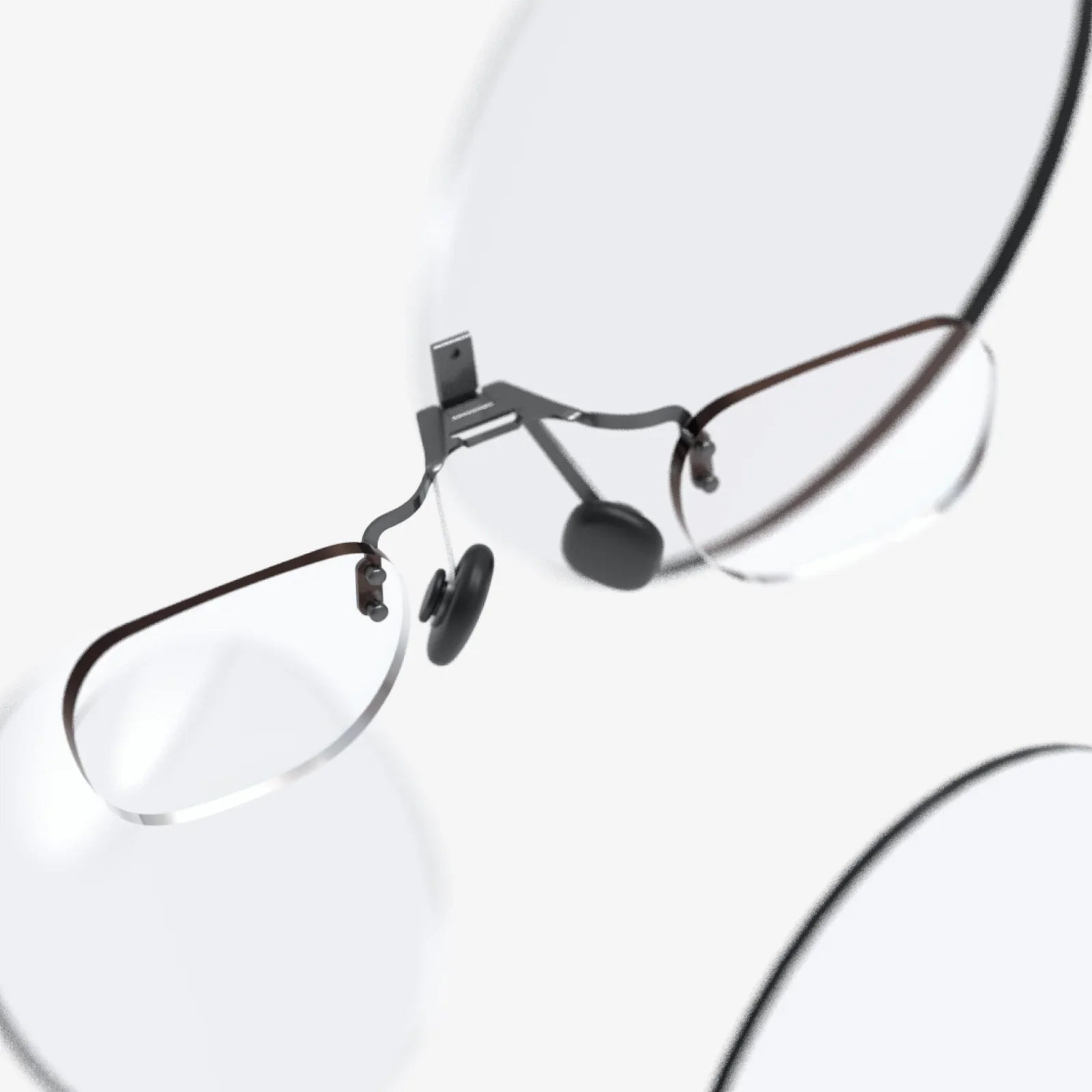
Imagine a world where your digital life isn't confined to a rectangle in your pocket or on your desk. It’s overlaid onto your reality, accessible with a glance, and interactive with a gesture. This isn’t a distant sci-fi fantasy; it’s the promise being delivered today by a new generation of wearable technology: sleek 4K AR VR glasses. These devices are poised to shatter the barriers between the physical and the digital, offering a glimpse into a future of computing that is more intuitive, immersive, and integrated into our daily lives than ever before.
The Evolution of a Vision: From Bulky Headsets to Everyday Eyewear
The journey to today's sleek form factor has been a long one. Early prototypes and consumer models were often characterized by their cumbersome design, heavy weight, and limited field of view. They were technological marvels, but they were built for enthusiasts and developers, not for the average consumer. The experience was often isolating, cutting the user off from their surroundings entirely in the case of VR, or providing a dim, unconvincing digital overlay in the case of AR.
The industry quickly identified design as the primary bottleneck to mass adoption. No matter how powerful the underlying technology, if the device was uncomfortable, socially awkward, or aesthetically unappealing, it would remain a niche product. This realization sparked a race to miniaturize components, improve optics, and re-envision the very concept of a head-mounted display. The goal shifted from creating a powerful console for your face to creating a pair of glasses that just happen to be a powerful computer.
Deconstructing the Magic: The Technology Behind the Sleek Design
Creating a device that is both powerful and discreet is a monumental feat of engineering. It requires several key technological advancements to work in harmony.
The Pinnacle of Visual Fidelity: 4K Resolution Per Eye
The leap to 4K resolution is arguably the most significant factor in achieving true immersion. Early headsets suffered from the "screen door effect," where users could discern the gaps between individual pixels, breaking the illusion of reality. A 4K display, often utilizing advanced Micro-OLED technology, packs an astonishing number of pixels into a tiny screen placed mere centimeters from the eye. This eliminates the screen door effect entirely, rendering text razor-sharp, virtual objects solid and believable, and vast digital landscapes with breathtaking detail. It’s the difference between looking at a world through a window and believing the window isn’t there.
The Art of Light Manipulation: Advanced Waveguide Optics
How do you project a digital image from a tiny screen at the temple of the glasses onto the entire field of view of the wearer? The answer lies in sophisticated optics, particularly waveguide technology. These are essentially transparent glass or plastic plates embedded within the lenses. They use a combination of diffraction gratings, holographic films, or other nanostructures to bend and redirect light from the micro-displays into the user’s eye. This allows the digital imagery to be superimposed onto the real world while keeping the lenses remarkably thin and transparent. This technology is the secret sauce that enables the sleek, glasses-like form factor for AR experiences.
The Brain of the Operation: On-Device AI and Spatial Processing
Sleek glasses must be more than just displays; they must be spatial computers. This requires a constant, real-time understanding of the environment. A suite of sensors, including high-resolution cameras, depth sensors (LiDAR), and inertial measurement units (IMUs), continuously scans the room. This data is processed by powerful, miniaturized chipsets often equipped with dedicated Neural Processing Units (NPUs). This onboard AI performs simultaneous localization and mapping (SLAM), understanding the geometry of the space, recognizing surfaces like tables and walls, and tracking the user’s hand movements with sub-millimeter precision. All this happens instantly, allowing digital objects to sit consistently on a physical table or for virtual characters to occlude realistically behind your real-world sofa.
A World Transformed: Applications Across Industries
The convergence of sleek design, high-resolution displays, and intelligent spatial computing unlocks a universe of practical applications that extend far beyond gaming.
Revolutionizing the Modern Workplace
The concept of the office is being redefined. Imagine architects and engineers walking through full-scale, interactive 3D models of their designs before a single foundation is poured. Medical students can practice complex surgical procedures on detailed holographic anatomies. For the knowledge worker, the potential is even more immediate. Instead of being tethered to multiple physical monitors, a user can summon vast, virtual screens anywhere they go—on a train, in a coffee shop, or in a minimalist home office. These screens persist in space, allowing for a fluid, focused, and immensely portable workflow that traditional computing cannot match.
The Next Era of Entertainment and Social Connection
Entertainment ceases to be something you watch and becomes something you experience. Instead of watching a movie on a TV, you could be sitting in a virtual theater with friends who are physically across the globe, all represented as expressive avatars. You could watch a basketball game from a virtual courtside seat or even from the perspective of the hoop itself. Social media transforms from a feed of images into a shared, spatial experience where you and a friend can decorate a virtual room with digital memorabilia or leave 3D messages and artwork pinned to specific locations in the real world for others to discover.
Enhancing Our Daily Lives
The most profound impact may be on our mundane, daily tasks. Navigation becomes intuitive, with glowing path markers and directional arrows overlaid onto the street in front of you. Shopping for a new sofa? See exactly how it would look and fit in your living room at full scale before you buy. Learning a new language? Labels could appear over real-world objects, identifying them in your target language. Cooking a complex recipe? Instructions and timers could hover right above your mixing bowl, hands-free. These glasses have the potential to become an indispensable assistant, enhancing our perception and capabilities without demanding our full attention.
Navigating the Challenges: The Path to Ubiquity
Despite the exciting progress, significant hurdles remain on the path to making these glasses as common as smartphones.
The Battery Life Conundrum
High-resolution displays, powerful processors, and constant sensor data processing are incredibly energy-intensive. Fitting a battery capable of all-day use into the slim arms of a pair of glasses is perhaps the greatest engineering challenge. Current solutions often involve a separate, pocketable battery pack, but the ultimate goal is to achieve a self-contained form factor with sufficient endurance. Breakthroughs in battery technology and extreme power efficiency will be required.
Designing for All-Day Comfort
"Sleek" must also mean "comfortable." Even a few extra grams of weight can cause fatigue over hours of use. Manufacturers are experimenting with new materials like magnesium alloys and advanced composites to reduce weight while maintaining durability. Furthermore, ergonomics must account for a wide variety of face shapes and sizes, often involving customizable nose pads and adjustable arms to distribute pressure evenly and securely.
The Invisible Interface: Moving Beyond Controllers
The user interface paradigm is still evolving. While hand-tracking has become remarkably accurate, enabling pinch-and-drag gestures and virtual button presses, it is not yet perfect. Voice commands offer a hands-free alternative but are not always practical in public or noisy settings. The next frontier may involve more subtle inputs, like EMG sensors that detect the electrical signals from intended muscle movements in the wrist or even neural interfaces. The goal is an interface that feels as natural as pointing your finger.
The Privacy Imperative
A device that sees the world through cameras raises obvious and serious privacy concerns. The ethical development of this technology requires robust, transparent policies. Features like a physical LED indicator that lights up when recording, clear user controls over data collection, and on-device processing of sensitive data (like mapping a user's home) without sending it to the cloud are essential to building public trust. The industry must proactively address these concerns to avoid a societal backlash.
The Horizon: What Lies Beyond the Lens
The current generation of sleek 4K AR VR glasses is just the beginning. We are rapidly moving towards even more integrated technologies. Future iterations may feature varifocal lenses that dynamically adjust to where the user is looking, eliminating eye strain and making virtual objects feel physically present. Haptic feedback systems, perhaps through gloves or even direct air pressure on the skin, will add a crucial sense of touch to digital interactions. Eventually, we may see the development of true contact-lens-based displays, representing the final form factor for always-available computing.
The emergence of sleek 4K AR VR glasses marks a fundamental shift in our relationship with technology. They are not merely a new screen but a new portal—a way to enhance our reality with a limitless layer of digital information and experience. They promise to untether us from our desks, deepen our connections with others, and empower us with contextual knowledge wherever we go. The devices are finally becoming worthy of the grand vision that has inspired technologists for decades. The boundary between science fiction and reality is blurring, and it’s putting on a pair of remarkably stylish glasses. The next computing revolution won't be in your hand; it will be on your face, and it will change everything you see.
Share:
VR Headset and AR Application: The Digital Frontier Reshaping Reality
AR and VR Smart Glasses Market Trends: The Next Frontier in Digital Interaction