


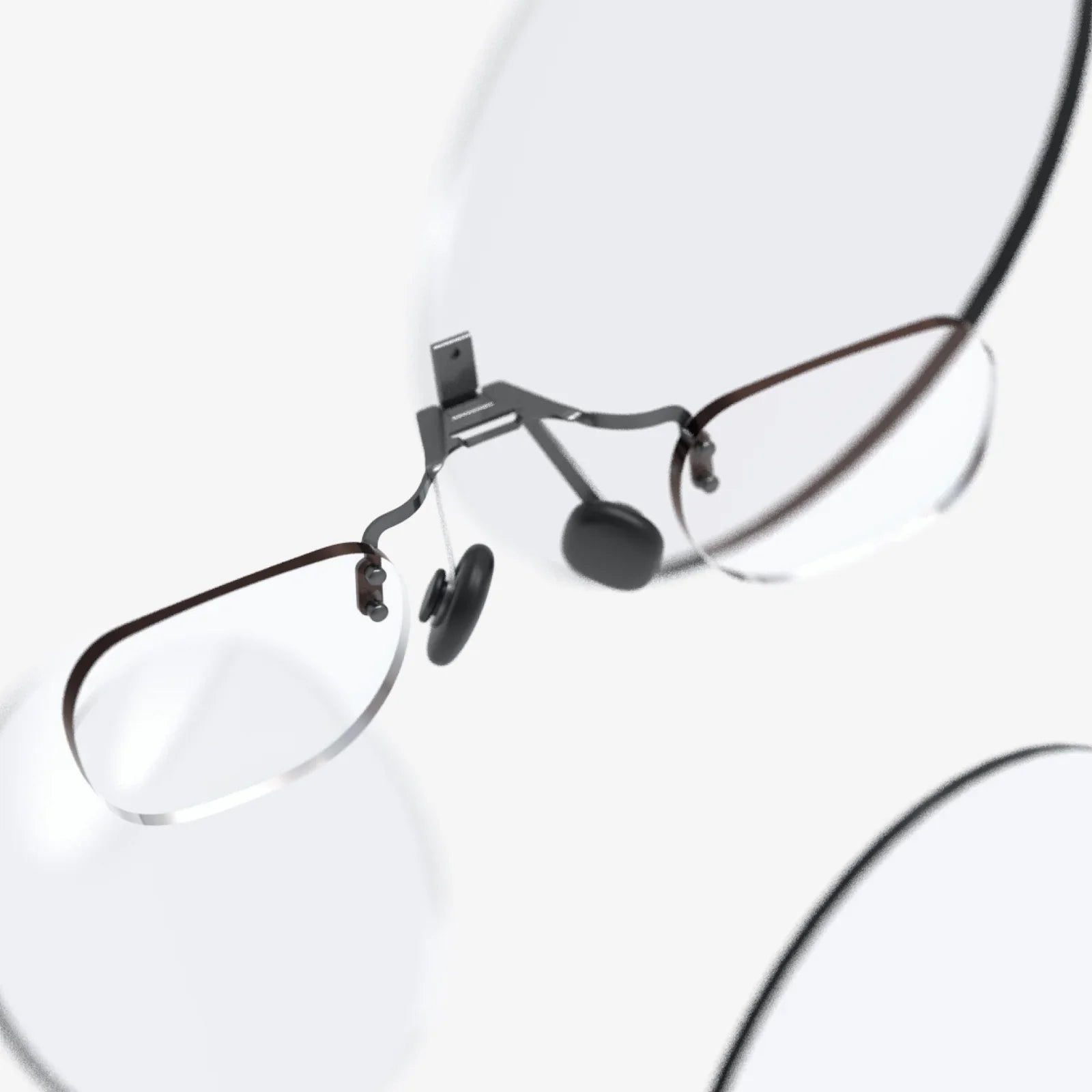
The world is on the cusp of a visual computing revolution, and the numbers prove it. The smart glasses market, once a niche playground for tech enthusiasts and industrial applications, is exploding onto the mainstream scene. The most telling metric of this seismic shift is the Compound Annual Growth Rate (CAGR), a figure that has captured the attention of investors, tech giants, and consumers alike. This isn't just about a new gadget; it's about the dawn of a new interface between humanity and information, and the market's robust growth rate is the beacon signaling its arrival.
Decoding the Metric: What is CAGR and Why Does It Matter?
Before diving into the specifics, it's crucial to understand what the smart glasses market CAGR represents. The Compound Annual Growth Rate is the mean annual growth rate of an investment over a specified period longer than one year. It provides a smoothed annual rate, mitigating the volatility of short-term fluctuations. For the smart glasses market, a projected CAGR often cited by leading market research firms falls within a strikingly high range, frequently between 15% to over 25% for the period spanning the late 2020s into the early 2030s. This is not merely incremental growth; it is exponential expansion. This figure matters because it quantifies confidence. It tells a story of anticipated mass adoption, significant technological advancement, and vast, untapped economic potential. It is the numerical embodiment of the market's transition from a speculative concept to a foundational technology of the future.
The Engine Room: Key Drivers Fueling the Exponential Growth
The impressive smart glasses market CAGR is not occurring in a vacuum. It is the direct result of several powerful, concurrent technological and societal forces converging to create a perfect storm of opportunity.
Technological Leapfrogging
The core technologies that enable smart glasses have advanced at a breathtaking pace. Early models were hampered by bulky designs, poor battery life, and underwhelming displays. Today, we are witnessing a revolution in miniaturization. Micro-displays, such as Liquid Crystal on Silicon (LCoS) and MicroLED, offer stunning brightness and resolution in packages smaller than a fingernail. Waveguide and holographic optical elements allow digital images to be seamlessly superimposed onto the real world without obstructing the user's view. Furthermore, advancements in semiconductor technology have led to ultra-low-power processors capable of handling complex augmented reality (AR) algorithms, computer vision, and on-device artificial intelligence (AI). This trifecta of display, optics, and processing power has finally made it possible to design smart glasses that are both powerful and socially acceptable to wear.
The Proliferation of 5G and Edge Computing
Smart glasses are not intended to be isolated islands of computation. Their true power is unlocked through connectivity. The global rollout of 5G networks is a critical enabler, providing the high-bandwidth, low-latency connection required to stream rich AR content and offload intensive processing tasks to the cloud. This symbiosis with edge computing allows for thinner, lighter glasses with longer battery life, as the heavy lifting of rendering complex graphics or running advanced AI models can be done on remote servers, with results beamed to the device almost instantaneously. This infrastructure shift removes a major barrier to creating a compelling consumer product.
The Industrial Metaverse and Enterprise Adoption
While consumer applications generate much of the buzz, the enterprise sector has been the steady, revenue-driving backbone of the smart glasses market, contributing significantly to its healthy CAGR. Industries are deploying smart glasses for remote expert assistance, where a specialist can see what a field technician sees and provide visual annotations and guidance in real-time, drastically reducing downtime and errors. They are used for complex assembly, overlaying digital work instructions directly onto physical components. In logistics and warehousing, smart glasses powered by AI can visually identify items, navigate workers to exact bin locations, and display picking lists, supercharging efficiency and accuracy. This enterprise adoption provides a solid, proven foundation of use cases and revenue that de-risks further investment and innovation for the broader market.
Shifting Consumer Mindset and the AI Paradigm
Societally, we are becoming more accustomed to technology mediating our experiences. The success of wearable tech like smartwatches and wireless earbuds has paved the way for smart glasses as the next logical form factor. Furthermore, the recent explosion of generative AI and large language models presents a new and compelling use case. Imagine smart glasses not just as a screen for your eyes, but as an intelligent, contextual assistant that can translate a foreign menu in real-time, identify a plant species on a hike, provide a summary of a document you're looking at, or remind you of the name of a colleague you just ran into. This shift from a display-centric to an AI-agent-centric model could be the final key to unlocking mass consumer desire.
Market Segmentation: A Landscape of Diverse Opportunities
The smart glasses market is not a monolith. Its growth is being driven by distinct segments, each with its own dynamics and contribution to the overall CAGR.
By Product Type
The market is broadly split between Integrated Smart Glasses, which are standalone computing devices, and Smart Glasses Accessories, which clip onto or are tethered to a smartphone for processing power. Integrated models represent the high-end, high-growth potential future, while accessory models offer a lower-cost entry point.
By Application
This is where the diversity of the market shines. The Enterprise & Industrial segment is the current revenue leader. The Consumer segment holds the largest long-term growth potential for entertainment, social media, and navigation. Healthcare is a rapidly emerging segment for surgical assistance, medical training, and patient data visualization. Other niches include Retail, for virtual try-ons, and Military & Defense.
By Region
Geographically, North America and Asia-Pacific are the twin engines of growth. North America benefits from a strong tech ecosystem and early enterprise adoption. The Asia-Pacific region, led by tech hubs and manufacturing powerhouses, is expected to witness the highest CAGR, driven by massive consumer markets, government support for tech innovation, and a robust supply chain.
Navigating the Headwinds: Challenges and Restraints
Despite the optimistic projections, the path to realizing the full potential of the smart glasses market CAGR is not without significant obstacles.
The Social Acceptance Hurdle
Perhaps the most formidable challenge remains design and social acceptance. For consumers to wear smart glasses all day, they must be indistinguishable from, or even more stylish than, traditional eyewear. They must be lightweight, comfortable, and not cause "cyber-sickness" or eye strain. Overcoming the "glasshole" stigma associated with early devices is a cultural challenge as much as a technical one.
Battery Life: The Perennial Constraint
Powering high-resolution displays, multiple cameras, and always-on sensors and connectivity is incredibly power-intensive. Delivering a full day of battery life in a slim form factor remains one of the industry's holy grails. Until battery technology sees a fundamental breakthrough, this will remain a key constraint on usage models.
The Privacy Conundrum
Smart glasses with always-on cameras and microphones raise profound privacy concerns. The potential for surreptitious recording creates a societal unease that must be addressed through clear, transparent, and user-centric privacy controls, ethical guidelines, and potentially new regulations. Building trust is paramount.
Content and Ecosystem Development
A hardware platform is only as valuable as the software and content that run on it. For smart glasses to thrive, developers need to create killer apps and immersive experiences that provide undeniable utility or entertainment. Building this ecosystem takes time and significant investment.
The Road Ahead: Beyond the Numbers
The smart glasses market CAGR is more than a statistic; it is a predictor of a transformed future. As the technology matures, we can expect to see a bifurcation in the market: highly specialized, powerful glasses for enterprise and professional use, and sleek, lifestyle-oriented glasses for consumers that prioritize subtlety and seamless AI integration. The ultimate endpoint is a device that fades into the background, becoming an invisible gateway to a digitally augmented layer of reality that enhances our perception, amplifies our intelligence, and connects us to information and to each other in ways we are only beginning to imagine.
Forget everything you thought you knew about wearable technology; the next decade will be dominated by what you see, not what you hold. The staggering growth rate of the smart glasses market is your first look at a world where data doesn't live on a screen in your pocket, but is woven directly into the fabric of your reality, forever changing how we work, play, and connect.
Share:
Smart Glasses Vaunt a Future of Seamless Augmented Reality Integration
Smart Glasses Vaunt a Future of Seamless Augmented Reality Integration