


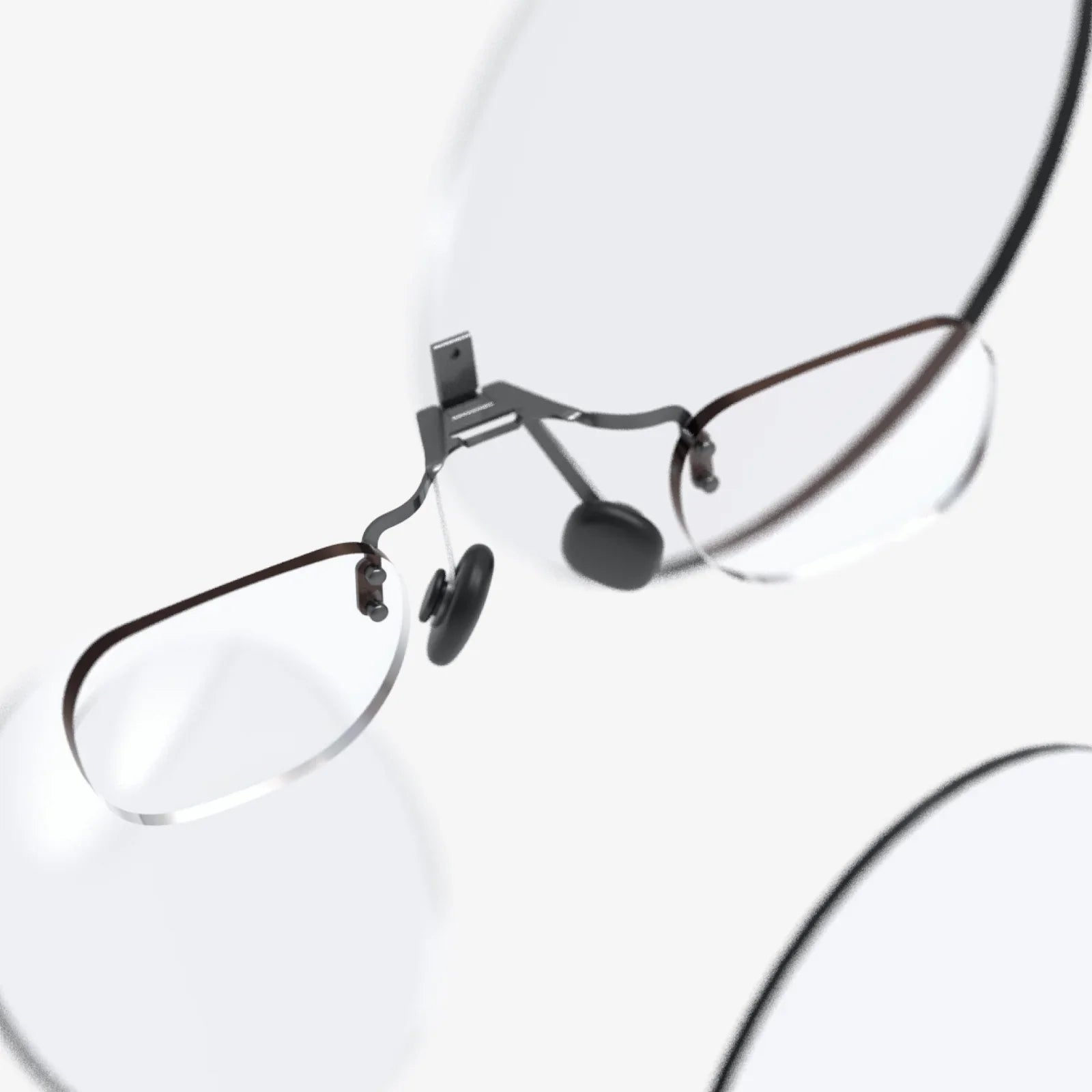
Imagine a world where digital information doesn’t live on a screen in your hand, but is seamlessly woven into the fabric of your reality. Directions float on the street in front of you, a foreign language is instantly translated on a restaurant menu, and a virtual colleague sits across from you at your physical desk. This is the promise of augmented reality (AR) glasses, a technology poised to revolutionize how we work, play, and connect. The race to perfect this vision is fierce, with a dynamic landscape of devices vying for a spot on your face. Navigating this emerging field can be daunting, which is why we’ve compiled this comprehensive analysis of the top contenders shaping the future.
The Spectrum of Augmented Reality
Before diving into the list, it's crucial to understand that not all AR glasses are created equal. They exist on a spectrum, primarily defined by their form factor and capability.
Optical See-Through vs. Video See-Through
Optical see-through glasses use semi-transparent waveguides or mirrors to project digital images directly into your eyes while allowing you to see the real world through the lenses. This method offers a more natural, lag-free view of reality but can struggle with contrast in bright environments. Video see-through glasses use outward-facing cameras to capture the real world and then display a processed video feed of your surroundings, combined with digital elements, on internal displays. This allows for more dramatic digital effects and occlusion (where digital objects can appear behind physical ones) but can introduce latency and a less natural feeling.
Tethered vs. Standalone
Another key differentiator is processing power. Tethered glasses act as a high-resolution display, relying on a wired or wireless connection to a smartphone, computer, or dedicated processing unit to handle the heavy computational lifting. This allows for more powerful graphics and complex applications but limits mobility. Standalone glasses have all the necessary computing power, battery, and sensors built into the frame, offering complete freedom of movement, though often at the cost of a bulkier design and less raw processing capability.
The Criteria for a Top-Tier Experience
Evaluating AR glasses involves balancing several, often competing, factors:
- Visual Fidelity: Resolution, field of view (FOV), brightness, and contrast are paramount. A narrow FOV can feel like looking through a mail slot, while dim displays are useless outdoors.
- Comfort & Design: They must be lightweight and comfortable enough for extended wear. Aesthetics matter; they shouldn’t look like laboratory prototypes.
- Battery Life: All-day battery is the holy grail, but most devices currently offer a few hours of active use.
- Tracking & Spatial Awareness: Precise head and hand tracking, along with environmental understanding (like meshing and plane detection), are essential for immersion.
- Audio: Spatial audio that integrates sound with the environment dramatically enhances the experience.
- Software Ecosystem: Hardware is useless without compelling applications, games, and productivity tools.
- Price: From developer kits to consumer-ready products, prices vary wildly.
The Vanguard of Visual Computing: A Detailed Look
Based on the above criteria, technological innovation, market impact, and future potential, here are the devices leading the charge.
1. The Enterprise Powerhouse
This category is dominated by a device designed for the toughest industrial and professional environments. It features a stunning optical see-through display with a wide field of view, incredible depth perception, and robust hand-tracking that works even with industrial gloves. Its design is ruggedized for factories, construction sites, and medical facilities. It’s not a consumer device—it’s a tool for training complex machinery repair, guiding remote experts through procedures, and visualizing architectural blueprints on-site. The price reflects its professional-grade status, but for enterprise, the ROI in efficiency and safety is proven.
2. The Mainstream Visionary
Perhaps the most anticipated entry, this device comes from a tech giant and represents a bold bet on spatial computing. It uses a sophisticated array of cameras and sensors for video pass-through, creating a highly immersive and interactive digital layer over reality. The eye-tracking and hand-tracking are exceptionally intuitive, requiring no controllers. The dual micro-OLED displays offer breathtaking resolution and color. However, its current form factor is more of a face-worn computer than traditional glasses, its battery is external, and its price point places it firmly in the early adopter and developer realm. Its success will hinge on the creation of a killer app ecosystem.
3. The Independent Innovator
Born from a renowned startup, these glasses are often celebrated for achieving a remarkable balance between performance and a relatively sleek form factor. They are one of the few standalone glasses that feel like a genuine step towards all-day wearables. They utilize advanced birdbath optics to deliver bright, colorful visuals in a package that resembles thick sunglasses. With built-in spatial audio and decent battery life, they are positioned as a companion for mobile productivity, navigation, and media consumption, offering a compelling glimpse into a glasses-first future without a tethered phone.
4. The Developer's Darling
A longstanding player in the space offers a robust platform favored by AR developers and researchers. Their latest model is a significant leap forward, featuring a high-resolution, full-color optical see-through display with a notably large field of view. It’s designed to be tethered to a computing pack, providing the graphical horsepower needed for complex simulations and detailed 3D model visualization. Its open and modular platform makes it the go-to choice for enterprise solutions, academic research, and creating the next generation of AR experiences.
5. The Niche Specialist
This unique device carves out a specific and powerful niche: immersive entertainment. Rather than augmenting your entire world, it’s designed to project a massive, theater-quality virtual screen in front of you. Think of it as a personal, portable IMAX cinema. The display technology is unparalleled for contrast and color saturation, making it perfect for watching movies, playing console games, or working within multiple virtual monitors from a laptop. It’s less about interacting with the real world and more about creating a profoundly personal and immersive media experience anywhere.
6. The Smartphone Companion
This model from a social media giant takes a different approach. It prioritizes style and social connectivity above all else. Designed in partnership with a renowned eyewear brand, they look almost indistinguishable from fashionable sunglasses. Their AR capabilities are more subtle—displaying notifications, playing music, taking photos and videos from a first-person perspective, and sharing them seamlessly. The processing is handled by a companion smartphone app. They are less about powerful 3D applications and more about lightweight, social, and always-on augmented life logging.
7. The Enterprise Workhorse
A predecessor to many modern AR glasses, this model from a major technology company found its footing in logistics and manufacturing. Its monocular display (information in one eye) provides workers with hands-free access to crucial information like inventory lists, picking instructions, and schematics. It’s rugged, reliable, and has been deployed at scale in warehouses worldwide, demonstrating clear efficiency gains. While its technology is now dated compared to newer binocular options, it remains a benchmark for practical, no-frills enterprise AR.
8. The Laser Light Pioneer
This device stands out for its unique display technology. Instead of OLEDs, it uses laser beam scanning to project a retina display directly onto the user’s eye. This allows for an always-in-focus image that is incredibly bright and efficient, enabling an extremely small and lightweight form factor that looks very much like standard glasses. The trade-off has historically been a limited field of view and color fidelity. However, its recent iterations have improved significantly, positioning it as a strong candidate for discreet, all-day information display for notifications, translations, and fitness metrics.
9. The Open-Source Challenger
Emerging from the open-source community, this project aims to democratize AR development. It provides a completely open hardware and software platform for creators and hackers to build upon. The design is modular, allowing users to swap out displays, cameras, and processing boards. While it lacks the polish and performance of commercial offerings, its value lies in its transparency, customizability, and the vibrant community driving it forward. It represents the spirit of experimentation that is crucial for the ecosystem's growth.
10. The Next Generation Prototype
We round out the list with a nod to the future. A tech titan is known to be developing AR glasses under a highly secretive project. While not commercially available, leaked information and patents suggest a focus on achieving the ultimate goal: true, all-day glasses that are socially acceptable and provide contextual, AI-powered information. They are rumored to leverage breakthroughs in holographic optics and ultra-low-power chipsets. This device represents the endgame that every company on this list is working towards—invisible computing that enhances life without getting in the way.
Beyond the Hardware: The Realities of Adoption
The path to mainstream AR adoption is littered with technological and social hurdles. The "holy grail" of AR—glasses that are as lightweight and stylish as Ray-Bans but with the power of a high-end laptop—is still years away due to constraints in battery technology, thermal management, and miniaturization.
Furthermore, society must grapple with new questions of privacy and etiquette. Always-on cameras and microphones on people’s faces will inevitably spark debates about surveillance and consent. Establishing new social norms for when it is and isn’t appropriate to use such devices will be a gradual process.
Finally, the killer application—the thing that makes AR glasses a "must-have" for the average person—has yet to be universally identified. While enterprise has found clear value in training and remote assistance, the consumer market is still searching for that transformative use case that moves beyond novelty.
A Future Forged in Light
The journey of AR glasses is a story of relentless innovation, where the boundaries between our physical and digital lives are dissolving. From the factory floor to the living room, these devices are not merely a new product category; they are the foundation of a new paradigm of human-computer interaction. The top 10 players today are each contributing a vital piece to this puzzle, whether it's through raw power, elegant design, or pioneering new display technologies. While the perfect pair of AR glasses for everyone doesn’t exist yet, the rapid pace of advancement suggests it’s not a matter of if, but when. The future is being built before our eyes, and very soon, we’ll all be wearing it.
Choosing the right pair of AR glasses today is less about finding a finished product and more about selecting a portal into the next era of computing. Each device offers a unique lens through which to glimpse a world supercharged with data and alive with digital possibility. The question is no longer whether this technology will arrive, but which vision of the future you're ready to step into first.
Share:
Wireless Portable Computer Monitor: The Ultimate Guide to a Truly Cord-Free Workspace
First AR Glasses: The Dawn of a New Reality and How It All Began