


Imagine a world where digital information doesn’t just live on a screen but is seamlessly woven into the fabric of your physical reality—where historical figures step out from behind museum glass to tell their stories, where repair instructions hover over a malfunctioning engine, and where the city around you reveals hidden layers of data, narrative, and connection. This is no longer the realm of science fiction; it is the burgeoning present and explosive future promised by augmented reality, a technology poised to fundamentally alter how we work, learn, play, and interact with our environment. The journey to understanding augmented reality is a journey into the next great platform shift in human-computer interaction.
The Core Concept: Blending Realities
At its simplest, augmented reality (AR) is a technology that superimposes a computer-generated image, video, or information onto a user's view of the real world. Unlike Virtual Reality (VR), which creates a completely artificial digital environment, AR enhances the real world by adding digital elements to it. This creates a composite view that exists part in reality and part in a digital simulation. The goal is to create a system where the user cannot tell the difference between the real world and the virtual augmentation, making the information presented feel like a natural part of the environment.
The magic of AR lies in its three defining characteristics, which set it apart from other digital experiences:
- Real-time Integration: AR operates in the present moment, processing the live view from a camera or through a transparent display to understand the environment and place digital content within it instantaneously.
- Precise 3D Registration: Digital objects are not just pasted onto the screen; they are "anchored" to specific points in the physical world. This means if you walk around a virtual object, your perspective changes just as it would with a physical object, maintaining its position and scale relative to its surroundings.
- Interactive Potential: True AR allows users to interact with the digital overlays, whether through touch, voice commands, gesture, or even gaze, creating a bidirectional flow of information between the user and the augmented environment.
The Engine Room: How AR Technology Works
Understanding augmented reality requires a peek under the hood at the sophisticated technologies that make it possible. The process is a complex dance of hardware and software working in concert.
Sensing the World
The first step is for the device to perceive and understand its environment. This is achieved through a suite of sensors:
- Cameras: Act as the digital eyes, capturing the live video feed of the real world.
- GPS: Provides coarse location data, useful for outdoor, large-scale AR experiences.
- Inertial Measurement Units (IMUs): These include accelerometers and gyroscopes that track the device's orientation, tilt, and movement in space.
- LiDAR (Light Detection and Ranging) and Depth Sensors: These advanced sensors fire out invisible lasers to measure the distance to objects, creating a precise 3D depth map of the environment. This is crucial for understanding the geometry of a room and for placing virtual objects behind or in front of real-world obstacles.
Processing and Perception
The raw sensor data is then processed by sophisticated algorithms and computer vision software. This is where the real magic happens:
- Simultaneous Localization and Mapping (SLAM): This is the cornerstone technology for most modern AR. SLAM allows a device to simultaneously create a map of an unknown environment (mapping) while tracking its own position within that environment (localization). It identifies unique features in the environment—corners, edges, patterns—and uses them as reference points to understand the device's movement and the world's layout in real-time.
- Object Recognition: Machine learning models can be used to identify specific objects, surfaces (horizontal planes like floors and tables, vertical planes like walls), and even text within the camera's view. This allows the AR system to know it's looking at a chair, a poster, or a face, and place contextually relevant content accordingly.
Rendering and Display
Once the environment is understood, the system renders the digital content and displays it to the user in perfect alignment with the real world. This happens through two primary methods:
- Smartphone and Tablet Displays: The most common form of AR today. The device's screen displays the camera feed, and the software composites the digital assets on top of this video stream. It's effective and accessible but requires holding up a device.
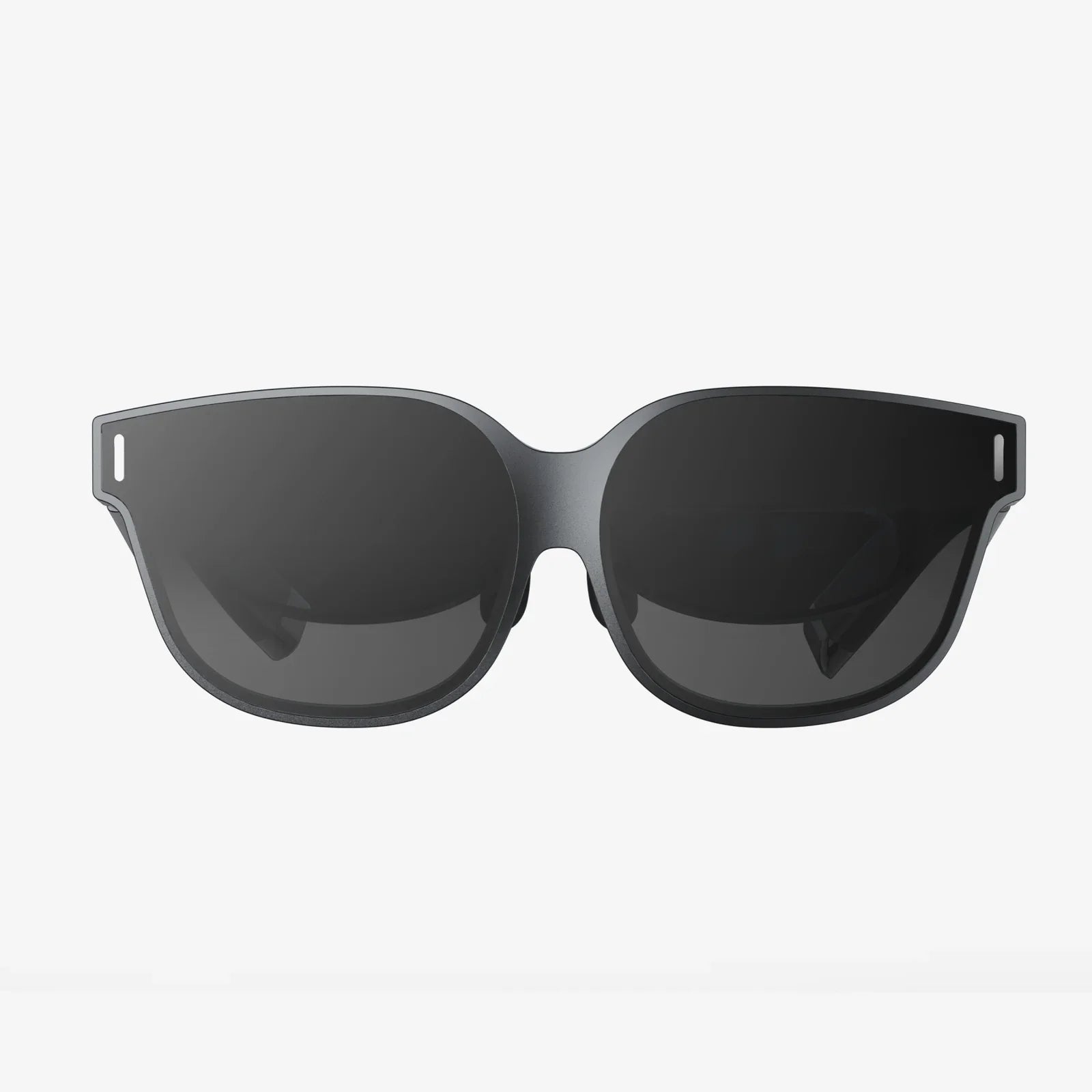
- Smart Glasses and Headsets: These represent the future of AR. They use either optical see-through (where digital images are projected onto transparent lenses) or video see-through (where cameras capture the outside world and display it on internal screens with the AR overlay) to create a hands-free, immersive experience. These wearables aim to make the technology a seamless part of everyday life.
A Spectrum of Experience: Marker-Based vs. Markerless AR
AR experiences can be broadly categorized based on how they anchor digital content to the real world.
Marker-Based AR
This was the early, more primitive form of AR. It relies on a predefined visual marker—often a black-and-white QR code or a specific image—to trigger the digital overlay. The camera identifies the unique pattern of the marker, which acts as a anchor point and tells the software where and how to display the content. While limited because it requires a specific trigger object, it is highly reliable and is still used in packaging, manuals, and certain marketing campaigns.
Markerless AR
This is the more advanced and flexible approach, enabled by SLAM and depth sensing. Markerless AR does not require a specific trigger image. Instead, it uses the natural features of the environment itself as the anchor. This allows for digital content to be placed on any surface, attached to any object, or fixed to a specific GPS coordinate. This is the technology behind furniture apps that let you place a virtual sofa in your living room or navigation apps that overlay directions onto the street in front of you.
Beyond the Hype: Transformative Applications Across Industries
The true power of understanding augmented reality is revealed not in its technology, but in its application. Its potential to revolutionize sectors is already being realized.
Revolutionizing Retail and E-Commerce
AR is solving the fundamental problem of online shopping: the inability to try before you buy. Apps now allow consumers to see how a pair of glasses looks on their face, how a new shade of paint transforms their wall, or how a piece of furniture fits and looks in their actual living space. This "try-it-on" and "see-it-in-your-home" functionality drastically reduces purchase uncertainty and return rates, creating a more confident and satisfying customer journey.
Enhancing Industrial and Manufacturing Workflows
In factories, warehouses, and on construction sites, AR is a powerful tool for efficiency and accuracy. Technicians wearing AR glasses can see schematics and repair instructions overlaid directly onto the machinery they are fixing. Warehouse workers can have the most efficient picking routes and item information displayed in their field of view, freeing their hands for work. Architects and engineers can visualize full-scale building models on empty plots of land, identifying potential design clashes before construction even begins.
Transforming Education and Training
AR brings learning to life. Instead of reading about the solar system, students can watch planets orbit around them in their classroom. Medical students can practice complex surgical procedures on detailed, interactive 3D holograms of the human body without risk. Historical events can be reenacted on a student's desk, making abstract concepts tangible and deeply memorable. This experiential learning fosters deeper engagement and understanding.
Redefining Healthcare
Beyond training, AR is assisting in live patient care. Surgeons can use AR headsets to view critical patient data, such as heart rate or a 3D model of a tumor from a recent MRI scan, without looking away from the operating table. This keeps them focused and informed. It can also aid in incredibly precise procedures, such as vein visualization for injections, making difficult sticks easier and less painful for patients.
Enriching Navigation and Tourism
Walking through a new city becomes an interactive history lesson with AR. Pointing a device at a monument could reveal its history, show historical images, or play a narration. Indoor navigation in complex spaces like airports or shopping malls becomes intuitive with arrows and directions painted onto the floor through your phone's screen. This contextual, location-based information layer turns every environment into an opportunity for discovery.
The Flip Side: Challenges and Ethical Considerations
As with any transformative technology, the path forward is not without significant hurdles and profound questions.
Technical and Social Hurdles
For AR to achieve its full potential, several challenges remain. Hardware needs to become smaller, lighter, more powerful, and have all-day battery life to be truly wearable. The "social acceptance" of walking around in public with a computer on your face is still a barrier. Furthermore, creating a robust and universal "AR cloud"—a persistent, shared digital layer over the world that everyone can access and contribute to—is a monumental technical undertaking.
Privacy in an Augmented World
This is perhaps the most critical issue. AR devices, by their very nature, are constantly scanning and recording the environment. This raises alarming privacy concerns: Who has access to this video and depth data? How is it stored and used? Could we see a world of constant, unsolicited facial recognition and targeted advertising based on what we look at and where we go? Establishing clear ethical guidelines and robust legal frameworks to prevent misuse and protect individual privacy is paramount.
The Digital Divide and Reality Blur
There is a risk that AR could exacerbate the digital divide, creating a world where a data-rich augmented experience is available only to those who can afford it. There are also concerns about the psychological effects of blurring the lines between the real and the virtual. Will we become more disconnected from genuine physical interaction? Could persistent digital graffiti deface our public and private spaces? These are societal questions that must be addressed as the technology evolves.
The Road Ahead: The Future is Layered
The evolution of AR is moving towards more seamless, context-aware, and intelligent systems. We are progressing towards AR glasses that look like ordinary eyewear, powered by AI assistants that understand our environment and our needs without explicit commands. The future may involve neural interfaces that project information directly into our perception, eliminating the need for screens altogether. This concept of "ambient computing"—where technology fades into the background and simply serves us—is the ultimate endpoint of AR development.
We are standing at the precipice of a new era, one where our reality becomes a customizable canvas. Understanding augmented reality is the first step in navigating this new world, not just as passive consumers, but as informed citizens who can shape its development. The digital layer is coming; the question is no longer if, but how we will choose to build it, regulate it, and ultimately, how we will allow it to enhance our human experience without diminishing our humanity. The power to define this future—to ensure it is equitable, ethical, and truly enriching—lies in our hands today.
Share:
Intelligence Smart Glass: The Invisible Revolution Transforming Our Digital and Physical Worlds
Eye Glasses Real or Virtual Image: The Physics of Correcting Your Vision