


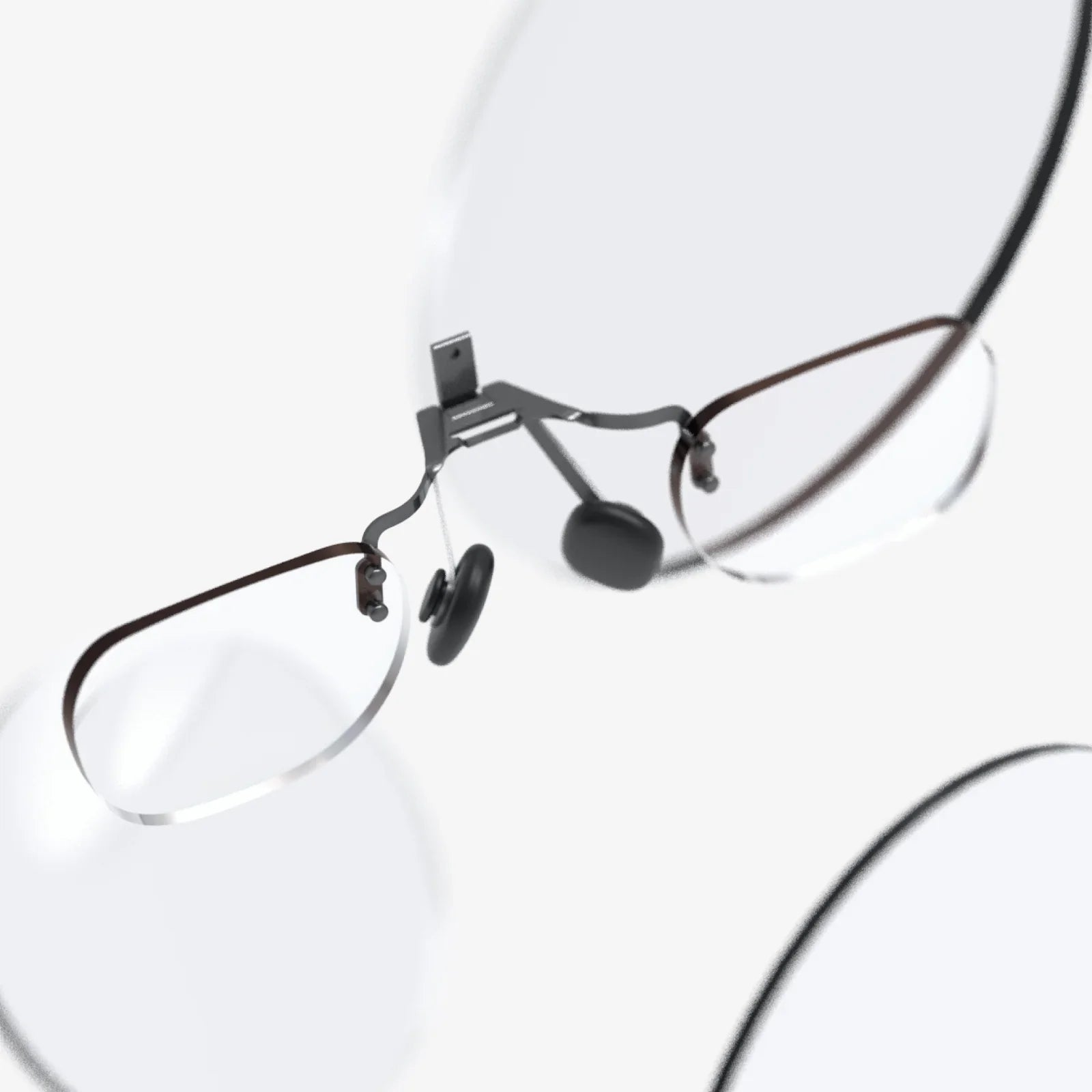
Imagine a world where information doesn't live on a screen in your hand, but floats in the air before your eyes. Where your workplace can be a sun-drenched beach, your instructor can be a hologram in your living room, and the line between the digital realm and physical reality isn't just blurred—it's erased. This isn't a distant sci-fi fantasy; it's the imminent future being built today at the powerful intersection of virtual reality apps and smart glasses, a technological synergy poised to revolutionize every facet of our lives.
The Confluence of Two Revolutionary Technologies
For years, virtual reality and augmented reality have traveled on parallel, often distinct, paths. Virtual reality offered deep, immersive escapism, typically through bulky headsets that transported users to completely digital environments. On the other hand, early iterations of smart glasses attempted to overlay useful information onto the real world, often struggling with limited functionality, social acceptance, and clunky design. The true revolution begins not with either technology alone, but with their fusion. The modern smart glass form factor is becoming the preferred vehicle for advanced virtual and augmented reality applications, creating a seamless continuum of experience.
This convergence is powered by a dramatic miniaturization of powerful components. Inside the sleek frames of contemporary smart glasses reside micro-OLED displays with stunning clarity, spatial audio speakers, a suite of cameras and sensors for mapping the environment, and sophisticated processors that understand the world in real-time. This hardware is the canvas, but the virtual reality app is the paint, brush, and artist combined. These sophisticated applications leverage the hardware to either replace the user's reality with a digital one or augment it with persistent, interactive digital layers.
Beyond Gaming: The Expansive Ecosystem of Use Cases
While immersive gaming remains a powerful driver, the application of this technology extends far beyond entertainment, infiltrating and enhancing core aspects of professional and personal life.
Redefining the Modern Workplace
The concept of the office is being fundamentally rewritten. Virtual reality apps on smart glasses enable truly immersive remote collaboration. Instead of a grid of faces on a video call, colleagues from across the globe can appear as life-like avatars in a shared virtual meeting room, able to interact with 3D models of a new product design, brainstorm on a virtual whiteboard, or walk through architectural plans at full scale. This fosters a sense of presence
and shared space that flat screens cannot replicate, boosting creativity and streamlining complex decision-making processes.
In fields like manufacturing, engineering, and medicine, the implications are even more profound. A surgeon could see critical patient vitals and anatomical guides overlayed directly onto their field of view during a procedure. A field engineer repairing a complex piece of machinery could have schematics, step-by-step instructions, and a remote expert's annotations visually pinned to the equipment in front of them, freeing their hands and dramatically reducing errors and downtime.
Transforming Education and Training
Learning is transitioning from a passive to an active, experiential endeavor. Imagine a medical student practicing a delicate surgical procedure on a hyper-realistic virtual patient, or a history class not just reading about ancient Rome but walking through a meticulously reconstructed virtual Forum. Virtual reality apps delivered through smart glasses allow for safe, repeatable, and cost-effective training in high-risk fields like aviation, firefighting, and law enforcement. This experiential learning paradigm dramatically improves knowledge retention and skill acquisition.
Revolutionizing Social Connection and Storytelling
Social media is evolving from a timeline of photos and text into a shared spatial experience. Instead of sending a text message, you could leave a virtual note for a family member on their refrigerator door, visible only through their glasses. Friends separated by oceans could meet up
in a virtual world to watch a movie together on a giant screen, feeling as if they are sitting side-by-side. Storytelling, too, becomes an immersive art form. You are no longer just watching a story unfold on a screen; you are standing within it, able to look around and explore the narrative environment from any angle.
The Architectural Marvel: How the Technology Works in Concert
The magic of this experience is delivered through a complex and elegant dance of hardware and software.
- Spatial Mapping and Computer Vision: Cameras and sensors on the glasses continuously scan the environment to create a real-time 3D map. This allows the virtual reality app to understand the geometry of the room, the position of surfaces, and the location of objects, so digital content can be placed and occluded correctly within the physical space.
- Precise Positional Tracking: Using a combination of inertial measurement units and visual data, the glasses track their own position and orientation in space with millimeter accuracy. This ensures that as you move your head, the digital world remains stable and anchored, preventing disorientation and creating a convincing sense of immersion.
- The Display Pipeline: High-resolution micro-displays project light through advanced waveguides or holographic optical elements embedded in the lenses. These waveguides bend the light, directing it into the user's eyes to form a sharp image that appears to be out in the world, not right on the lens.
-
Intuitive Interaction: Interaction is moving beyond controllers. Voice commands, hand-tracking that allows users to
grab
and manipulate virtual objects with their fingers, and even emerging technologies like neural interfaces are creating more natural and intuitive ways to communicate with the digital layer.
Navigating the Labyrinth: Challenges and Considerations
Despite the breathtaking potential, the path to ubiquitous adoption is not without significant hurdles that developers and society must address.
The Social Hurdle: From Geek to Chic
Technology must be not only powerful but also socially acceptable. The success of this paradigm hinges on creating smart glasses that people actually want to wear all day. This demands a relentless focus on aesthetics, making them indistinguishable from, or even more desirable than, traditional eyewear. They must be lightweight, comfortable, and offer all-day battery life. Overcoming the cyborg
stigma is perhaps the single greatest barrier to mainstream adoption.
The Privacy Imperative
Devices with always-on cameras and microphones worn on one's face represent a profound privacy challenge. The industry must establish and adhere to ironclad ethical standards. Features like recording indicator lights that cannot be disabled, transparent data usage policies, and on-device processing for sensitive data are non-negotiable. Users must have complete control over their data and when they are being recorded. Building trust is paramount.
Battery Life and Computational Power
High-fidelity graphics and constant sensor data processing are incredibly power-intensive. Pushing for longer battery life while maintaining a small, comfortable form factor is a constant engineering battle. Solutions include more efficient processors, low-power modes for simple tasks, and the potential for offloading heavy computation to a powerful companion device in your pocket.
Avoiding Digital Divides and Physical Dangers
As with any transformative technology, there is a risk of exacerbating social and economic inequalities. Ensuring equitable access will be crucial. Furthermore, immersing oneself in a digital world while navigating the physical one presents obvious safety concerns. Developing robust digital guardians and safety protocols to prevent accidents is essential.
Glimpsing the Horizon: The Future Forged in Light and Code
The trajectory of this technology points toward a future that is increasingly context-aware, personalized, and seamlessly integrated. We are moving toward photorealistic avatars for telepresence, AI assistants that can see what you see and offer contextually relevant information, and persistent digital worlds mapped perfectly onto our own. The ultimate goal is a technology that fades into the background—a silent, intelligent partner that enhances our perception of reality without overwhelming it.
The journey from a clunky novelty to an indispensable personal computer for your face is already underway. The combination of virtual reality apps and smart glasses represents more than just a new gadget; it is a fundamental shift in the human-computer interface. It’s a portal to new worlds, a tool for unprecedented productivity, and a lens through which we will reinterpret our own reality. The device that will finally unlock the full potential of the spatial computing era is not in a lab; it’s evolving rapidly, soon to be perched on the noses of millions, ready to change everything we know about seeing, doing, and connecting.
Share:
How Will Virtual Reality Change Business: The Next Digital Revolution
What Is Virtual Reality Simple Definition: A Deep Dive Into The Digital Universe