


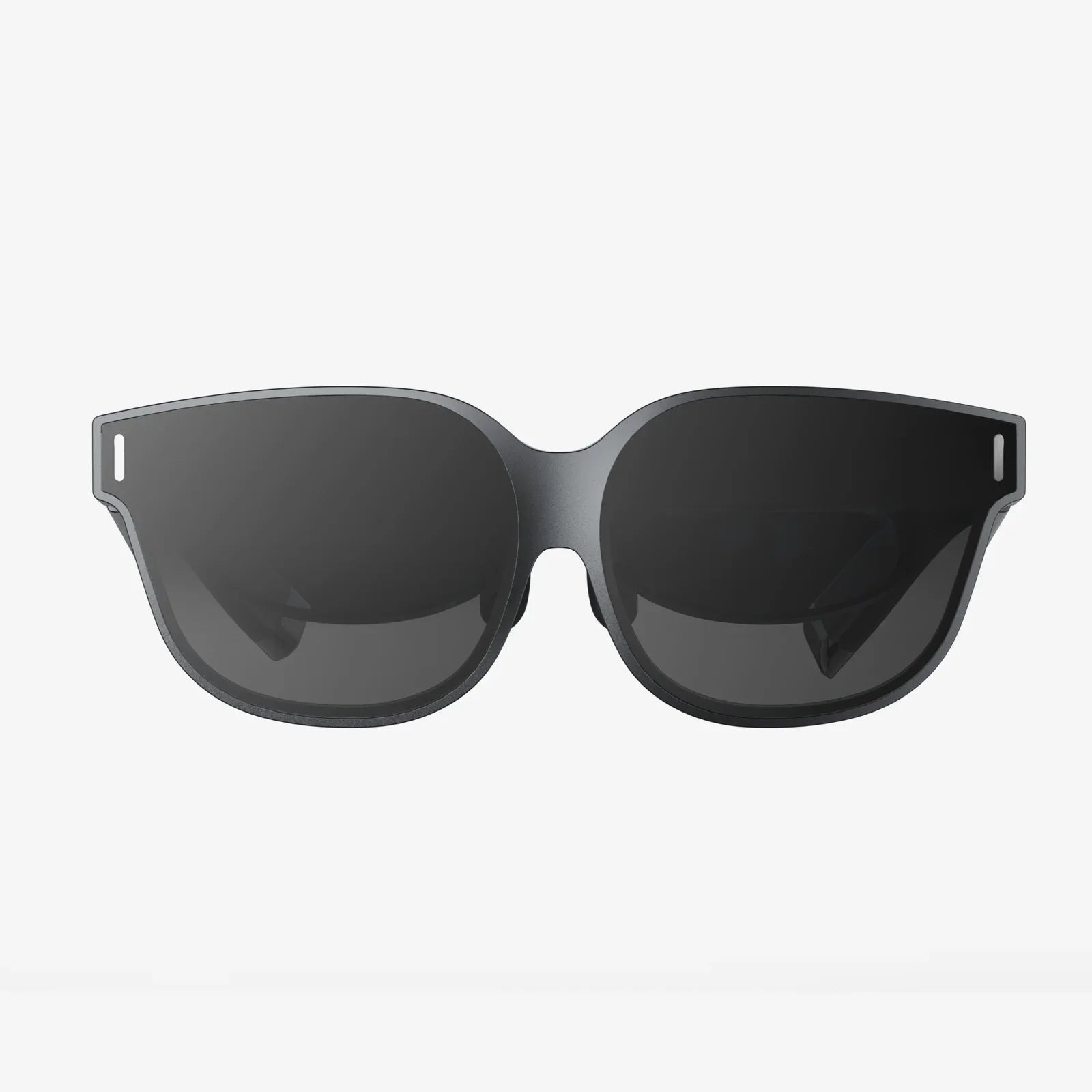
You slip on a pair of sleek frames, and the world around you transforms. Data overlays your field of vision, digital creatures scamper across your coffee table, and a navigational arrow hovers on the road ahead. It feels like magic, like a future promised to us in countless science fiction tales. But have you ever stopped to wonder, who first dared to imagine this reality? Who built the first bridge between our tangible world and the limitless digital one? The quest to uncover who created AR glasses is a journey through time, filled with forgotten prototypes, military-grade experiments, and visionaries who saw potential in the impossible long before the world was ready.
The Conceptual Dawn: From Sci-Fi to Science Fact
Long before engineers etched circuits onto silicon, the foundational idea of augmented reality was being sketched out in the pages of literature and on movie screens. These creators, though not building physical hardware, were the essential first architects of the concept. They provided the blueprint, the why that would later inspire the how.
In 1901, L. Frank Baum, the author of The Wonderful Wizard of Oz, published a lesser-known work titled The Master Key. In it, he described a set of character-revealing spectacles, a primitive concept of data overlay. Decades later, in 1968, author and computer scientist Ivan Sutherland gifted the world with a more tangible vision. His seminal paper, A Head-Mounted Three Dimensional Display, laid out the theoretical framework for a device that would serve as "a window into a virtual world." While his own creation, The Sword of Damocles, was a Virtual Reality device, its principles of head-worn, immersive computing were the direct progenitor of all head-mounted displays to follow, making Sutherland one of the most crucial intellectual creators of the field.
The Military-Industrial Complex: Breeding Ground for Innovation
If science fiction authors provided the dream, then the immense research and development budgets of the military-industrial complex provided the crucible. The need for superior situational awareness on the battlefield and in the cockpit drove the creation of the first true functional AR systems.
In the 1960s, a Harvard professor and computer graphics pioneer named Ivan Sutherland, funded by the Defense Advanced Research Projects Agency (DARPA) and the Office of Naval Research, created "The Sword of Damocles." This monstrous head-mounted display is widely considered the first-ever head-mounted display (HMD) system. It was so heavy it had to be suspended from the ceiling, and its crude wireframe graphics were a far cry from today's photorealistic overlays. Yet, it contained the essential DNA of all AR and VR to come: a stereoscopic display that transformed digital information into a perceived three-dimensional space.
The baton was then picked up by the U.S. Air Force. Throughout the 1980s and 1990s, their research into virtual fixtures and advanced cockpit displays pushed the technology forward. Engineers and scientists at the Armstrong Laboratory worked on projects that aimed to overlay targeting information and flight data directly onto a pilot's visor, creating the first heads-up displays (HUDs) that evolved into more advanced helmet-mounted sights. These teams, operating in secrecy, were the unsung creators of the rugged, high-performance display technology that would later be miniaturized for consumer use.
A Name in the Ledger: The First "Augmented Reality" System
While many were building components, it was an aircraft company employee who first assembled the pieces and gave the technology its name. In 1990, Tom Caudell, a researcher at Boeing, was working with a colleague, David Mizell, to solve a complex problem: simplifying the arduous process of assembling miles of wiring in aircraft cabins. Instead of relying on bulky physical diagrams and manuals, they conceived of a head-mounted display that would project digital, animated wire diagrams and instructions directly onto the physical boards where workers would assemble them.
Faced with describing this new technology, Caudell rejected terms like "virtual reality" because the system wasn't creating a new world; it was enhancing the existing one. He coined the term "Augmented Reality" to define it. While the Boeing system was a specialized industrial tool and not a consumer product, its creation marked a pivotal moment. Caudell and Mizell were the first to conceptualize and name a practical, industrial application for the technology that we now universally call AR.
The Academic Architects: Building the Foundation
Parallel to military and industrial research, academia became a hotbed for innovation, pushing the boundaries of what AR could do. University labs, free from immediate commercial or military constraints, became the playground for pure research that would prove essential.
In 1992, Louis Rosenberg developed the Virtual Fixtures system at the U.S. Air Force's Armstrong Laboratory. This was a staggering achievement—a fully immersive AR system that used an exoskeleton to allow users to manipulate physical objects in a environment augmented by virtual overlays that improved human precision. It was one of the first functional AR systems to demonstrate complex user interaction.
Perhaps the most significant academic contribution came from a team at Columbia University. In 1996, Steve Feiner, Blair MacIntyre, and Doree Seligmann unveiled the KARMA (Knowledge-based Augmented Reality for Maintenance Assistance) system. Using a see-through HMD, KARMA provided real-time graphical overlay instructions for repairing a laser printer. It was a landmark project that demonstrated the powerful potential of AR for knowledge transfer and complex task completion, a concept that now underpins enterprise AR applications worldwide. These academics were not creating commercial glasses, but they were creating the indispensable software and interaction paradigms that would make them useful.
The 21st Century Surge: Miniaturization and the Modern Era
The turn of the millennium saw the necessary technologies—processing power, miniaturized sensors, display technology, and battery life—finally begin to converge. This period shifted the question from "Who created AR?" to "Who will perfect it for the mass market?"
A huge leap forward came from a team many don't associate with hardware: a company known for its internet search engine. In 2013, they unveiled a prototype that shocked the world: a pair of glasses that could record video, provide directions, answer questions, and translate languages in real time, all hands-free. While the project was ultimately shelved as a consumer product, its public demonstration was a cultural touchstone. It proved that functional, if still imperfect, AR glasses were possible outside of a lab, inspiring a wave of developers and companies to enter the space. The team of engineers and designers behind this project played an outsized role in catalyzing the modern AR industry.
This era also saw the rise of specialized enterprise AR. Companies like Vuzix and others, building on decades of display technology, began creating ruggedized smart glasses for logistics, manufacturing, and field service. These were not created by a single individual but by large, focused teams of optical engineers, software developers, and industrial designers solving specific, high-value problems for businesses. Their work proved the commercial viability of AR outside of gaming and entertainment.
The Myth of the Lone Creator and the Reality of Collaborative Genius
So, who truly created AR glasses? The answer is that there is no single answer. The development of augmented reality eyewear is the antithesis of the "lone genius in a garage" myth. It is a story of collaborative, iterative genius across generations.
- Ivan Sutherland created the foundational HMD technology.
- Military Engineers refined it for performance and survival in extreme conditions.
- Tom Caudell & David Mizell gave it a name and a practical purpose.
- Academic Researchers like Louis Rosenberg and Steve Feiner built the interactive software frameworks.
- 21st-Century Tech Teams miniaturized the components and connected it to the cloud.
Each creator stood on the shoulders of giants who came before, adding a critical piece to the puzzle. The AR glasses we see emerging today are the culmination of this relentless, multi-decade collaboration. They are a fusion of optics, computer vision, material science, and artificial intelligence, each field representing the work of thousands of dedicated individuals.
This legacy continues today. The next chapter is being written by researchers developing holographic waveguides, engineers creating more powerful and efficient micro-LED displays, and software developers crafting the next generation of AR applications. The creation of AR glasses is not a finished event but an ongoing process, a symphony of innovation where new players constantly add their voice to the chorus. The true creator of the ultimate AR glasses may be a collective intelligence—a global network of scientists, engineers, and dreamers—whose final masterpiece has yet to even be revealed.
Imagine a device so intuitive it feels like a natural extension of your own mind, unlocking human potential in ways we can barely fathom. That future is being built now, not in a secret lab under one person's name, but through the combined legacy of all those who ever dared to look at an empty pair of frames and see a new way of looking at everything.
Share:
Virtual Reality in Retail Market Size: A Deep Dive into the Billion-Dollar Transformation
Best 3D Home Theater System: Your Ultimate Guide to Immersive Entertainment