


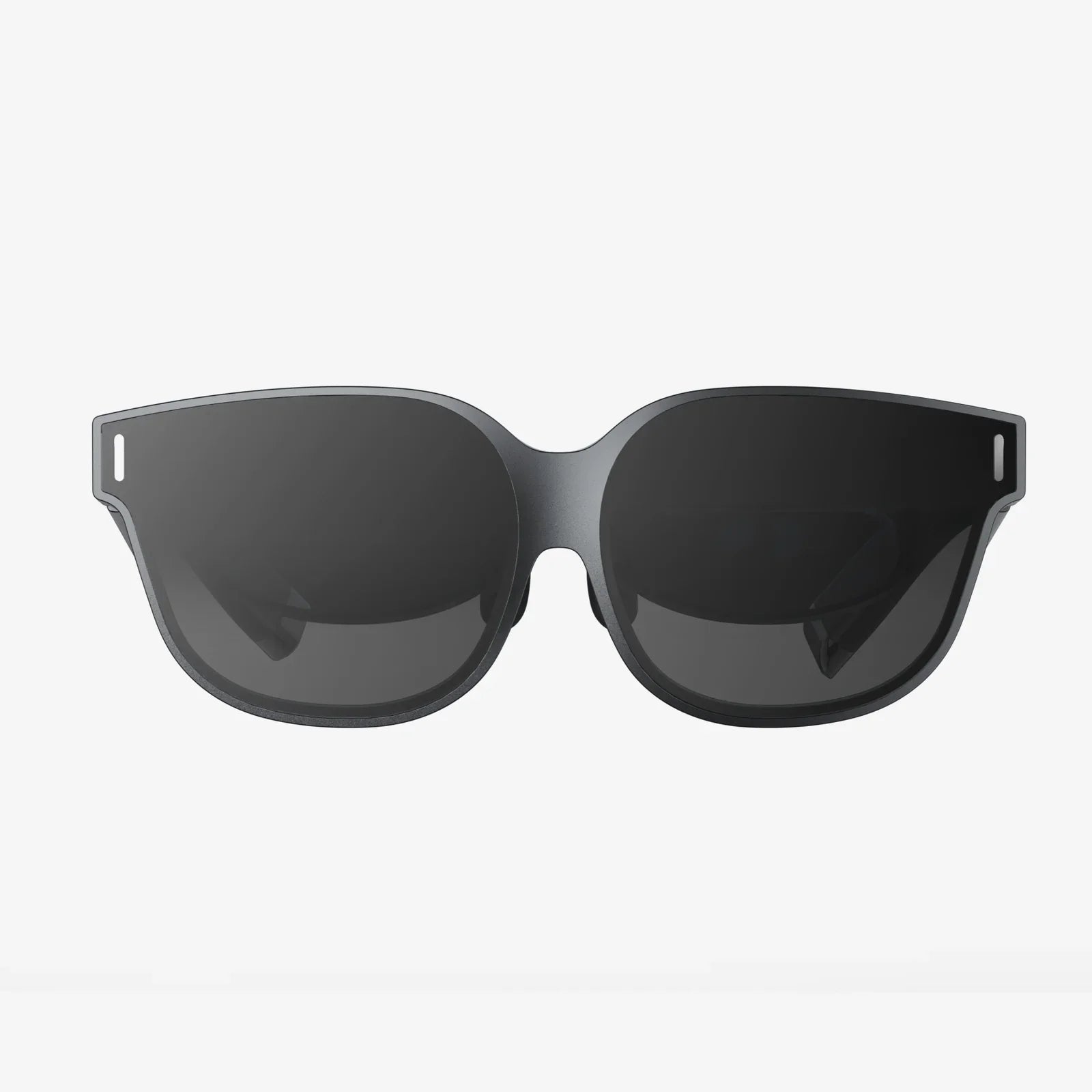
Imagine a world where information doesn't live on a screen in your hand, but is seamlessly woven into the very fabric of your reality. A world where your field of view becomes a dynamic canvas for knowledge, communication, and imagination. This is not a distant science fiction fantasy; it is the imminent future being unlocked by a single, transformative technology: augmented reality glasses. The question is no longer if they will become a ubiquitous part of our lives, but why we will choose to embrace them, and in doing so, fundamentally redefine our relationship with technology and with each other.
Beyond the Gimmick: From Novelty to Necessity
The journey of augmented reality (AR) has been one of gradual, yet accelerating, maturation. For years, it existed primarily on smartphone screens—a clever trick that required users to hold up a device, effectively creating a barrier between them and the experience. AR glasses shatter that barrier. They represent the logical, and perhaps ultimate, endpoint of personal computing: a technology that doesn't demand our attention but enhances it; one that works for us in the periphery of our vision until we need it, rather than demanding we step into its world.
The skepticism is understandable. Early iterations of any transformative technology are often clunky, expensive, and limited in scope. But to dismiss AR glasses based on their current embryonic form would be akin to dismissing the personal computer in the 1970s because it couldn‘t stream 4K video. The trajectory is clear. The hardware will become lighter, more powerful, and socially acceptable. The software will become more intuitive and contextually aware. And the network infrastructure, including edge computing and 5G/6G, will provide the low-latency, high-bandwidth backbone required for truly seamless experiences. We are on the cusp of crossing the chasm from novelty to necessity.
The Unseen Engine: Spatial Computing and Contextual Awareness
At the heart of why AR glasses matter is the paradigm of spatial computing. Unlike traditional computing, which is confined to a 2D rectangle, spatial computing understands and interacts with the three-dimensional world. AR glasses are the primary interface for this new paradigm. They are equipped with a sophisticated array of sensors—cameras, LiDAR, depth sensors, and inertial measurement units—that constantly scan and map the environment. This allows the device to understand not just what it is looking at, but the geometry, spatial relationships, and context of the scene.
This contextual awareness is the magic ingredient. It enables digital content to not just overlay the real world, but to interact with it convincingly. A virtual pet can hide behind your real sofa. Navigation arrows can be painted onto the road itself, not just on a abstract map. An instruction manual can highlight the exact bolt on a machine engine that needs to be tightened. This deep integration of the digital and physical creates a sense of presence and utility that is impossible to achieve with any other device.
Revolutionizing the Way We Work and Create
Perhaps the most immediate and powerful application for AR glasses lies in the professional sphere. They promise to untether knowledge workers and frontline workers alike from static workstations, unleashing new levels of efficiency, safety, and collaboration.
The Demise of the Desktop
For the knowledge economy, AR glasses can replace the multi-monitor setup with an infinite, virtual canvas. Imagine a financial analyst examining 3D data visualizations that float in their office, manipulating complex models with gestures. Or a software developer who can see their code on one virtual screen, a live deployment dashboard on another, and a video call with a colleague in a third, all while pacing around the room. This is not just about convenience; it’s about expanding cognitive bandwidth by leveraging our natural spatial memory and freeing ourselves from the physical constraints of traditional hardware.
Empowering the Hands-On Workforce
The impact on fields like manufacturing, logistics, field service, and healthcare is even more profound. AR glasses can provide:
- Remote Expertise: A senior engineer located across the globe can see what a field technician sees, annotate their field of view with arrows and notes, and guide them through a complex repair in real-time, drastically reducing downtime and travel costs.
- Digital Work Instructions: Instead of juggling clipboards or tablets, a warehouse worker can see picking instructions and inventory locations overlaid directly on the shelves. A surgeon can have vital patient statistics and imaging data visible without looking away from the operating table.
- Enhanced Safety: Glasses can highlight potential hazards, provide real-time safety protocol reminders, or warn a technician if they are about to touch a live component.
Transforming How We Connect and Socialize
Human connection is the next frontier. Current digital communication tools—video calls, text messages, social media feeds—are notoriously poor at conveying the nuance and presence of face-to-face interaction. They flatten us into 2D images and text. AR glasses have the potential to create a new form of communication: shared presence.
Imagine sharing a experience with a loved one who is physically distant. You could watch a virtual movie together on a virtual big screen, feeling as if you are sitting side-by-side on the same couch. A grandparent could read a bedtime story to their grandchild, with animated characters from the book popping out and dancing around the room for both of them to see. Colleagues from around the world could collaborate around a virtual 3D prototype as if it were physically in the room with them. This technology promises to make digital interaction feel less like staring at a window into someone else‘s world and more like being together in a shared, hybrid space.
Redefining Learning and Exploring Our World
AR glasses are the ultimate tool for contextual learning. They can unlock layers of information hidden within our environment, turning the entire world into an interactive classroom and museum.
- Education: History students walking through ancient ruins could see digitally reconstructed buildings rise around them. Biology students could dissect a virtual frog or walk through a beating human heart. Complex abstract concepts in physics or mathematics could be visualized and manipulated in 3D space, making them instantly comprehensible.
- Tourism and Culture: A tourist walking through a city could see historical photographs overlaid on modern buildings, get translations of street signs instantly, or follow a virtual guide who points out hidden details. Art galleries could allow visitors to see the layers of a painting, the artist‘s sketches, or historical context for a piece, all by simply looking at it.
- Personal Memory Aid: In a more personal application, glasses could act as a perfect memory aid, subtly displaying the name of a person you just met or reminding you where you left your keys by highlighting them in the room.
Navigating the Inevitable Challenges
The path to widespread adoption is not without significant hurdles. These challenges are not merely technical but deeply societal and ethical.
Privacy and the Societal Contract: A device that constantly captures video and audio of its surroundings is a privacy advocate‘s nightmare. The potential for surveillance, both corporate and governmental, is immense. The solution will not be purely technological but will require a new societal contract—clear, transparent, and strict regulations on data collection, usage, and retention. Features like a physical shutter light or clear audio indicators when recording will be non-negotiable for building public trust.
The Digital Divide and Accessibility: As with any powerful technology, there is a risk that AR glasses could exacerbate existing inequalities. Ensuring they are affordable, accessible to people with disabilities, and designed for a global audience will be critical to preventing a new form of digital exclusion.
Social Acceptance and Etiquette: The sight of people seemingly talking to themselves or gesturing at the air will take time to normalize. New social etiquette will need to evolve. When is it rude to wear glasses during a conversation? How do we signal to others that we are fully present versus distracted by digital content? These are social questions that will be answered through use and time.
A New Lens on Reality
The ultimate "why" for augmented reality glasses is that they represent a more human-centric future for technology. They promise to end our slavery to the black mirror in our pockets, not by removing information, but by integrating it into our lives in a more natural, intuitive, and empowering way. They have the potential to make us more knowledgeable workers, more connected friends and family members, more effective learners, and more engaged citizens of the world. They are not about escaping reality, but about enhancing it, annotating it, and understanding it more deeply. The screen has served us well, but it is a limiting, isolating portal. Augmented reality glasses offer us something far more profound: a true window, one where the digital and physical finally converge to expand the very horizon of human experience.
We stand at the precipice of a new era, one where the line between the digital and the physical will blur into irrelevance. The device that will catalyze this shift isn't a faster phone or a bigger screen; it's a pair of intelligent lenses that will quite literally change our perspective on everything. The world is about to gain a new layer, and those who choose to look through it will find themselves at the forefront of a revolution more intimate and transformative than any that has come before.
Share:
Smart Glasses Integration with Phones: The Seamless Future of Personal Computing
More Wearable Tech: The Seamless Integration of Intelligence into Our Daily Lives