


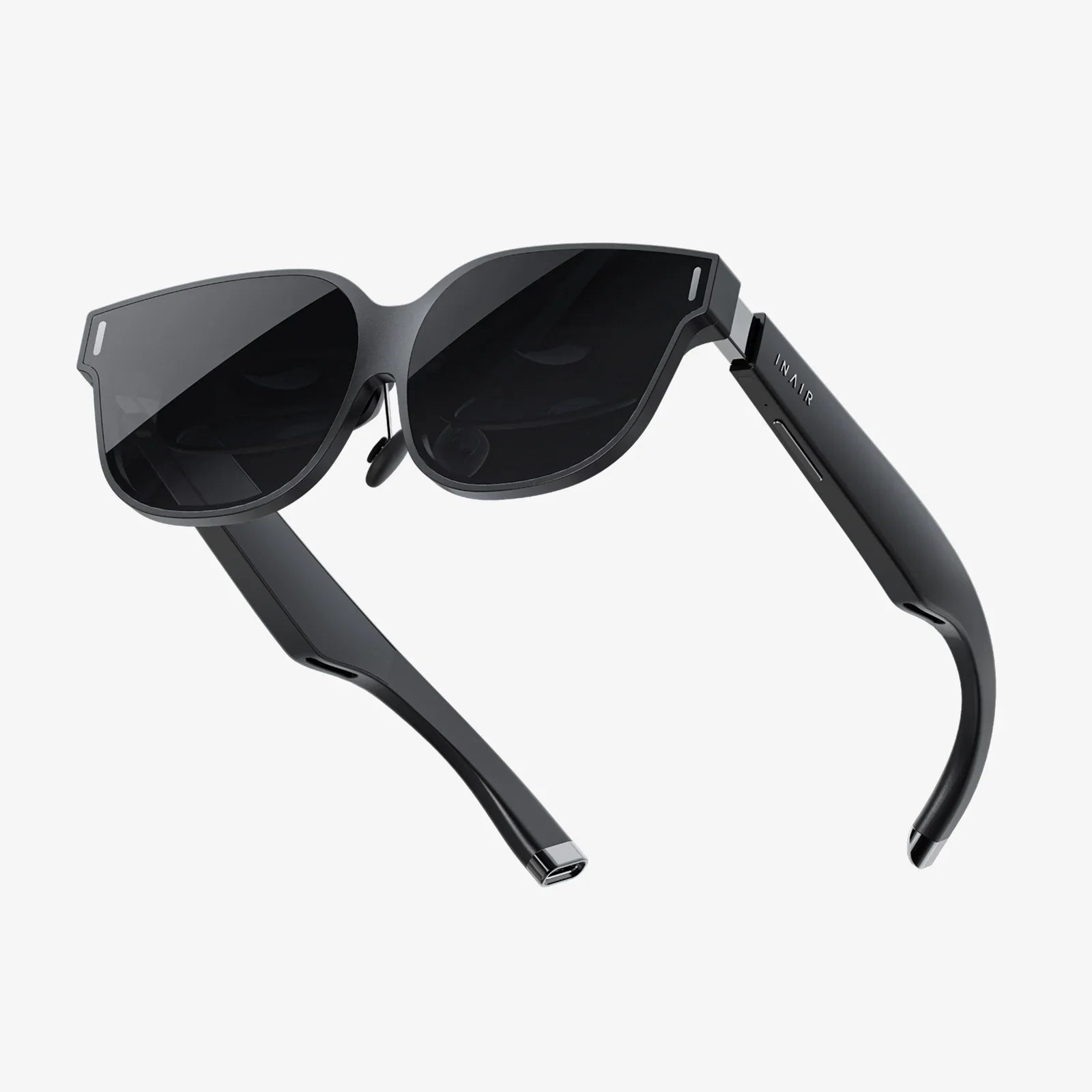
- by wangfred
Why Was Augmented Reality Created: Bridging the Digital and Physical Worlds
- by wangfred
Imagine a world where the digital and the physical are no longer separate realms, where information doesn't just live on a screen but is painted onto the very fabric of your reality. This is the promise of augmented reality, a technology whose origins are far more profound and purposeful than a simple quest for novelty. The story of why augmented reality was created is a fascinating tapestry woven from threads of human ambition, technological necessity, and a deep-seated desire to expand the very limits of our perception.
Long before the hardware existed to make it a reality, the seed of augmented reality was planted in the human imagination. The fundamental why stems from an innate human drive to enhance our capabilities and interact with information in more intuitive ways. We have always used tools to extend our reach and our senses—from the telescope that brought the stars closer to the written word that preserved knowledge. Augmented reality is the logical next step in this evolution: a tool to extend our perception of reality itself.
This concept was powerfully articulated in 1990 by researchers Tom Caudell and David Mizell of Boeing. While working on an experimental project to simplify the complex process of assembling aircraft wiring harnesses, they coined the term "augmented reality." They envisioned a head-mounted display that would overlay digital diagrams and instructions onto the physical wiring boards, guiding workers step-by-step. Their creation was a direct response to a critical industrial need: reducing error, cutting costs, and managing increasingly complex data. This was not about entertainment; it was about solving a tangible, high-stakes problem by seamlessly integrating digital information into a physical task.
However, the philosophical underpinnings go back even further. In 1968, computer scientist Ivan Sutherland, often called the "father of computer graphics," created "The Sword of Damocles," widely considered the first head-mounted display system. While primitive and terrifying in appearance, it was a proof-of-concept for a window into a virtual world. Sutherland’s work, though foundational for virtual reality, established the core principle of mediating our view of the world with computer-generated graphics. The intent was to explore new paradigms of human-computer interaction, to create displays that could show information that didn't exist in the real world but was crucial for the user. The goal was amplifying human intelligence.
If the philosophers and computer scientists provided the blueprint, it was often the military and aerospace industries that provided the funding and the urgent, real-world problems necessary to turn theory into reality. The high-stakes, high-budget environments of defense and aviation became the primary incubators for early AR technology.
The most iconic example is the Heads-Up Display (HUD). First developed for fighter pilots in the 1950s and refined over decades, the HUD projects critical flight data—like altitude, speed, and targeting reticles—onto the pilot's canopy or a transparent screen in their line of sight. The purpose was unequivocal: to increase situational awareness and reduce cognitive load. By allowing pilots to keep their "heads up" and focused on the battlefield instead of looking down at their instruments, HUDs dramatically enhanced safety and combat effectiveness. This was augmented reality in its purest, most vital form: contextual information overlaid on the real world to enable faster, better decision-making in life-or-death situations.
This military-driven development didn't stop in the cockpit. Research into augmented reality for ground troops explored systems that could display tactical maps, identify friendly units, or provide schematic overlays of building interiors during operations. The creation of AR in this context was a direct response to the "fog of war"—the age-old problem of incomplete information on the battlefield. The technology was conceived as a tool to cut through that fog, to give soldiers a superhuman understanding of their environment.
Parallel to the military's mission-critical work, academia was exploring AR's potential as the next fundamental shift in how humans interact with computers. The dominant paradigm for decades has been the WIMP interface—Windows, Icons, Menus, Pointer—primarily controlled by a keyboard and mouse. Researchers asked a simple but powerful question: what comes after WIMP?
Pioneers like Steve Mann, who began experimenting with wearable computing and augmented vision in the 1970s and 80s, embodied this pursuit. His work was not funded by a corporate or military goal but by a personal and academic vision of "mediated reality" or "humanistic intelligence," where computers would act as intelligent assistants to our senses rather than demanding our full attention. For these creators, AR was conceived as a way to re-integrate computing back into the natural human environment, moving away from the isolating desktop experience and towards a continuous, ambient flow of information.
Throughout the 1990s and early 2000s, university labs were hotbeds of AR innovation. Researchers developed tracking systems that could accurately align digital content with the physical world, explored new display technologies, and built prototype applications for fields like medicine, maintenance, and navigation. The driving force here was the academic imperative to push the boundaries of knowledge and explore the potential of a technology before the market had defined its use. They were creating AR because they believed it was the next logical step in the evolution of the human-computer interface.
For much of its history, AR was a technology confined to labs, factories, and cockpits. Its creation was justified by solving specific, expensive problems for industry and defense. The catalyst for its explosion into the public consciousness was the proliferation of powerful smartphones. Suddenly, a device with a camera, sensors, a screen, and immense processing power was in billions of pockets.
Early consumer-facing AR was often novelty-driven—overlaying cartoon characters onto live camera feeds or adding digital hats to social media photos. However, beneath the surface, the core reasons for its creation remained. Navigation apps began overlaying directional arrows onto a live view of the street, solving the problem of abstract map interpretation. Furniture retailers created apps that let users see how a digital sofa would look in their actual living room, solving the problem of uncertainty in online shopping. Translation apps could overlay translated text directly onto foreign street signs, breaking down language barriers in real-time.
In the consumer realm, AR was created to enhance everyday experiences, bridge the gap between online and offline commerce, and make information more contextual and immediately actionable. It shifted from a tool for experts to a utility for everyone, fulfilling the original vision of making computing more ambient and integrated into our lives.
Today, the original reasons for creating augmented reality have converged and amplified. It is simultaneously a practical tool and a medium for incredible new experiences.
Ultimately, augmented reality was not created for a single reason. It was born from a confluence of needs: the need to see crucial data without distraction, the need to perform complex tasks with greater accuracy, the need to interact with digital information in a more human way, and the need to tell stories that spill out of the frame. It is a technology that seeks not to replace our world, but to enrich it, inform it, and add a new layer of understanding and magic to our everyday existence. The journey from The Sword of Damocles to the device in your pocket is a unified pursuit of that goal.
The true power of this technology lies not in the novelty of digital overlays, but in its profound ability to contextually connect us to the vast digital universe, transforming how we work, learn, heal, and play by seamlessly weaving that information into the world we already know and see.
Share:
AI Glasses Startup: The Next Frontier in Personal Technology and Human-Computer Interaction
Immersion Augmented Reality: Blurring the Lines Between the Digital and Physical Worlds