


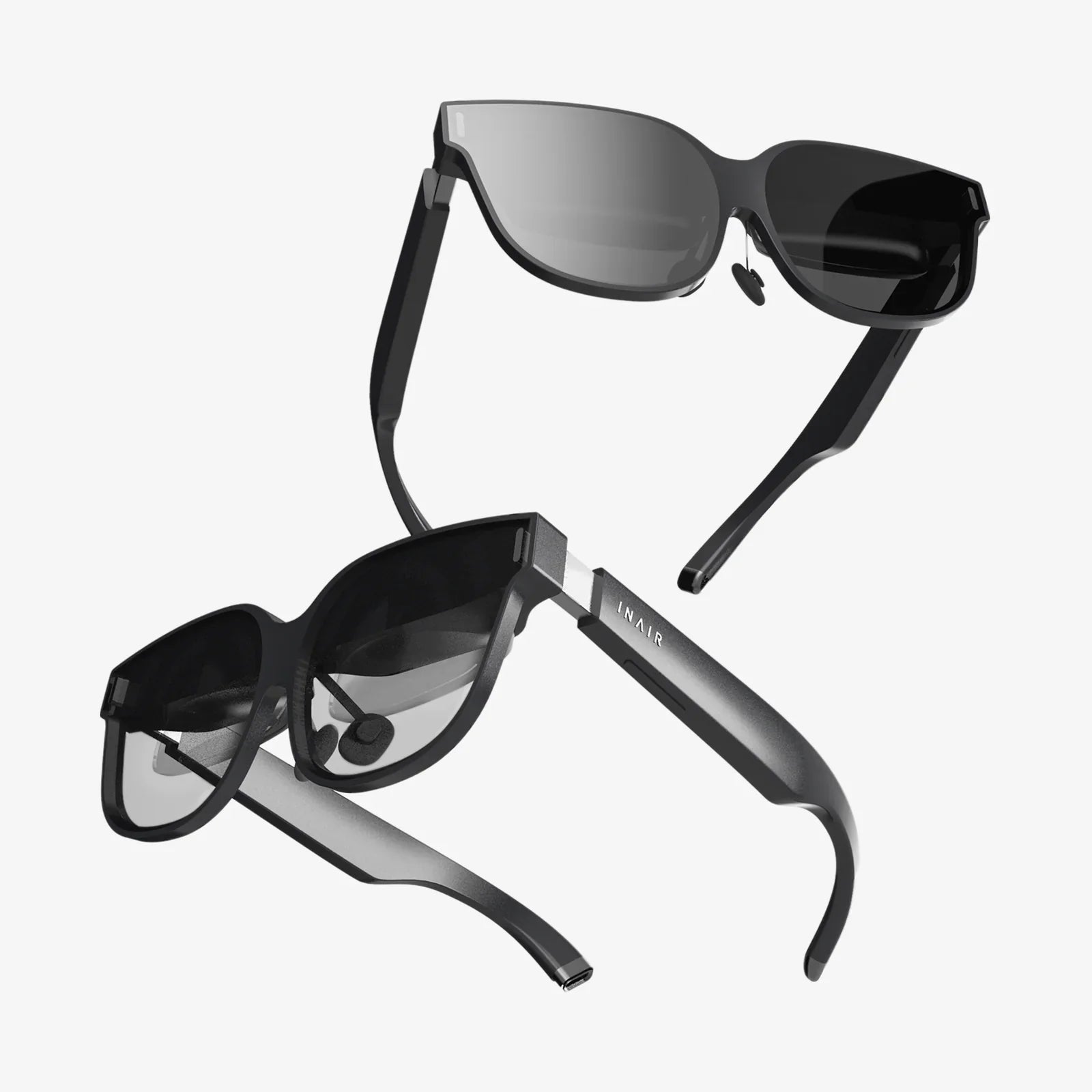
Imagine a world where information doesn't live on a screen in your hand, but floats effortlessly in the air before you, interactively layered onto the very fabric of your reality. This is the promise, the allure, and the imminent future being unlocked by a new class of wearable technology: XR real AR glasses. This isn't science fiction; it's the next great leap in human-computer interaction, a silent revolution poised to reshape everything from how we work and learn to how we connect and play. The boundary between our physical existence and the digital universe is about to dissolve, and it all starts with a pair of glasses.
Demystifying the Spectrum: Understanding XR, AR, and the Hardware Evolution
To truly appreciate the significance of modern XR real AR glasses, we must first untangle the acronyms that define this space. Extended Reality (XR) serves as the overarching umbrella term, encompassing all combined real-and-virtual environments, including its more famous subsets: Virtual Reality (VR), Augmented Reality (AR), and Mixed Reality (MR).
Virtual Reality is an immersive, digital-only experience. It transports the user to a completely computer-generated world, typically achieved through a fully enclosed headset that blocks out the physical environment. Its primary domain is entertainment, simulation, and gaming, creating experiences detached from one's immediate surroundings.
Augmented Reality, the core technology behind the devices we're discussing, is fundamentally different. Rather than replacing your world, AR enhances it. It superimposes digital information—images, text, 3D models, animations—onto your view of the real world through a transparent lens. The earliest, most primitive form of this is the smartphone-based AR we've all experienced, using a device's camera to display digital content on its screen. However, this is a clumsy proxy for the true potential of the technology.
This brings us to the pivotal evolution: XR real AR glasses. These are self-contained, wearable glasses that project digital content directly onto their transparent lenses, allowing you to see your world, unchanged, with a digital layer added on top. They are untethered from phones, designed for all-day wear, and aim to become as ubiquitous and socially acceptable as a standard pair of spectacles. They represent the maturation of AR from a novel app feature into a persistent, contextual, and incredibly powerful computing platform.
The Architectural Marvel: How Real AR Glasses Actually Work
The magic of seeing a digital dinosaur roam your living room or having a navigation arrow painted onto the street is enabled by a sophisticated symphony of hardware components working in perfect harmony. The architecture of these devices is a marvel of modern engineering.
At the heart of the system are the waveguide displays. This is the critical technology that makes sleek, glasses-like form factors possible. Unlike projectors that shine images onto a reflective surface, waveguides are incredibly thin, transparent pieces of glass or plastic etched with microscopic patterns. Light from a micro-LED or laser projector at the temple of the glasses is injected into the waveguide. This light bounces along through internal reflection, interacting with the etchings, before being finally directed out towards the user's eye. The result is a bright, sharp digital image that appears to be floating in the world beyond the lens, all while allowing the user to see their natural environment clearly.
But knowing where to put that image requires the glasses to understand the world. This is achieved through a suite of advanced sensors. Typically, this includes:
- Cameras: Multiple monochrome and RGB cameras continuously scan the environment.
- Depth Sensors: Using technologies like structured light or time-of-flight (ToF) sensors, these components measure the distance to objects, creating a 3D map of the space. This allows digital objects to be occluded behind real-world furniture and interact with physical surfaces.
- Inertial Measurement Units (IMUs): These accelerometers and gyroscopes track the precise movement and rotation of the user's head with incredible speed and accuracy, ensuring the digital content remains locked in place even as you move.
Processing all this sensor data in real-time is a monumental task. It requires a powerful on-device System-on-a-Chip (SoC) specifically designed for spatial computing. This processor handles simultaneous localization and mapping (SLAM), which is the process of constructing a map of an unknown environment while simultaneously tracking the device's location within it. It's this complex, instantaneous understanding of geometry and space that makes convincing AR possible.
Finally, spatial audio completes the illusion. By using tiny speakers near the ears that employ head-related transfer function (HRTF) algorithms, sounds from digital objects can be made to seem like they are coming from specific points in the room around you, further blurring the line between what is real and what is rendered.
Beyond Novelty: The Transformative Industrial and Enterprise Applications
While consumer applications often grab headlines, the most immediate and profound impact of XR real AR glasses is occurring in the enterprise and industrial sectors. Here, the technology is not for entertainment; it is a powerful tool solving critical problems, enhancing safety, and driving unprecedented efficiency.
In manufacturing and field service, technicians wearing AR glasses can have schematic diagrams, instruction manuals, or animated assembly guides overlaid directly onto the machinery they are repairing. A novice engineer can receive remote, real-time guidance from an expert located across the globe, who can literally draw annotations into the novice's field of view, pointing precisely to the component that needs attention. This "see-what-I-see" remote collaboration drastically reduces downtime, minimizes errors, and democratizes expertise.
The healthcare sector stands to be revolutionized. Surgeons can have vital patient statistics, ultrasound data, or 3D anatomical models projected into their vision during procedures, allowing them to maintain focus on the patient without glancing away at a monitor. Medical students can practice complex procedures on detailed holographic patients, and nurses can use the glasses to instantly identify veins for cannulation or access a patient's records hands-free while in the room.
In architecture, engineering, and construction (AEC), professionals can walk through a physical construction site and see the full-scale 3D BIM (Building Information Model) overlaid onto the unfinished structure. They can identify potential clashes between systems (e.g., plumbing running through a beam) before they are built, saving millions in rework. Interior designers can place virtual furniture and finishes into an empty room, allowing clients to "see" the final result before a single purchase is made.
In logistics and warehousing, workers can receive picking instructions with digital arrows guiding them through the most efficient route, with boxes highlighted in their vision, dramatically speeding up fulfillment processes. The applications are vast, tangible, and already delivering a clear return on investment, proving that this technology is far more than a gimmick.
The Social and Consumer Frontier: Redefining Connection and Daily Life
As the technology matures, becoming lighter, more powerful, and more affordable, its migration into the consumer mainstream is inevitable. The implications for how we socialize, consume media, and navigate daily life are staggering.
The concept of the "virtual meeting" will evolve from a grid of faces on a screen to a shared spatial workspace. Colleagues from around the world could appear as life-like avatars or holograms sitting around your physical desk, able to interact with 3D models and data visualizations as if they were physically present. This sense of "telepresence" could finally crack the code on meaningful remote collaboration, fostering a deeper human connection than video calls ever could.
Entertainment will become contextual and immersive. Imagine watching a cooking tutorial where the recipe instructions and timer hover next to your mixing bowl, or a sports game where live stats and player profiles appear next to the action on your living room wall. Gaming will escape the confines of the television, transforming your entire home into a level for digital adventures where creatures can hide behind your sofa and puzzles are solved by interacting with your real environment.
On a simpler, yet profoundly impactful level, these glasses could become our primary interface with the digital world, replacing smartphones. Notifications could appear subtly in your periphery. Real-time translation could be displayed as subtitles under a person speaking a foreign language. Navigation would involve a path laid out on the sidewalk ahead of you. The constant need to look down at a device would vanish, allowing us to be more present in our surroundings while still being connected to the global network of information.
Navigating the Invisible Storm: The Challenges on the Horizon
For all its potential, the path to an AR-glasses-everywhere future is fraught with significant technical, social, and ethical challenges that must be thoughtfully addressed.
The technical hurdles remain substantial. Battery life is a constant battle, as the processing and display requirements are immense. The form factor, while improving, still needs to converge on a design that is indistinguishable from regular fashion glasses to achieve mass social acceptance. Display technology needs to advance to provide a wide field of view, high resolution, and the ability to function perfectly in bright sunlight without washing out.
However, the most complex challenges are not technical, but human. Data privacy and security present a monumental concern. Devices with always-on cameras and microphones, continuously scanning and mapping our most intimate spaces—our homes, our offices—collect an unimaginable trove of sensitive data. The potential for surveillance, data misuse, and hacking is unprecedented. Robust, transparent, and user-centric data policies will be non-negotiable for any company hoping to succeed in this space.
There are also deep social and psychological considerations. Will a world where everyone is partially immersed in a digital layer lead to greater isolation, or more enriched interaction? How do we establish new social etiquette for when it is appropriate to use such devices? What are the long-term effects on our attention spans, memory, and our fundamental perception of reality? The "attention economy" could become an all-out war for your visual field, with advertisers clamoring to place virtual billboards in your personal space.
Furthermore, the digital divide could evolve into a "reality divide," a new societal schism between those who can afford to augment their world with helpful information and those who cannot, potentially exacerbating existing inequalities in education and opportunity.
The journey ahead for XR real AR glasses is not merely one of making smaller processors and brighter displays. It is a journey that will require careful collaboration between engineers, designers, ethicists, policymakers, and society at large to ensure this powerful technology amplifies our humanity rather than diminishes it.
The true potential of this technology lies not in flashy demos, but in its ability to fade into the background of our lives. The ultimate success of XR real AR glasses will be measured by their invisibility—not as physical objects, but as a seamless medium that enhances our perception without demanding our conscious attention. We are standing at the precipice of a new layer of reality, one we will paint together with light, data, and human intention. The tools to build it are now arriving, and they look deceptively simple, resting on the bridge of your nose, waiting to open your eyes to a world unseen.
Share:
Budget VR Headset India: Your Ultimate Guide to Affordable Virtual Reality in 2024
How to Link VR Headset to TV: The Ultimate Guide to Shared Immersion