


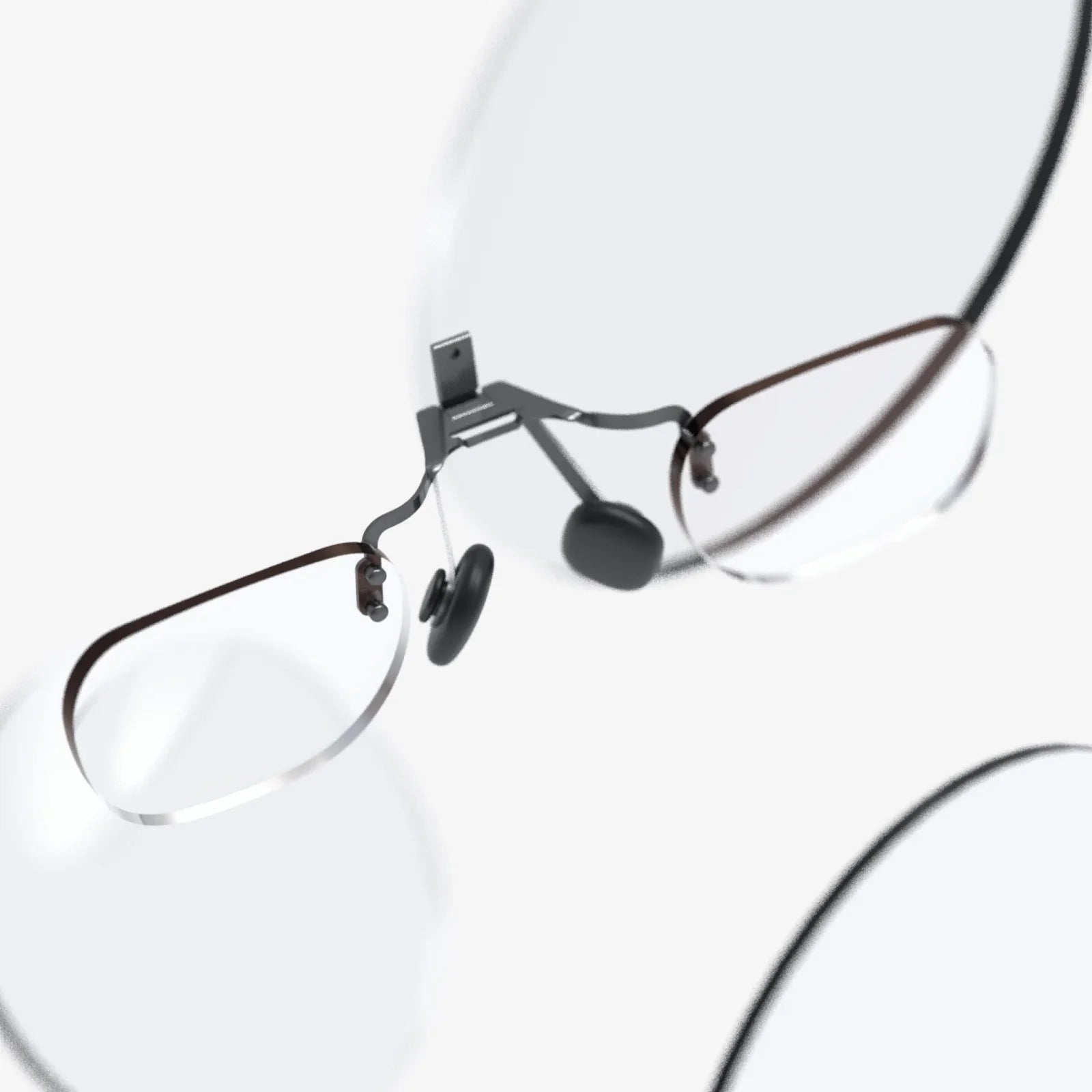
- by wangfred
AI 3D Glasses The Next Evolutionary Leap in How We Perceive Reality
- by wangfred
Imagine a world where the line between the digital and the physical doesn't just blur—it vanishes. Where information doesn't reside on a screen but is painted onto the very fabric of reality itself, accessible with a glance and interactable with a gesture. This is not a distant science fiction fantasy; it is the imminent future being unlocked by the development of advanced AI 3D glasses, a technological convergence that promises to redefine human perception, interaction, and understanding of the world around us.
For decades, the concept of overlaying digital information onto our field of view has captivated technologists and dreamers alike. Early iterations of augmented reality (AR) devices were often bulky, limited in capability, and struggled with the fundamental challenge of convincingly anchoring digital objects in a dynamic, three-dimensional space. They could show us information, but they couldn't truly understand the world we were looking at. The missing ingredient, the catalyst that transforms a simple display mounted on your face into an intelligent window into a new reality, is artificial intelligence. It is the fusion of sophisticated AI with advanced optical systems that births a new category of device: true AI 3D glasses.
At their heart, AI 3D glasses are a feat of miniaturization and computational prowess. They are more than just a screen; they are a comprehensive sensory platform.
The journey begins with a suite of sensors. High-resolution cameras continuously capture the user's environment, while depth sensors, such as LiDAR or time-of-flight sensors, actively map the geometry of the space, measuring distances with precision to create a real-time 3D point cloud. Inertial Measurement Units (IMUs) track the precise movement and rotation of the user's head, ensuring digital content remains stable and locked in place, whether it's a virtual sculpture on a table or a navigation arrow superimposed on the sidewalk.
This constant stream of raw data is meaningless without interpretation. This is where the AI comes in, acting as the brain of the system. Onboard neural processing units (NPUs) or a seamless connection to powerful cloud-based AI models perform a series of complex tasks in milliseconds:
The final piece is the display technology itself. Using waveguides, holographic optical elements, or micro-LED projectors, these glasses beam light directly into the user's eyes, superimposing crisp, bright 3D imagery onto the real world. The goal is to achieve a wide field of view, high resolution, and the ability to manage occlusion—allowing digital objects to realistically hide behind physical ones.
The potential applications for this technology are as vast as human endeavor itself, stretching across every professional field and seeping into our daily lives.
In industrial and technical fields, AI 3D glasses are moving from a novelty to a necessity. For a field technician repairing a complex piece of equipment, the glasses can overlay step-by-step holographic instructions directly onto the machinery, highlighting the specific bolt to turn or the component to replace. They can display real-time sensor data and performance metrics, allowing for predictive maintenance. For architects and engineers, 3D models of their designs can be brought to life at full scale on an empty construction site, enabling them to walk through a building before a single brick is laid, identifying design clashes and making informed decisions. In logistics and warehousing, workers can see optimal picking routes, have item locations highlighted, and instantly verify inventory, dramatically increasing efficiency and reducing errors.
The impact on medicine is profound. Surgeons can wear sterile versions of these glasses to see critical patient information—like heart rate or blood pressure—floating in their field of view without looking away from the operating table. More importantly, they can overlay pre-operative scans, such as MRI or CT data, directly onto the patient's body, effectively giving them X-ray vision to see exactly where a tumor is located or where a blood vessel runs beneath the surface. This enhances precision, reduces risk, and improves patient outcomes. Medical students can practice procedures on hyper-realistic holographic patients, and complex anatomical structures can be studied in 3D, revolutionizing medical education.
Imagine a video call where the other person appears as a photorealistic hologram sitting across from you at your kitchen table, able to make eye contact and share expressions naturally. AI 3D glasses promise to make telepresence truly feel like presence, collapsing geographical distances in a way flat screens never could. In entertainment, the implications are staggering. The living room can transform into a gaming arena where fantastic creatures burst from the walls and gameplay happens all around you. You could watch a sports game with live stats hovering over the action or have a cinematic experience with a screen that feels a hundred feet wide, all from anywhere you choose to sit.
On an everyday level, the technology becomes an invisible assistant. Navigation arrows can be painted onto the street, guiding you to your destination. You can look at a restaurant and instantly see its reviews and menu. When shopping, you could see product information, price comparisons, and even how a piece of furniture would look in your home before you buy it. Language barriers could dissolve, with subtitles for real-world conversations appearing in real-time. For individuals with visual impairments, the glasses could enhance contrast, recognize and announce faces, read text aloud, and identify obstacles, granting a new level of independence.
Despite the exciting potential, the path to mainstream adoption is fraught with significant technical and social hurdles that must be overcome.
Technical Hurdles: The dream is a pair of glasses that are indistinguishable in weight and form factor from ordinary eyewear. We are not there yet. Balancing processing power with battery life is a constant battle; rendering complex 3D graphics is computationally intensive and power-hungry. Heat dissipation in such a small device is another major engineering challenge. Furthermore, achieving visual perfection—where digital objects are indistinguishable from real ones in terms of brightness, resolution, and occlusion—requires further breakthroughs in optics and display technology.
The Privacy Paradox: This is perhaps the most significant societal challenge. AI 3D glasses, by their very nature, are equipped with always-on cameras and microphones. The potential for mass surveillance is unprecedented. Who has access to the continuous video feed of your life? Could conversations be recorded? Could individuals be identified without their consent? The ethical implications are vast. Robust, transparent data policies, on-device processing for sensitive data, and clear user controls over data collection will be non-negotiable for public acceptance. The specter of a world where our every glance is tracked and analyzed is a dystopian possibility that must be proactively guarded against through legislation and ethical design.
Social Acceptance and the Digital Divide: Walking down the street with a computer on your face talking to holograms that others cannot see presents a new social dynamic. Will it be considered rude? How do we negotiate shared physical spaces when everyone is partially immersed in a private digital world? There is a risk of further fracturing our shared reality. Furthermore, the cost of this advanced technology could initially create a new digital divide, separating those who can afford to augment their reality from those who cannot, potentially leading to inequalities in education, employment, and access to information.
The advent of pervasive, AI-driven augmented reality forces us to ask profound questions about the nature of reality and human experience. If we all perceive a world subtly—or not so subtly—augmented by algorithms and corporate-controlled data, do we still share a common reality? Our perception, which has evolved over millennia to interpret the natural world, will now be mediated by software. This could lead to a form of perceptual dependence, where we trust the AI's interpretation of the world more than our own senses.
The potential for manipulation is also immense. The same technology that can highlight a beautiful historical fact about a building could also be used to overlay targeted advertisements on every surface or propaganda that alters our perception of a place or event. The concept of truth and authenticity in our environment becomes malleable. Establishing ethical frameworks for what can be augmented, and by whom, will be one of the great challenges of the coming decade.
We are standing at the precipice of a new era, one where the digital and physical universes are merging into a single, seamless experience. AI 3D glasses are the key that unlocks this unified reality, offering a glimpse into a future of boundless information, enhanced capabilities, and redefined human connection. The technology is barreling forward, pushing against the limits of physics and our own social conventions. The question is no longer if this future will arrive, but how we will choose to shape it. Will we build a future that enhances human dignity, connection, and understanding, or one that leads to greater isolation, inequality, and manipulation? The answer lies not just in the hands of engineers, but in all of us, as we decide what kind of reality we want to see.
This isn't just about a new device; it's about rearchitecting the very lens through which humanity sees its world. The next time you put on a pair of glasses, they might not just help you see more clearly—they might help you see everything differently, revealing a hidden world of data, story, and connection woven into the tapestry of the everyday. The view through this new lens will change everything.
Share:
Potential Uses of Augmented Reality: Transforming Industries and Redefining Human Experience
Adjustable Focus Eyeglasses Technology: The Future of Personalized Vision Correction