


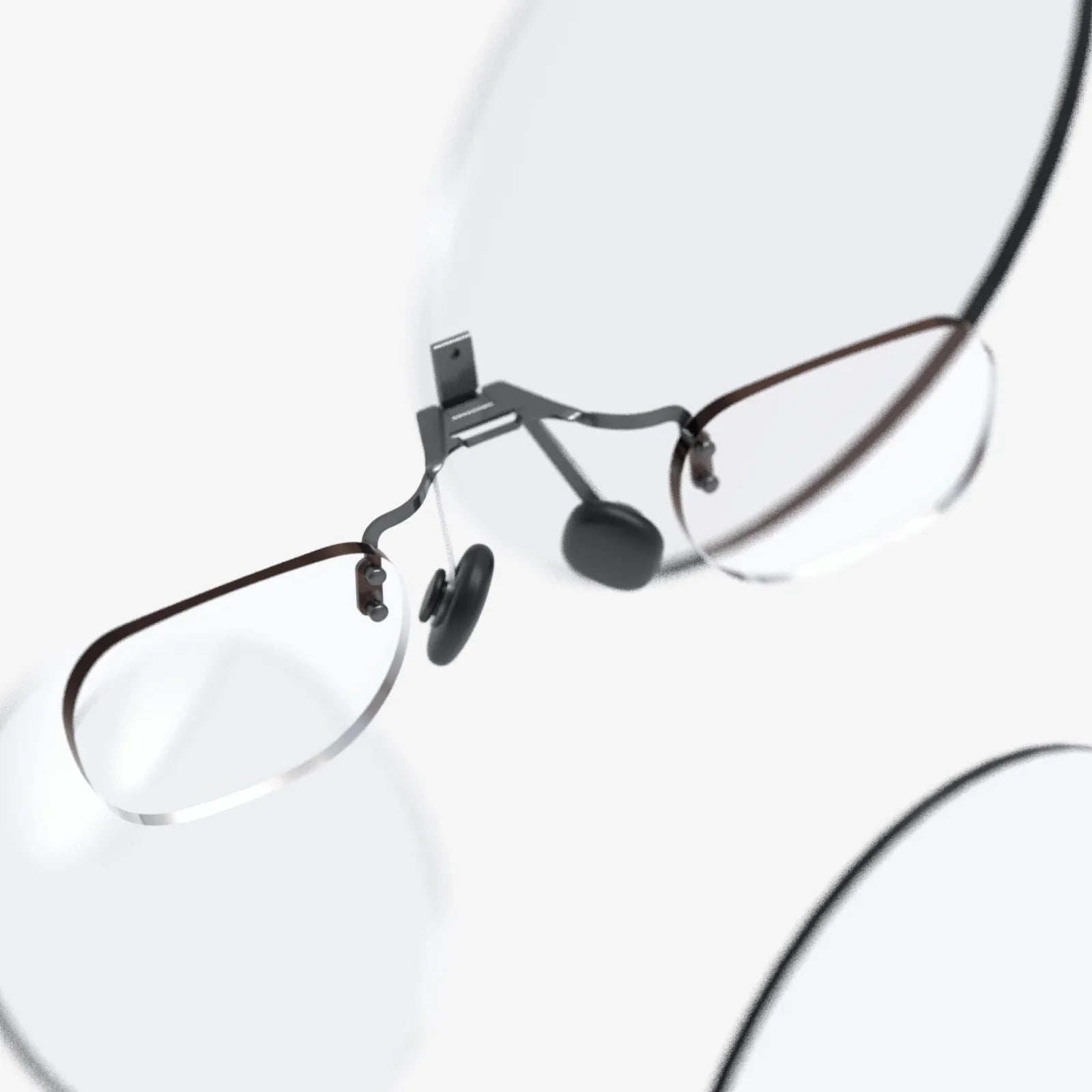
Imagine a world where digital information doesn't confine you to a screen but instead, enhances your reality, overlaying a rich tapestry of data, graphics, and connectivity onto the world you see through perfectly clear lenses. This isn't science fiction; it's the burgeoning reality made possible by a new generation of augmented reality glasses, defined not by opaque displays but by their revolutionary clear lenses. This technology promises to fundamentally reshape our interaction with the digital realm, moving computing from our pockets and laps directly into our line of sight, all while maintaining a natural and unobstructed view of the real world. The race is on to perfect this seamless blend of physical and virtual, and the key to winning it lies in the clarity of the lens itself.
The Evolutionary Leap from Opaque to Transparent Displays
The journey to modern clear-lens AR began with clunky headsets and limited field-of-view displays that often blocked the user's environment. These devices served a purpose but were far from the elegant, all-day companions envisioned by futurists. The pivotal shift came with the understanding that for AR to be truly embraced, it must be additive, not obstructive. The hardware had to recede into the background, both figuratively and literally. This meant the display technology could no longer be the primary focus; instead, the lens through which we perceive our world had to remain pristine and unaltered in its clarity.
This drive for invisibility sparked innovation in several core technological domains. The goal was no longer just to project an image but to project it in such a way that it appears to coexist within the user's natural field of vision, without dimming, coloring, or distorting the real world. This requires a delicate ballet of optics, miniaturization, and computational power, all orchestrated within the slim, lightweight form factor of standard eyeglasses.
Deconstructing the Magic: How Clear Lenses Project a Digital World
The core technological marvel of these devices is their ability to project vivid, bright images onto a transparent surface without compromising its see-through quality. This is achieved through a combination of sophisticated optical systems that work in concert.
Waveguide Technology: Bending Light to Our Will
Among the most prominent solutions is waveguide technology. Think of a waveguide as a transparent conduit for light. Tiny projectors, often using LEDs or lasers, are positioned on the temples of the glasses. These projectors shoot light into the edge of the clear lens, which acts as the waveguide. Through a process involving diffraction gratings—microscopic structures etched onto the lens surface—the light is "folded" and guided through the lens until it is redirected outward toward the user's eye.
The genius of this system is its efficiency and cleanliness. The complex optics are miniaturized and embedded within the lens itself, leaving the bulk of the surface area completely clear for unimpeded vision. The image is then superimposed over the user's view of the real world, creating the iconic AR effect.
Holographic Optical Elements (HOEs) and Light-Field Displays
Another cutting-edge approach involves Holographic Optical Elements (HOEs). These are essentially holograms recorded within the lens material that are designed to control the path of light with extreme precision. HOEs can be tuned to only interact with the specific wavelengths of light coming from the projector, allowing all other ambient light to pass through unaffected. This results in exceptionally bright and clear digital images, even in high-ambient-light conditions like a sunny day outdoors, while maintaining the transparency of the lens.
Emerging research is also exploring light-field displays, which project not just a flat image but a field of light rays that mimic how light naturally enters the eye from real objects. This technology aims to solve a critical challenge in AR: vergence-accommodation conflict, which can cause eye strain. By allowing the eye to naturally focus on digital objects at different depths, light-field technology promises a more comfortable and realistic experience.
Beyond Novelty: Transformative Applications Across Industries
The true value of clear-lens AR is revealed not in demos but in its practical, life-changing applications. By providing hands-free, contextual information, it is poised to revolutionize numerous professional and personal fields.
Revolutionizing Enterprise and Field Work
In industrial and technical settings, the impact is immediate and profound. A technician repairing a complex piece of machinery can see schematics, torque specifications, and animated repair guides overlaid directly on the equipment they are working on. Their hands remain free, their focus remains on the task, and their access to information is instantaneous. Similarly, an architect walking through a construction site can visualize the final building's blueprint perfectly aligned with the steel girders and concrete foundations, identifying potential issues before they become costly mistakes.
Redefining Healthcare and Medical Training
The medical field stands to benefit enormously. Surgeons could have vital signs, ultrasound data, or 3D anatomical models projected into their view during procedures without ever looking away from the patient. Medical students could practice complex procedures on holographic patients, gaining invaluable experience in a risk-free environment. The ability to see the invisible—from vein mapping to X-ray vision—through a clear lens could become a standard tool for diagnosis and treatment.
Enhancing Navigation and Everyday Life
For the consumer, the applications are equally compelling. Imagine walking through a foreign city with subtle directional arrows and cultural information about landmarks appearing on your lenses, eliminating the need to constantly look down at a phone. At the supermarket, you could see recipes pop up as you look at ingredients, or instantly see sustainability ratings and allergy information. During a conversation with a new colleague, a discreet reminder of their name and role could appear, easing social anxiety. The device becomes a silent, intelligent assistant, enhancing your capabilities without isolating you from your surroundings.
The Human Factor: Design, Social Acceptance, and the Path Forward
For this technology to move from specialized tool to mainstream adoption, it must overcome significant hurdles related to design, social norms, and personal privacy.
The Imperative of Fashion and Form Factor
The first generation of AR headsets suffered from a conspicuous and often awkward design. Clear-lens AR glasses must be indistinguishable from, or even more desirable than, fashionable eyewear. They must be lightweight, comfortable for all-day wear, and come in a variety of styles to suit personal tastes. The technology must be so seamlessly integrated that the user forgets they are wearing a powerful computer, and the people around them see nothing but a stylish pair of glasses. The success of this category hinges on its ability to become a normalized part of our wardrobe.
Navigating the Delicate Balance of Privacy and Awareness
The always-on, always-sensing nature of AR glasses raises legitimate privacy concerns. The ability to record video, identify objects, and overlay information creates a potential for misuse. Clear ethical guidelines and robust privacy controls will be non-negotiable. Features like clear recording indicators and ethical design frameworks that prioritize user consent and data security are essential to earning public trust. Furthermore, a key design challenge is ensuring the technology promotes situational awareness rather than detracting from it. The digital overlay must enhance the real world, not distract from it, especially in critical situations like driving or walking down a busy street.
The Clear Vision of Tomorrow
We are standing on the precipice of a new computing paradigm, one where the boundary between our digital and physical lives finally dissolves. The development of advanced clear lenses for AR glasses is the critical enabler of this future. It represents a fundamental shift from technology that demands our attention to technology that respectfully augments our perception. The path forward is filled with technical and societal challenges, but the potential reward is a world more connected, more informed, and more intuitively interwoven with the digital tools that empower us. The clear lens is more than just a piece of optics; it is the window to this new reality, and it is opening wider every day.
The era of staring down at a screen is drawing to a close, soon to be replaced by looking forward into a world illuminated with context, connection, and knowledge, all visible through a pane of perfectly clear glass. This isn't just an upgrade to your tech; it's an upgrade to your reality, and it's arriving looking deceptively ordinary.
Share:
Augmented Reality Design News: The Invisible Revolution Reshaping Our World
Benefits of Augmented Reality Glasses: Transforming How We See and Interact With the World