


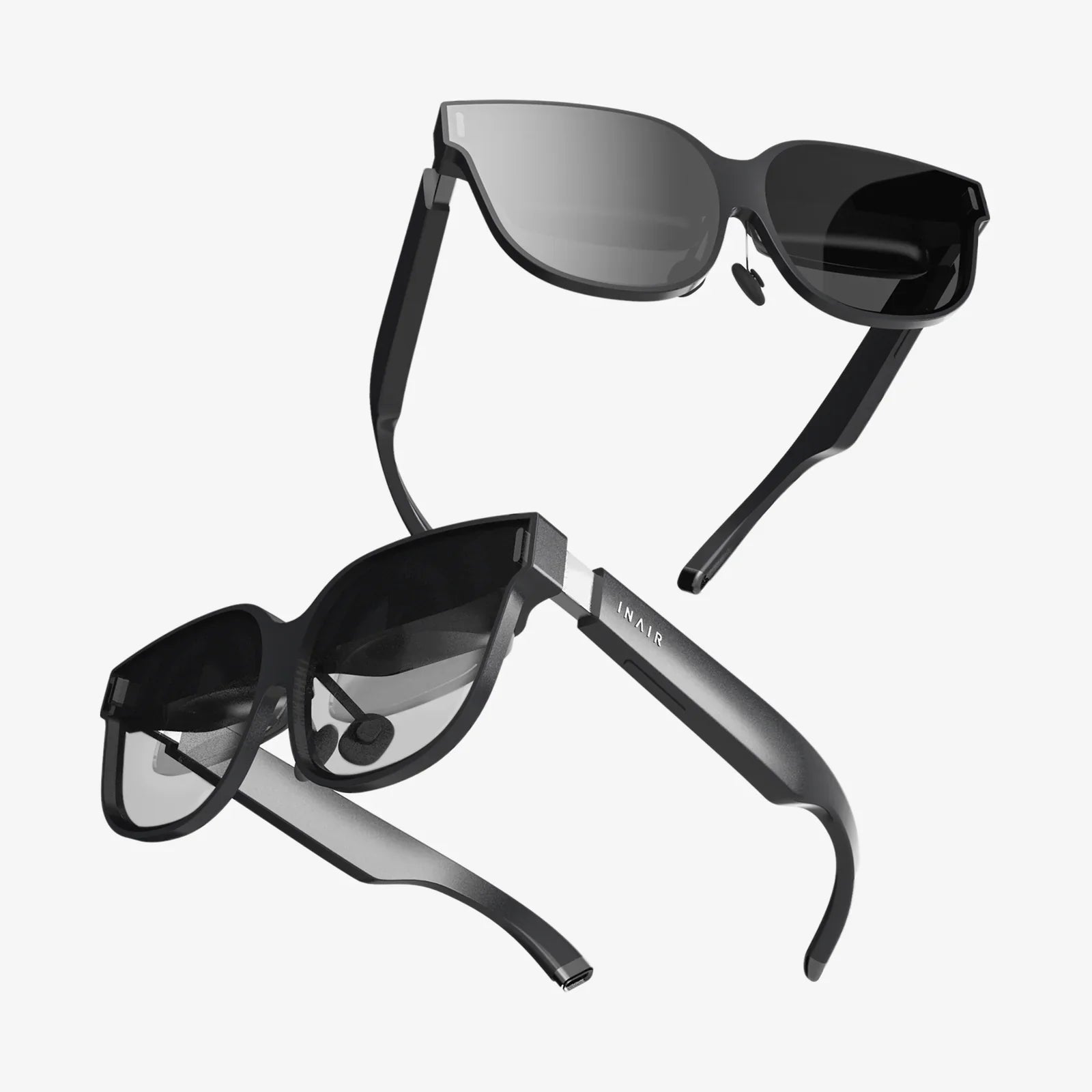
Imagine a world where your digital life isn't confined to a slab of glass in your hand or a monitor on your desk. Instead, it's layered seamlessly over the world around you, accessible with a glance, a gesture, or a voice command. This isn't a distant sci-fi fantasy; it's the reality being built today, and devices like the InAir 2 Pro AR glasses are at the forefront of this revolution. They promise to untether us from our screens and unlock a new dimension of interaction, productivity, and entertainment. The future is not just in your hands; it's projected directly onto your retina, changing everything you thought you knew about personal technology.
The Architectural Leap: Engineering an Invisible Portal
The magic of any advanced augmented reality headset lies in its ability to convincingly overlay digital information onto the real world without obtrusion. This requires a symphony of miniaturized components working in perfect harmony. The InAir 2 Pro represents a significant leap in this domain, employing cutting-edge waveguide technology. Unlike earlier AR devices that used bulky combiners or half-silvered mirrors, waveguides are essentially transparent glass or plastic plates etched with microscopic patterns. These patterns act as a relay system, guiding light from micro-displays located near the temple into the user's eye.
The result is a bright, high-contrast image that appears to float in space several feet away, all while allowing the user to see their natural environment with minimal obstruction. This optical engine is the heart of the device, and its efficiency directly impacts the form factor, battery life, and overall user comfort. Furthermore, advanced eye-tracking sensors are integrated to understand precisely where the user is looking. This isn't just for intuitive navigation; it enables dynamic depth of field, where virtual objects can appear to blur realistically when you focus past them, and foveated rendering, a power-saving technique that renders the area you're directly looking at in high resolution while subtly reducing the detail in your peripheral vision.
A Canvas for Your World: Unpacking the Visual Experience
The primary metric for any display is fidelity, and the InAir 2 Pro aims to set a new standard for consumer-grade AR. The specifications often tout a high-resolution micro-OLED display for each eye, capable of delivering stunning clarity and vibrant colors. With a field of view significantly wider than its predecessors, the digital canvas feels less like looking through a letterbox and more like a natural extension of your vision. This expanded field of view is crucial for immersion, preventing the "screen door" effect and making persistent digital objects feel truly anchored in your space.
Brightness is another critical factor. To be visible in a variety of lighting conditions, from a dimly lit office to a bright sunny day outdoors, the displays must be exceptionally luminous. The combination of high brightness, high resolution, and a wide color gamut means that text appears razor-sharp for reading documents or browsing the web, videos are rich and engaging, and 3D models are detailed and life-like. This transforms the device from a novelty into a legitimate tool for both work and play, providing a usable, large virtual screen anywhere you go.
The Sound of the Future: Immersive Spatial Audio
A truly immersive experience is not solely visual. Audio plays an equally important role in selling the illusion of digital objects existing in your environment. The InAir 2 Pro typically incorporates bone conduction technology or carefully directed speaker arrays. Bone conduction transducers send subtle vibrations through the user's skull bones, directly stimulating the inner ear while leaving the ears completely open to hear ambient sounds. This is a safety feature as much as an audio one, ensuring users remain aware of their surroundings.
More impressively, these systems are often paired with advanced spatial audio algorithms. This means sounds are processed to have a specific point of origin in 3D space. A notification ping might appear to come from your left wrist, a video call participant's voice could emanate from a fixed point on your virtual screen, and in a game, you could hear the footsteps of an opponent approaching from behind. This 360-degree audio sphere completes the sensory immersion, making the blended reality of the digital and physical worlds feel cohesive and convincing.
Redefining the Human-Computer Interface
How do you interact with a interface that has no physical buttons or touchscreen? The InAir 2 Pro moves beyond the traditional paradigms of mouse, keyboard, and touch, embracing a future of intuitive, multimodal control. This often involves a combination of voice commands, hand tracking, and a sleek companion controller.
Built-in microphones with noise cancellation allow for robust voice assistant integration. You can launch apps, search the web, send messages, or control playback simply by speaking. Meanwhile, outward-facing cameras continuously track the user's hands. Sophisticated machine learning models interpret gestures: a pinching motion to select, a swipe in the air to scroll, or a flick to dismiss a window. This allows for subtle, effortless control that feels like magic. For precision tasks like typing or gaming, a small, ergonomic wireless controller offers tactile feedback and familiar inputs, providing the best of both worlds.
Power and Performance: The Brain Behind the Lenses
Driving these high-resolution displays, complex tracking algorithms, and spatial audio is a formidable computational task. The approach is often a hybrid one. The glasses themselves house a sophisticated SOC (System on a Chip) that handles sensor data processing, display driving, and basic tasks to ensure low-latency response. This is essential for maintaining the alignment of digital objects with the real world, a phenomenon known as persistence.
For more demanding applications—high-end gaming, complex 3D modeling, or multitasking with numerous windows—the glasses can seamlessly tether to a powerful external device, such as a high-end smartphone or a dedicated computing puck. This wireless tethering, often using a low-latency protocol, allows the glasses to remain lightweight and comfortable while leveraging the raw processing power of another device. This symbiotic relationship ensures that the user always has access to the right level of performance for the task at hand.
A World of Use Cases: Beyond Novelty
The true test of any technology is its utility. The InAir 2 Pro moves far beyond being a cool gadget, offering tangible benefits across numerous aspects of daily life.
- The Ultimate Productivity Machine: Imagine having multiple large, floating displays available wherever you are—on a train, in a coffee shop, or on your couch. You can arrange your email, documents, and video calls around you, creating a personalized and portable office that vastly outperforms a single laptop screen.
- Immersive Entertainment: Your personal theater is always with you. Watch movies on a virtual massive screen, play mobile games with console-like immersion, or experience 360-degree videos that transport you to another place.
- Enhanced Navigation and Context: Walking through a new city? Directional arrows can be painted onto the street in front of you. Look at a restaurant, and its reviews and menu pop up seamlessly. This contextual overlay of information onto the real world is a killer app for AR.
- Remote Assistance and Collaboration: A technician wearing the glasses can share their view with a remote expert who can then annotate the real world in front of them, guiding them through a complex repair step-by-step.
The Road Ahead: Challenges and the Evolving Ecosystem
Despite the impressive technology, the path to mainstream adoption is not without hurdles. Battery life remains a key challenge, as powering displays, cameras, and processors is demanding. Advances in battery technology and power-efficient chips are constantly pushing the boundaries. Social acceptance is another factor; the look and design of AR glasses are rapidly evolving to become more like fashionable eyewear, reducing the "cyborg" stigma.
Furthermore, the software ecosystem is still in its relative infancy. While developers are creating incredible AR-native applications, the full potential of the platform will only be realized when a robust ecosystem of apps and services is built around it, encouraging a virtuous cycle of hardware adoption and software innovation. Privacy and data security regarding always-on cameras and microphones are also paramount concerns that manufacturers must address with transparent policies and robust on-device processing.
We are standing at the precipice of a fundamental shift in how we interact with technology. The InAir 2 Pro AR glasses are not just another gadget; they are a portal to this new reality. They represent the culmination of years of research in optics, sensors, and miniaturization, packaged into a form that is finally approaching consumer-friendly. They challenge the very definition of a computer, suggesting that the most powerful computer shouldn't be on your desk or in your pocket, but integrated into your perception of the world itself. This is the beginning of a journey from a world of screens to a world of scenes, and the view from here is breathtaking.
Share:
Future Screen Technology: Beyond the Glass Slab and Into a World of Liquid Light
Infinite Screen The Next Frontier in Visual Technology and User Experience