


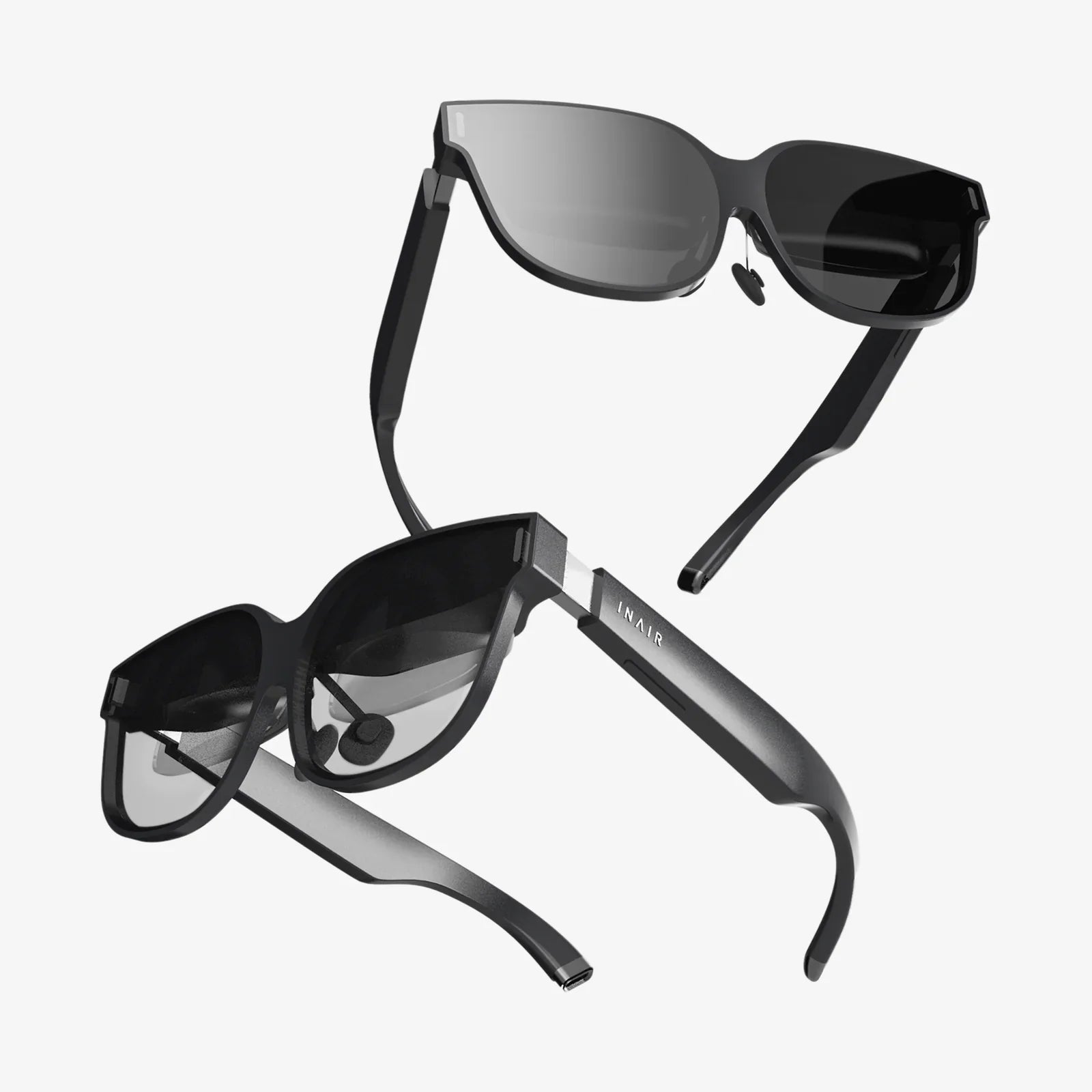
Imagine a world where your entire digital universe—your emails, your movies, your video calls, your favorite video game—is projected seamlessly onto the world in front of you, accessible with a simple glance. This isn't a scene from a science fiction film; it's the burgeoning reality made possible by a revolutionary piece of wearable technology known as projector glasses. These devices are poised to fundamentally alter our relationship with information, entertainment, and each other, moving computing from our palms and laps directly into our field of vision. This comprehensive guide delves into the intricate technology, the vast potential, and the complex challenges of this transformative wearable tech that is quietly building the bridge to a truly augmented future.
The Core Technology: How Miniature Projectors Create a Giant Screen
At the heart of every pair of projector glasses lies a feat of optical engineering. Unlike traditional displays that you look at, these devices project an image for you to look through. The core components work in concert to create this magical effect.
Microdisplays and Light Engines
The image generation starts with a microdisplay, an incredibly small screen, often built using technologies like LCoS (Liquid Crystal on Silicon), DLP (Digital Light Processing), or micro-OLED. This tiny chip is illuminated by a miniature, high-efficiency LED or laser-based light engine. The combination acts as the digital film slide, creating the raw image with precise color and detail before it is sent to the optics.
Waveguides and Combiners: Bending Light to Reality
This is where the true magic happens. Simply projecting a image towards the eye would result in a blurry, unusable mess. Instead, projector glasses use sophisticated optical systems to direct the image. The most common method involves waveguides. These are transparent glass or plastic substrates etched with microscopic patterns that act like a complex maze for light. The image from the microdisplay is injected into the edge of the waveguide.
Through a process of total internal reflection and diffraction, the light from the image "surfs" through the waveguide until it is directed out towards the user's retina. A combiner optic, often integrated into the waveguide itself, then merges or "combines" the digital image with the light from the real world. This creates the final augmented view where virtual elements appear to coexist with physical objects. Different types of waveguides, such as diffractive, holographic, and reflective, offer various trade-offs in field of view, clarity, and manufacturing complexity.
Sensors and Processing: The Intelligent Core
For the projected image to be interactive and contextually aware, projector glasses are packed with a suite of sensors. These typically include:
- Inertial Measurement Units (IMUs): Accelerometers and gyroscopes that track head movement and orientation with extreme precision.
- Cameras: Forward-facing cameras for computer vision tasks, and often inward-facing cameras for eye-tracking.
- Depth Sensors: In some models, time-of-flight sensors or stereoscopic cameras map the environment in three dimensions.
- Microphones and Speakers: For audio input and output, enabling voice commands and private audio.
A powerful onboard processor fuses all this sensor data in real-time. It understands where you are looking (via eye-tracking), how your head is moving, and what objects are in your environment. This allows the system to anchor virtual objects to physical spaces—placing a virtual monitor on your wall that stays put even if you turn your head—and enables intuitive hands-free control.
A Spectrum of Applications: Beyond Novelty
The potential uses for projector glasses extend far beyond a cool tech demo. They are finding purpose across numerous professional and consumer domains.
Professional and Enterprise Use Cases
This is where the technology is currently making its most significant impact. The value proposition of hands-free access to information is immediately obvious in many industrial settings.
- Field Service and Repair: A technician repairing a complex machine can have schematics, instruction manuals, or a live video feed from a remote expert superimposed directly onto the equipment they are working on. This drastically reduces error rates, training time, and the need to look away at a tablet or manual.
- Healthcare and Surgery: Surgeons can view vital signs, ultrasound images, or 3D anatomical models in their visual field without breaking sterility or looking up at a monitor. Medical students can learn through detailed anatomical overlays.
- Logistics and Warehousing: Warehouse workers can see picking lists, inventory data, and optimal navigation paths through a facility, streamlining the fulfillment process and improving accuracy.
- Design and Architecture: Architects and engineers can visualize 3D models at scale, walking through virtual buildings before a single foundation is poured, making collaborative design reviews more immersive.
Consumer and Lifestyle Applications
While the enterprise market leads adoption, the consumer future is incredibly enticing.
- Immersive Entertainment: The ultimate private theater experience. Users can watch films, sporting events, or play games on a virtual screen that feels dozens of feet wide, from anywhere—on a plane, in bed, or on the couch without disturbing others.
- Personal Computing: Imagine having multiple virtual monitors for your laptop or smartphone, creating a massive, portable workstation. You could browse the web, check social media, or write documents with digital content floating in your space.
- Navigation and Tourism: Walking through a new city with turn-by-directions painted onto the sidewalk, or looking at a historic building to see its name and history materialize before your eyes.
- Accessibility: For individuals with low vision, projector glasses could highlight obstacles, enhance contrast, or magnify text in the real world, acting as a powerful visual aid.
Navigating the Challenges: The Path to Mainstream Adoption
Despite the exciting potential, projector glasses face significant hurdles before they become as commonplace as smartphones.
Technical Hurdles
- Field of View (FOV): One of the biggest limitations is the FOV. Early devices often feel like looking through a postage stamp at the virtual image. Expanding this to a more natural, peripheral-vision-filling experience is a major optical challenge.
- Resolution and Brightness: Projecting a bright, high-resolution image that is visible in various lighting conditions, especially bright sunlight, requires powerful yet tiny components that don't drain battery life or overheat.
- Battery Life: The combination of processing, projection, and sensors is power-intensive. Achieving all-day battery life in a comfortable, lightweight form factor is a key engineering goal.
- Form Factor and Social Acceptance: The goal is to look like a regular pair of glasses. Current technology often results in thicker arms or slightly awkward designs. Achieving a socially acceptable, fashionable design is crucial for consumer adoption.
Human Factors and Societal Considerations
- Eye Strain and Vergence-Accommodation Conflict: A fundamental issue with current AR displays is that they project a image at a fixed focal plane (e.g., several feet away), but your eyes might be converged to look at a virtual object that appears closer. This mismatch can cause eye strain and headaches for some users. Solving this with varifocal or light field technology is an active area of research.
- Privacy and Security: Glasses with always-on cameras and microphones raise legitimate privacy concerns. Clear ethical guidelines, visual indicators when recording, and robust data security are non-negotiable for public trust.
- Digital Distraction and Safety: The potential for these devices to become a dangerous distraction, especially while walking or driving, is a serious concern. Developing robust context-aware systems that prioritize safety is paramount.
The Future Vision: Where Do We Go From Here?
The evolution of projector glasses is inextricably linked to advancements in several fields. We can expect to see continued miniaturization of components, driven by the semiconductor industry. Breakthroughs in materials science will lead to better, cheaper waveguides. Advances in artificial intelligence will make the devices more contextually aware and intuitive, anticipating user needs. The ultimate goal is a pair of glasses that are indistinguishable from regular eyewear, with all-day battery life, a vast field of view, and stunning visual fidelity. This will not be the endpoint, but rather the starting point for a new platform, much like the iPhone was for mobile apps. It will spawn entirely new industries, forms of art, and ways of social connection that we are only beginning to imagine.
The journey from clunky prototypes to sleek, powerful projector glasses mirrors the evolution of all transformative technology. They represent a fundamental shift from pulling a device out of our pocket to having information and experiences woven into the very fabric of our perception. While challenges remain, the trajectory is clear: the boundary between the digital and the physical is dissolving. Projector glasses are not just another screen; they are the window through which we will increasingly experience a richer, more informed, and seamlessly connected world, fundamentally redefining what it means to see and to know.
Share:
The Current State of Augmented Reality: Bridging the Digital and Physical Divide
The Best VR Headset in the World - A Guide to Unmatched Immersion