


- by wangfred
Real Image vs Virtual Image Screen Projection: The Ultimate Visual Technology Breakdown
- by wangfred
Imagine a world where your car's dashboard floats magically above the hood, where navigation arrows are painted onto the road itself by your headlights, and where immersive augmented realities blend seamlessly with your physical surroundings. This isn't science fiction; it's the burgeoning reality of advanced screen projection, a field built upon a centuries-old optical principle: the critical distinction between a real image and a virtual image. Understanding this dichotomy is not just an academic exercise for physicists—it's the key to unlocking how we will interact with information and entertainment in the coming decades. The battle between the tangible and the illusory is reshaping our visual landscape, and it all starts with the fundamental nature of an image.
Before we can dive into the high-tech applications, we must first build a foundational understanding of what an image actually is. In optical terms, an image is a reproduction of an object formed by light rays. These rays, after interacting with lenses or mirrors, converge or appear to diverge from a point. The human eye, a sophisticated optical instrument itself, interprets this pattern of light and the brain processes it into a recognizable scene. The method by which these light rays are manipulated gives rise to the two distinct categories: real and virtual.
The core differentiator lies in the path of the light rays. For an image to be perceived, light must enter our eyes. However, where that light actually comes together determines its classification. This isn't merely a theoretical distinction; it has profound practical implications for the design of every projection and display system in existence, from the simplest magnifying glass to the most complex holographic display.
A real image is, in a very literal sense, tangible. It is formed when light rays emanating from a source physically converge at a specific point in space after passing through a convex lens or reflecting off a concave mirror. This convergence means that if you were to place a screen—like a sheet of paper, a wall, or a cinema screen—at that exact point, the image would be projected onto it, sharp and clear. The image can be seen by a human eye looking at the screen, and it could, theoretically, be captured on a physical surface without the need for an observer.
The most ubiquitous example of real image projection is the standard movie theater. The projector's lamp shines light through a film or digital chip, and a complex set of lenses focuses this light, converging the rays onto the massive screen hanging at the front of the room. The image exists on that screen; you can touch the screen and know that is where the picture is. Traditional overhead projectors (OHPs) and the modern data projector in a conference room operate on this exact same principle.
A virtual image, in stark contrast, is an illusion—albeit a perfectly convincing one. It is formed when light rays diverge after reflecting off a mirror or refracting through a lens. Your brain, hardwired to process light as traveling in straight lines, traces these diverging rays backwards to a point from which they appear to have originated. This apparent point of origin is the virtual image. Crucially, the light rays never actually pass through this point; it is a construct of perception.
If you were to place a screen at the location of a virtual image, nothing would appear. The image cannot be physically projected because the light does not converge there. It can only be seen by looking through the optical device, as the device itself is directing the light into your eyes.
The simplest example is a flat bathroom mirror. The image of yourself you see appears to be located behind the glass, but you know there's nothing actually there. If you tried to project that image onto a sheet of paper held behind the mirror, you would fail. A magnifying glass also creates a virtual image; when you hold it close to a page, the text appears larger. The enlarged letters you see are not floating in the air above the page; they are a virtual image constructed by your brain.
Modern projection technology often employs clever optical designs that use both types of images in sequence to achieve a desired effect. A standard projector first creates a real image internally. This real image is then re-imaged through additional lenses, sometimes effectively turning it into a virtual source that is then projected as a new real image onto the final screen. This process allows for greater control over focus, throw distance, and image quality.
The real revolution, however, is happening with technologies that deliberately leverage virtual image projection to create previously impossible experiences. This is the domain of heads-up displays (HUDs) and augmented reality (AR) glasses.
The automotive and aviation industries have been the pioneers of applied virtual image projection. A Heads-Up Display (HUD) does not project a real image onto the windshield. If it did, the image would be unfocused and fixed to the glass surface, which would be useless and distracting.
Instead, a HUD works by creating a real image on a small, high-quality screen or via a laser scanning system inside the dashboard. This real image is located at the focal point of a concave mirror or a specially shaped combiner lens. This optical element collimates the light—making the rays parallel—and reflects them towards the windshield. When these parallel rays enter your eyes, your brain interprets them as coming from a point far in the distance, often 10 to 20 feet in front of the car. This creates a sharp, virtual image that appears to be floating over the road ahead.
The genius of this design is that your eyes don't need to refocus from the distant road to the close-up dashboard and back. The speedometer or navigation arrow, being a virtual image at optical infinity, sits comfortably in the same focal plane as the traffic ahead. This drastically reduces eye strain and keeps the driver's attention where it belongs: on the road. This same principle is used in fighter jet cockpits, allowing pilots to access critical data without looking down at their instruments.
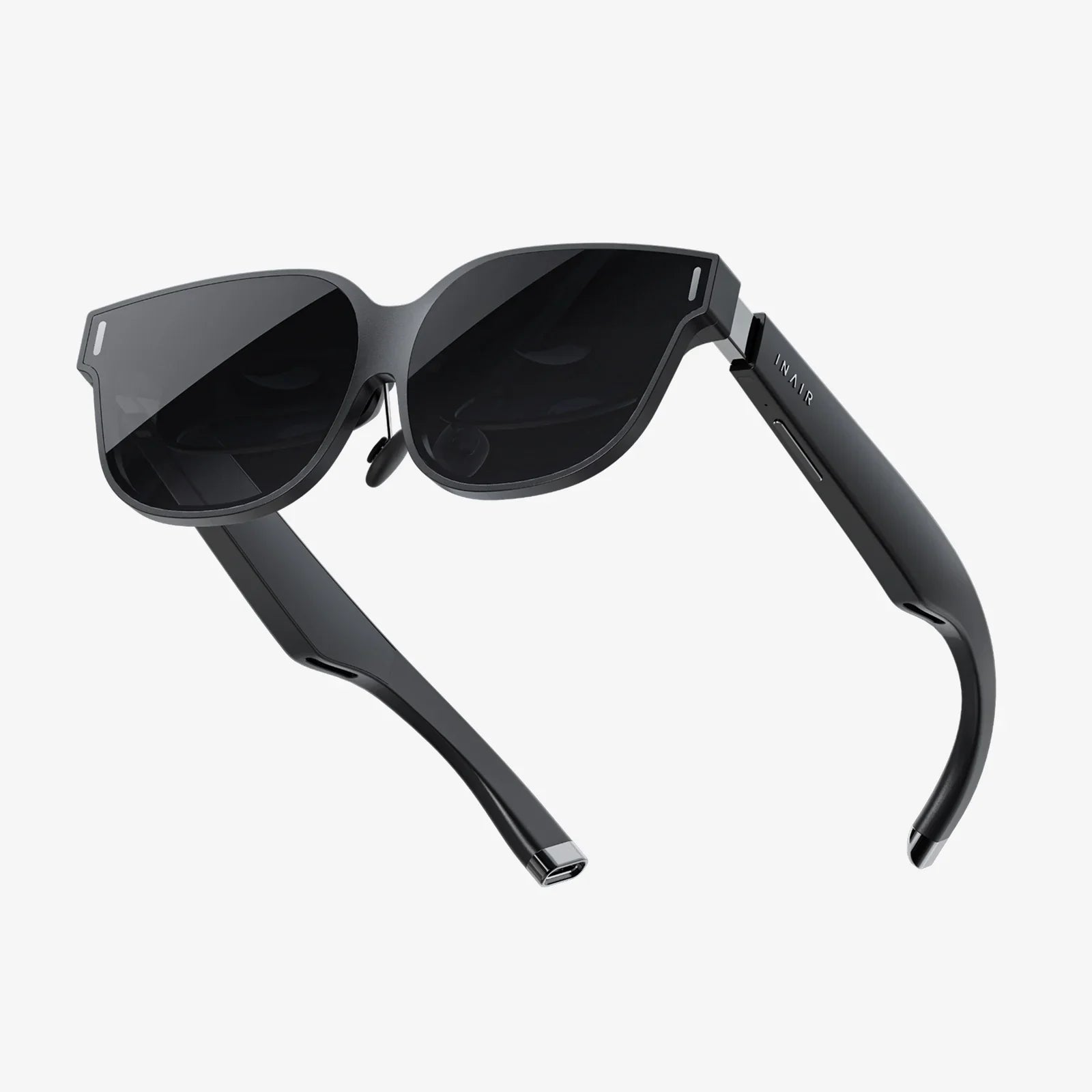
AR and VR headsets are the ultimate expression of this optical engineering. They are, at their core, sophisticated virtual image projection systems.
Virtual Reality (VR) headsets completely replace your field of view with a digital environment. Tiny high-resolution screens are placed very close to your eyes. Lenses placed between your eyes and the screens take the real image from the screen and transform it into a wide-field, immersive virtual image that appears to be at a comfortable distance, preventing eye fatigue and selling the illusion of a vast virtual world.
Augmented Reality (AR) is even more complex. The goal is to seamlessly blend digital virtual images with the real world. Waveguide technology is a common method. A miniature projector creates a real image. This light is then injected into a transparent piece of glass or plastic (the waveguide) containing microscopic structures. The light bounces along inside the glass through total internal reflection until it reaches an output area, where it is directed into the user's eye. The user sees a crisp digital virtual image superimposed over the real world seen through the transparent glass. This allows for digital characters to appear on your real-world tabletop or for repair instructions to be overlaid directly onto a malfunctioning machine.
The choice between a real image projection system and a virtual image projection system is not about which is "better," but about which is appropriate for the intended use case.
As technology progresses, the line between real and virtual will continue to blur. Light field displays and true holography aim to create light fields that are indistinguishable from reality, potentially rendering the traditional definitions obsolete. These systems will generate images that have properties of both: they may be projectable like a real image yet appear to have depth and parallax like a virtual image, existing coherently within our three-dimensional space.
The next time you watch a movie, use your car's navigation, or see a demo of cutting-edge AR glasses, you'll understand the invisible optical battle at play. You'll know that the cinema screen is a canvas for converging rays of tangible light, a real image shared by all. And you'll appreciate that the arrow guiding you on the road is a sophisticated phantom, a virtual image crafted from light and intended for your eyes only. This fundamental understanding of real versus virtual is the lens through which we can truly see the breathtaking future of visual technology, a future where our reality will be continually redefined and enhanced by the magic of projected light.