


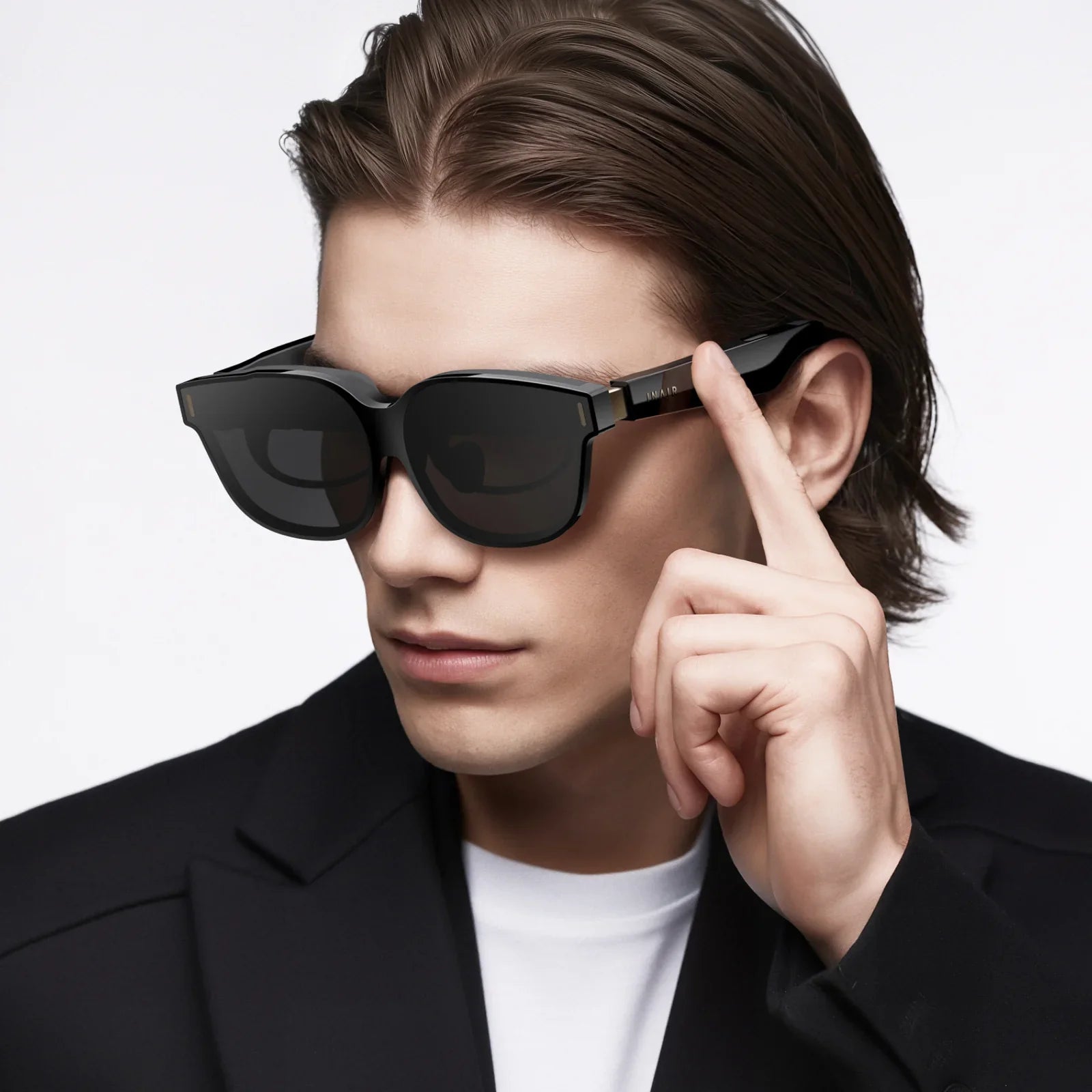
Imagine a world where the boundary between your digital life and physical reality doesn't just blur—it vanishes. Where stepping into a breathtaking virtual landscape or a crucial professional meeting is as simple and natural as putting on your everyday glasses. This isn't a distant sci-fi fantasy; it's the imminent future being forged by the rapid, groundbreaking evolution of VR wearing glasses. This technological convergence promises to shatter the final barriers to mass adoption, transforming clunky headsets into a sleek, accessible, and indispensable part of our daily lives. The era of immersive computing is dawning, and it will be worn on our faces.
The Evolution of Form Factor: From Bulky Headsets to Sleek Spectacles
For years, virtual reality has been synonymous with large, cumbersome headsets. These devices, while powerful, often featured a complex array of straps, external sensors, and significant front-heavy weight. They were engineered for maximum performance but often at the cost of comfort and social accessibility. The experience was isolating, both physically and socially, relegating VR to dedicated gaming sessions or specific professional applications behind closed doors.
The emergence of VR wearing glasses marks a fundamental paradigm shift. The driving philosophy is no longer just about raw power contained in a box, but about elegant integration into the user's life. This requires monumental advancements in miniaturization, optical engineering, and power management. The goal is to distill the core components of a high-end VR system—processors, displays, sensors, and batteries—into a form factor that resembles, and ultimately is, a pair of stylish spectacles.
This miniaturization is made possible by several key technologies. Pancake lenses, which use folded optics, allow for a much shorter distance between the display and the eye, dramatically reducing the overall depth and bulk of the device. Micro-OLED displays provide incredibly high resolution and vibrant colors in a minuscule package. Furthermore, the shift inside-out tracking, where all sensors are embedded on the glasses themselves, eliminates the need for external base stations, making the entire system self-contained and portable. This evolution is not merely cosmetic; it is a complete re-imagining of what VR hardware can and should be.
A New Era of Accessibility and Inclusivity
Perhaps the most profound impact of the shift to a glasses form factor is the dramatic increase in accessibility. Traditional VR headsets present significant barriers for the millions of people worldwide who rely on prescription eyewear. Users were forced to wear uncomfortable contact lenses, purchase custom-made lens inserts—an added cost and hassle—or awkwardly cram their glasses inside the headset, often resulting in a subpar visual experience and pressure on the face.
VR wearing glasses inherently solves this problem. By designing the system as eyewear first, manufacturers can integrate prescription lenses directly into the product. Imagine ordering a pair of VR glasses with your exact prescription, tailored precisely to your needs. This seamless integration means that individuals who require vision correction can experience perfect visual clarity in the virtual world without any compromises. This removes a critical obstacle, opening up the world of immersive computing to a vast demographic that was previously underserved.
This inclusivity extends beyond vision correction. The reduced weight and balanced design alleviate the neck strain and facial pressure often associated with heavier headsets. The simpler, more intuitive design—modeled on an object people are already familiar with—lowers the intimidation factor, making the technology appealing to older generations and those less technologically inclined. By becoming more accessible, VR ceases to be a niche hobby and becomes a universal tool for work, connection, and entertainment.
Revolutionizing Professional and Social Applications
The implications of this form factor shift extend far beyond gaming. The professional world stands to be utterly transformed. Consider the potential for architects and designers. Instead of presenting a client with a 2D blueprint on a screen, they could hand them a pair of glasses. Instantly, the client could walk through a full-scale, photorealistic 3D model of their future home, examining sightlines, spatial relationships, and material choices as if they were already built.
In medicine, a surgeon could don a pair of VR glasses to visualize a complex procedure, overlaying patient scans and vital statistics directly onto their field of view without looking away from the operating table. Medical students could practice intricate techniques on virtual cadavers from anywhere in the world. Remote collaboration becomes truly immersive; team members across the globe could gather around a virtual 3D model of a new engine design or a molecular structure, interacting with it and with each other's avatars as if they were in the same room. The ability to quickly put on and take off the device makes these professional interactions as fluid as joining a video call is today.
Socially, the glasses format is a game-changer. Current headsets create a physical barrier between users, cutting them off from their immediate environment. Glasses-style VR, especially with the integration of advanced passthrough cameras, allows for mixed reality experiences. You could have a virtual television screen pinned to your real wall while still being able to see your living room and interact with family members. You could play a virtual board game that appears to be sitting on your actual coffee table. This blends the digital and physical, making immersive technology a part of shared social experiences rather than an escape from them.
The Technological Hurdles and Considerations
Of course, compressing high-end VR into a glasses form factor presents immense engineering challenges. The most significant constraint is battery life. Powering high-resolution displays, powerful processors, and numerous sensors consumes substantial energy. Fitting a battery capable of providing hours of use into the slim arms of glasses is a formidable task. Solutions being explored include distributed battery systems, ultra-low-power chipsets, and innovative charging solutions like swappable battery packs or efficient wireless charging cases.
Computational power is another hurdle. While standalone processing has advanced leaps and bounds, the most graphically intensive experiences still often rely on a wired or wireless connection to a powerful external computer. The industry is racing to develop ever more efficient and potent mobile processors that can deliver stunning visuals without external aid. Edge computing and cloud streaming may also play a role in offloading heavy processing tasks in the future.
Finally, there are questions of social etiquette and privacy. As with any camera-equipped wearable, there will be concerns about recording in public spaces. Clear visual indicators that recording is taking place, robust privacy controls, and the development of new social norms will be essential for widespread acceptance. The design of the devices must also be fashionable and customizable, as they will be worn openly and seen as a personal accessory, not hidden away in a living room.
Glimpsing the Road Ahead: A Blended Reality Future
The development of VR wearing glasses is not the end goal, but a crucial stepping stone. It represents the final maturation of VR hardware into a truly personal and practical device. The logical progression is towards even more advanced augmented reality (AR) glasses that can seamlessly overlay digital information onto the real world, eventually replacing smartphones as our primary gateway to digital information.
The VR glasses of tomorrow will feature photorealistic passthrough, effectively functioning as high-fidelity AR glasses. They will be always-connected, leveraging 5G and beyond for low-latency cloud processing. Haptic feedback gloves and more sophisticated controllers will provide a deeper sense of touch and interaction within these virtual spaces. Artificial intelligence will be deeply integrated, acting as a personal assistant within the immersive environment, helping you navigate, retrieve information, and create content.
We are moving towards a future of spatial computing, where the digital world is not confined to rectangles in our pockets but is mapped onto our physical environment. VR wearing glasses are the key that will unlock this future, moving us from a model of "putting on a headset" to one of "wearing our computer." It will change how we learn, how we work, how we socialize, and how we see the world itself.
The revolution will not be televised; it will be worn. The cumbersome VR headset is destined to become a relic, a curious reminder of the technology's awkward adolescence. As the lines between device and accessory, virtual and physical, and utility and fashion continue to merge, we are stepping into an era of unparalleled connection and creation. The next time you put on your glasses, you might just be putting on a window to another world—or a powerful new layer on top of this one.
Share:
AR & VR in the Workplace: The Immersive Future of Business Operations
AI Glasses 2024: The Dawn of a New Augmented Reality Era