Imagine a world where the digital and the physical are no longer separate realms, where information and imagination are painted onto the canvas of reality itself. This is the promise held within two of the most transformative technologies of our time: Augmented Reality and Virtual Reality. They are gateways, not to new worlds, but to new ways of perceiving and interacting with our own. The journey to understand them is a journey to the very frontier of human-computer interaction.
Defining the Digital Duo: Core Concepts
While often mentioned in the same breath, AR and VR are fundamentally different experiences, each with its own unique purpose and technological requirements. Understanding this distinction is the first step in appreciating their individual and collective potential.
What is Virtual Reality (VR)?
Virtual Reality is the technology of complete immersion. It is a fully digital, computer-generated simulation of an environment, whether real or fantastical. The primary goal of VR is to isolate the user from their physical surroundings and transport them into a meticulously crafted digital world. This is achieved through a head-mounted display (HMD) that blocks out the external world and replaces it with a stereoscopic 3D display, creating a convincing sense of presence—the feeling of actually "being there."
Key characteristics of VR include:
-
Immersion: The user's visual and auditory senses are completely engaged by the virtual environment.
-
Interactivity: Users can navigate and manipulate objects within the virtual space, often using handheld controllers or gloves that track hand movements.
-
Isolation: The experience is designed to be exclusive, cutting off the physical world to maximize focus on the digital one.
What is Augmented Reality (AR)?
Augmented Reality, by contrast, is the technology of enhancement. Rather than replacing the real world, AR overlays digital information—images, text, data, 3D models—onto the user's view of their immediate physical environment. The real world remains the foundation, but it is "augmented" with a layer of interactive, computer-generated perceptual information. This blend creates a composite view that enriches the user's interaction with reality.
Key characteristics of AR include:
-
Integration: Digital content is seamlessly integrated into and responds to the real-world environment in real-time.
-
Contextual Awareness: AR systems use cameras and sensors to understand the environment, allowing digital objects to interact with physical surfaces (e.g., a virtual character sitting on a real chair).
-
Accessibility: While specialized headsets exist, AR experiences are often delivered through ubiquitous devices like smartphones and tablets, making the technology widely accessible.
The Technology Behind the Magic
Creating these convincing experiences requires a sophisticated fusion of hardware and software, pushing the boundaries of processing power, display technology, and sensory tracking.
VR's Technological Pillars
A robust VR system relies on several core components:
-
Head-Mounted Displays (HMDs): These are the goggles that house the high-resolution displays, lenses, and built-in headphones. They are the primary window into the virtual world.
-
Tracking Systems: To sell the illusion of presence, the system must track the user's head and body movements with extreme precision. This is done through a combination of internal sensors (gyroscopes, accelerometers) and external cameras or base stations that map the user's position in physical space.
-
Input Devices: Handheld controllers are the standard, providing haptic feedback and tracking hand and finger movements. More advanced systems use computer vision to enable hand-tracking without controllers.
-
Computational Power: Rendering two high-frame-rate, high-resolution displays simultaneously requires significant graphical processing power to avoid latency, which is a primary cause of motion sickness.
AR's Technical Foundations
AR technology focuses on perception and integration:
-
Sensors and Cameras: The device's camera continuously scans the environment. Sensors like LiDAR (Light Detection and Ranging) create a depth map of the surroundings, understanding the geometry of the space.
-
Processing: The system processes this visual data to identify surfaces, planes, and objects, determining where and how to place digital content convincingly.
-
Display Technology: AR content can be viewed through various means:
-
Smartphone/Tablet Screens: The device's screen acts as a viewfinder, showing the real world from the camera's perspective with digital elements superimposed.
-
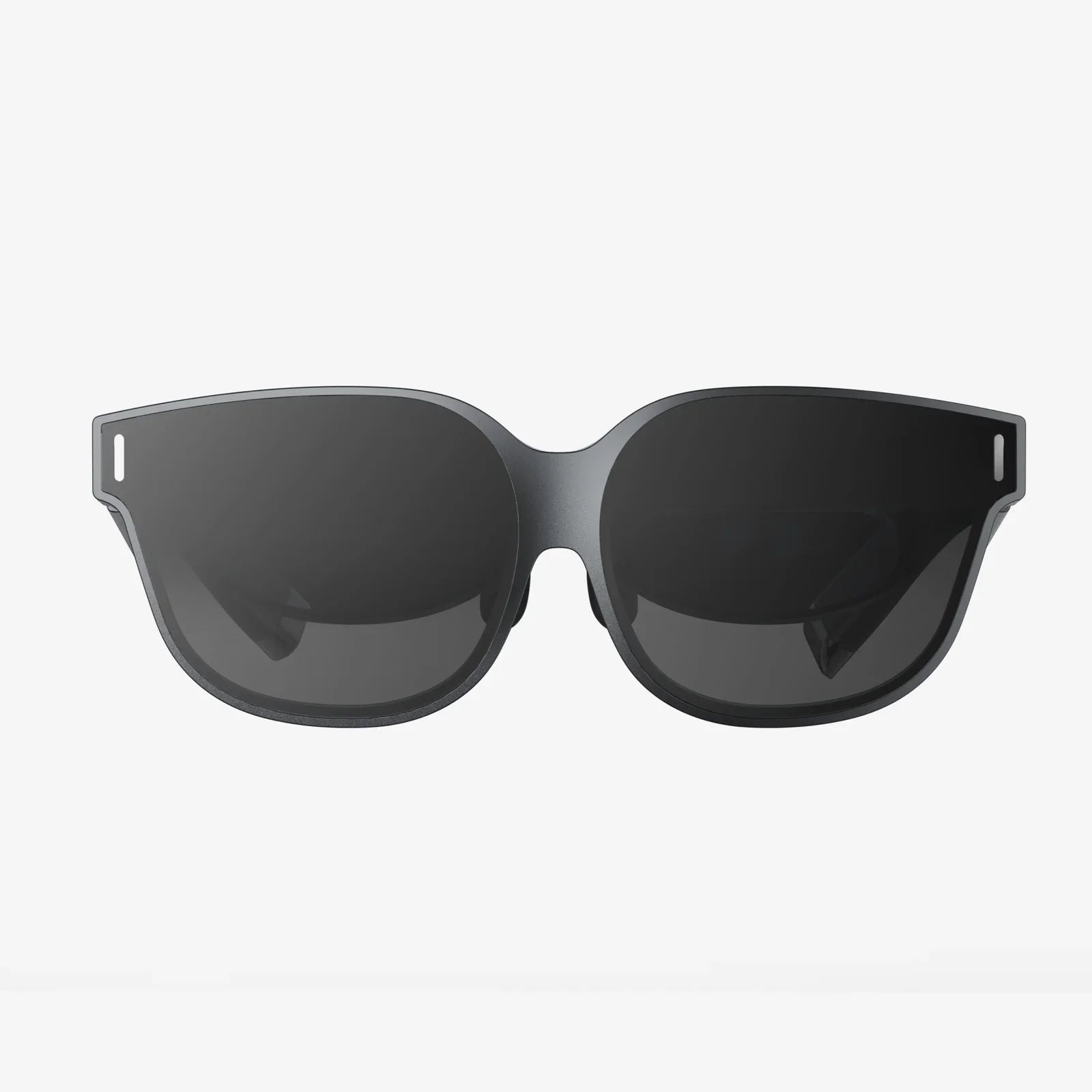
Smart Glasses: These transparent lenses use projectors to beam light directly onto the retina or use waveguides to layer digital images onto the user's field of view, allowing them to see the real world clearly alongside the digital content.
A Spectrum of Experiences: From AR to VR and MR
It is helpful to view these technologies not as binary opposites but as existing on a spectrum, often referred to as the "Virtuality Continuum." At one end is the completely real environment, and at the other is a fully virtual one. AR sits closer to the real world, while VR is at the opposite extreme.
Bridging the middle of this spectrum is a hybrid technology known as Mixed Reality (MR). MR is a more advanced form of AR where digital objects are not just overlaid but are anchored to and interact with the real world in real-time. A virtual ball in MR can bounce off a real wall and roll under a real table, with its physics and occlusion (hiding behind objects) behaving as a real object would. This requires a deep understanding of the environment, making MR the most computationally complex but also the most immersive and interactive blend of real and virtual.
Transforming Industries: Real-World Applications
The value of AR and VR extends far beyond entertainment. They are powerful tools solving real-world problems across countless sectors.
Revolutionizing Education and Training
These technologies are creating unparalleled opportunities for experiential learning.
-
VR: Medical students can practice complex surgical procedures in a risk-free virtual operating room. History students can take a guided tour of ancient Rome, walking its streets and witnessing historical events.
-
AR: Mechanics can see an overlay of repair instructions and part names when looking at an engine. Astronomy students can point their tablet at the night sky to see constellations and planetary information identified and labeled.
Advancing Healthcare and Therapy
The medical field is leveraging these technologies for both treatment and training.
-
VR: Used for exposure therapy to help patients with phobias (like fear of heights or flying) confront their fears in a controlled, safe environment. It is also used for physical rehabilitation, turning exercises into engaging games.
-
AR: Surgeons can use AR glasses to see critical patient data, such as heart rate or a 3D model of a tumor, superimposed directly onto their field of view during an operation without looking away at a monitor.
Powering Industrial Design and Manufacturing
From design to maintenance, AR and VR are streamlining complex processes.
-
VR: Architects and designers can create and walk through full-scale 3D models of buildings or products before a single physical resource is spent, allowing for early detection of design flaws and client approvals.
-
AR: Factory technicians performing maintenance on a complex machine can wear AR glasses that highlight the specific components that need attention and provide step-by-step animated instructions overlaid onto the machinery itself.
Redefining Retail and Commerce
These technologies are closing the gap between online and in-store shopping.
-
AR: Customers can use their smartphones to "place" virtual furniture in their living room to see how it fits and looks with their decor before purchasing. Cosmetic brands offer apps that allow users to try on makeup virtually.
-
VR: Car manufacturers offer virtual showrooms where potential buyers can configure a car to their exact specifications, step inside it, and even take it for a virtual test drive from their home.
Gazing into the Crystal Ball: The Future of AR and VR
The evolution of these technologies is accelerating, promising even more seamless and powerful integrations into our daily lives. The future points towards several key developments:
-
The Metaverse: A persistent, shared network of 3D virtual worlds, often envisioned as the next iteration of the internet. It would fuse AR, VR, and MR into a single, interconnected digital universe where people can work, socialize, and play.
-
Advanced Hardware: Lighter, wireless, higher-resolution headsets with more natural input methods like advanced eye-tracking and neural interfaces are on the horizon, making the technology more comfortable and intuitive.
-
5G and Cloud Computing: The high bandwidth and low latency of 5G networks will enable more complex AR and VR experiences to be streamed from the cloud, reducing the need for expensive local hardware and making high-end experiences more accessible.
-
AI Integration: Artificial Intelligence will make these environments smarter. AI-powered digital humans will become more realistic companions, and environments will dynamically adapt to user behavior.
Considerations and Challenges
Despite the immense potential, the path forward is not without its obstacles. Issues of user privacy, data security, and the potential for social isolation in VR environments are serious concerns that developers and policymakers must address. The high cost of premium hardware remains a barrier to mass adoption for VR, while AR still grapples with creating socially acceptable and stylish form factors for all-day wear. Furthermore, minimizing physiological effects like motion sickness in VR and ensuring digital overlays in AR are accurate and non-distracting are ongoing technical challenges.
The lines on the map of our reality are being redrawn, not by cartographers, but by coders and creators. What is augmented reality and VR if not the most profound tools for exploration since the ship and the telescope? They offer a new lens through which to see everything—from the molecules in a textbook to the far reaches of a fantasy universe. This is not just about the future of gaming or shopping; it is about the future of human experience itself, and that future is already beginning to load all around us.


Share:
Use of AR and VR: Reshaping Reality and Redefining Human Experience
Is AI to Its Glasses What the Brain Is to the Human Eye?