


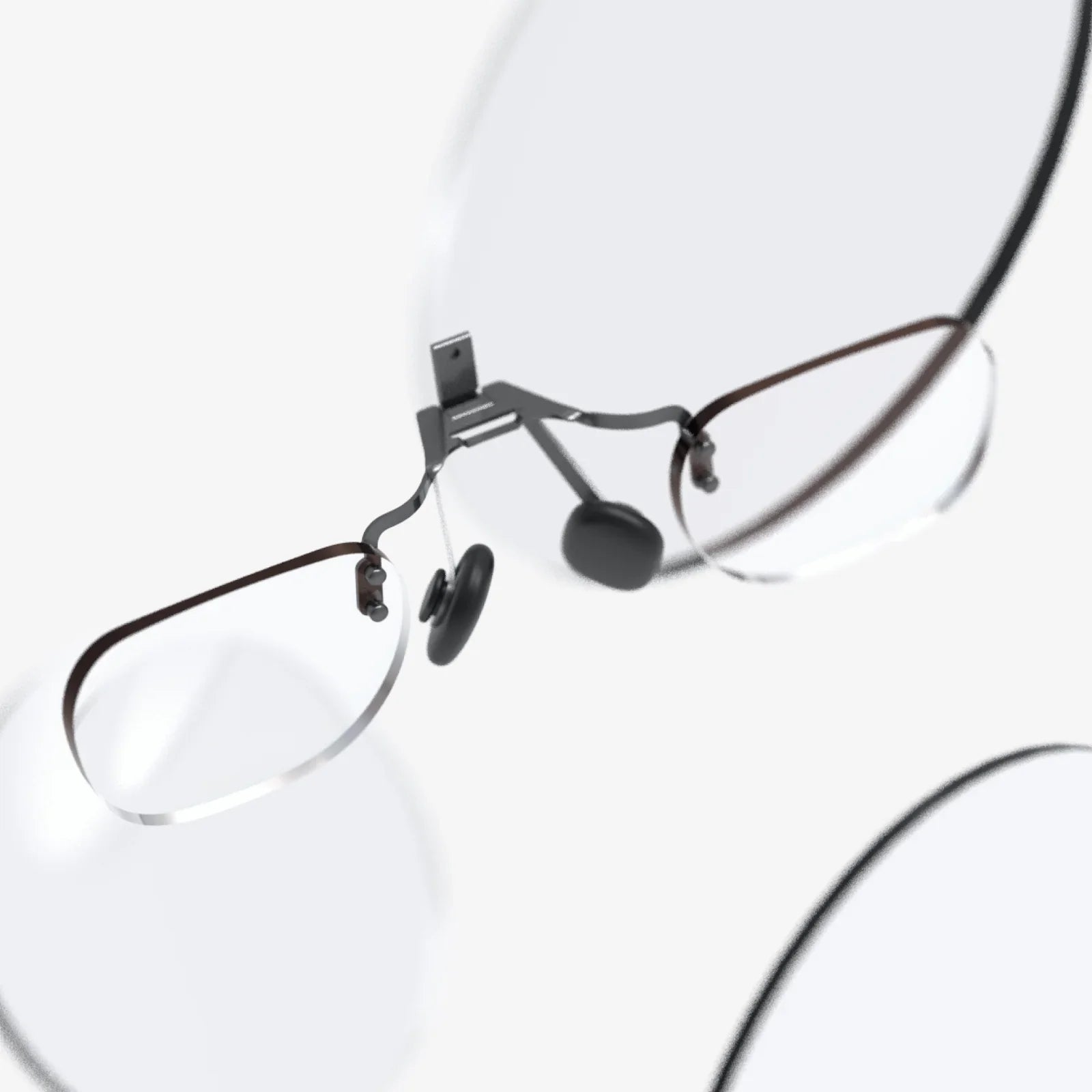
Imagine a world where information floats before your eyes, where digital friends sit on your real sofa, and your office can materialize on a pristine beach at a moment's notice. This isn't a distant sci-fi fantasy; it's the tangible future being built today, and its gateway will be perched on our noses by 2025. The next generation of XR glasses is coming, and it promises to be the most significant leap in personal computing since the smartphone.
The Evolutionary Leap: From Clunky Prototypes to Polished Prodigy
The journey to 2025's XR glasses has been one of relentless miniaturization and refinement. Early prototypes often resembled cumbersome head-mounted computers, tethered to powerful external packs and offering limited battery life. The user experience could be isolating, and the social stigma of wearing such obvious technology in public was a significant barrier to mainstream adoption.
By 2025, this narrative is set to change dramatically. The focus has shifted from raw, brute-force power to sophisticated, integrated system-on-chip (SoC) designs. These specialized processors handle the immense computational load of tracking, rendering, and AI inference with remarkable efficiency. This means the entire computing apparatus can be housed within the frames of the glasses themselves, eliminating the need for cumbersome wires trailing to a pocket or backpack.
Battery technology, while not seeing mythical breakthroughs, will benefit from extreme optimization. Combined with low-power displays and efficient processors, 2025's devices will likely offer all-day usage for core functions, with more intensive applications managed through smart power gating and perhaps even novel charging solutions like solar-sensitive coatings or ultra-fast induction charging.
A Form Factor Finally Finds Its Fashion
Perhaps the most visible and critical evolution will be in design. The goal for 2025 is not to create the most powerful headset, but the most desirable pair of glasses. Manufacturers are collaborating with renowned eyewear designers and brands to create a spectrum of styles—from bold statement pieces to subtle, classic frames that are indistinguishable from premium optical wear.
Materials will play a key role. Expect widespread use of advanced, lightweight polymers, memory metals for a perfect, comfortable fit, and even sustainable composites. The era of the one-size-fits-all black plastic visor is over. The 2025 XR glass ecosystem will cater to diverse tastes, ensuring that wearing them feels like a fashion choice, not a technological compromise. This social acceptance is the final hurdle to true ubiquity, and it's one that the industry is laser-focused on clearing.
Seeing the World Anew: Display and Visual Fidelity
The window to your digital world is the display. By 2025, several competing technologies will likely mature to consumer-ready levels. MicroLED displays, known for their incredible brightness, high resolution, and pixel-level precision, will be a frontrunner, enabling vivid visuals even in direct sunlight. Competing technologies like laser-beam scanning (LBS) and holographic waveguides will also advance, each offering trade-offs in field of view (FOV), brightness, and power consumption.
The holy grail—a wide field of view that fills a significant portion of your vision without sacrificing resolution or form factor—will be closer than ever. While not yet at the full human FOV, it will be expansive enough for immersive experiences. More importantly, visual pass-through will become standard and high-fidelity. High-resolution cameras will feed the real world to internal displays with such low latency and high dynamic range that the digital overlay will feel perfectly anchored to reality, eliminating the nausea-inducing lag or visual artifacts of earlier devices.
The Invisible Engine: AI and the Spatial Contextual Layer
The hardware is only half the story. The true magic of 2025's XR glasses will be powered by artificial intelligence. These devices will be less like screens and more like intelligent companions that perceive and understand the world with you.
A persistent, real-time spatial contextual layer will be the operating system's foundation. Using a suite of sensors—high-resolution RGB cameras, depth sensors, LiDAR, and microphones—the glasses will continuously map and analyze your environment. On-device AI processors will instantly identify objects, surfaces, people, and text, allowing for intuitive interaction.
This isn't just augmented reality; it's amplified intelligence. Your glasses will help you remember names, translate street signs instantly, identify constellations in the night sky, or highlight the specific wrench you need from a cluttered toolbox.
Privacy and security will be paramount. This intimate data collection will necessitate a privacy-first architecture. Expect features like physical camera shutters, explicit activity indicators, and most processing to occur on-device, with sensitive data never needing to touch a cloud server unless absolutely necessary and with explicit user consent.
Transforming Industries: The Professional Paradigm Shift
The enterprise and professional sectors will remain the primary drivers of adoption and innovation. By 2025, XR glasses will be indispensable tools in numerous fields.
- Remote Assistance & Training: A senior engineer thousands of miles away can see what a field technician sees, annotate the real world with arrows and instructions, and guide them through a complex repair procedure, drastically reducing downtime and errors.
- Design & Architecture: Architects and interior designers will walk through full-scale 3D models of their creations before a single foundation is poured. They can manipulate virtual structures with hand gestures, change materials in real-time, and experience the spatial flow of a building firsthand.
- Healthcare: Surgeons could have vital patient statistics and imaging data visually overlaid on their field of view during procedures. Medical students could practice on detailed, interactive holograms of human anatomy.
- Logistics & Manufacturing: Warehouse workers will have optimal picking routes and inventory information displayed directly on their path, streamlining fulfillment processes to unprecedented levels of efficiency.
Redefining Social Connection and Storytelling
Beyond work, 2025's XR glasses will begin to redefine how we connect and play. Social interactions will move beyond flat video calls into spatial computing experiences. You could share a virtual campfire with friends scattered across the globe, feeling as if you're all in the same room, watching a movie on a virtual big screen that feels just as real as your physical television.
Entertainment will become experiential. Instead of watching a documentary about ancient Rome, you could take a guided walk through a historically accurate reconstruction of the Forum. Gaming will explode beyond the TV and into your living room, with characters and enemies dodging around your furniture, creating a uniquely personal and physically active play space.
This era will also see the rise of the creator economy for the physical world. New platforms will enable artists and developers to design digital artifacts, interactive stories, and informational layers tied to specific locations. A city park could host an AR sculpture garden, a historical battlefield could come alive with reenactments, and your favorite coffee shop could have a unique, collectible digital mascot only visible through your glasses.
The Road Ahead: Challenges and Considerations
The path to this bright future is not without its obstacles. Beyond the technical hurdles of battery life and display technology, significant challenges remain.
Digital Equity: As with any transformative technology, there is a risk of creating a new digital divide. Will these powerful tools be accessible to all, or will they become a luxury that further separates socioeconomic classes? The industry and policymakers must work to ensure that the benefits of spatial computing are widely distributed.
Health and Safety: Long-term studies on the effects of having bright displays so close to the eyes are ongoing. Furthermore, navigating the real world while distracted by digital information presents obvious safety concerns, particularly when walking city streets or driving. Robust safety features, like contextual awareness that dims or pauses content when it detects you are crossing a road, will be non-negotiable.
The Nature of Reality: As our digital and physical lives become increasingly intertwined, profound questions will emerge. How will constant digital augmentation affect our memory, our attention spans, and our connection to the un-augmented physical world? Establishing healthy digital boundaries and etiquette for this new medium will be a societal project that unfolds alongside the technology itself.
The XR glasses of 2025 represent more than a product launch; they are the culmination of decades of research and the starting pistol for a new era of human-computer interaction. They won't be perfect, but they will be powerful, usable, and desirable enough to move from the fringes into the mainstream. They promise to make us more capable, more connected, and more creative. The world is about to get a major upgrade, and it's all happening right before our eyes.
Share:
Best XR Glasses for Gaming: The Ultimate Portal to Immersive Play
AR VR Testing: The Complete Guide to Ensuring Immersive Excellence